HVAC Evacuation Pump: The Complete Guide to Pulling a Deep, Reliable Vacuum
Understand how vacuum pumps work, how to size and select one, and how to run a proper evacuation that removes moisture and non-condensables from any air conditioning or heat pump system.
Start LearningEvery sealed refrigeration system depends on a clean, dry internal environment. Before a technician charges a system with refrigerant, the lines, coils, and components must be evacuated to remove air, nitrogen, and moisture. This is where the HVAC evacuation pump becomes essential. A properly performed evacuation protects the compressor, preserves lubricant chemistry, and helps the system reach its rated efficiency.
This guide explains what an evacuation pump does, the main pump types and their tiers, how to size a pump for the job, and the field practices that separate a professional-grade evacuation from a rushed one. If you are preparing for a new installation or a repair, understanding this step will help you evaluate contractor workmanship and make informed decisions.
What Is an HVAC Vacuum Pump?
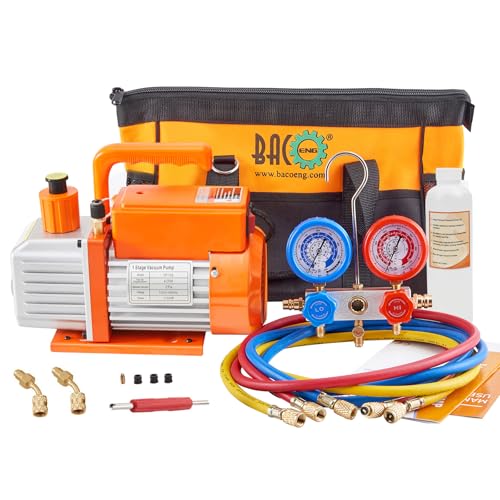
An HVAC vacuum pump is a mechanical device that removes air and moisture from a refrigeration circuit by lowering the internal pressure to a deep vacuum. Most field pumps are rotary vane designs that use oil to seal clearances, lubricate moving parts, and absorb trace moisture. The pump connects to the system through service hoses and a manifold gauge set, and a micron gauge monitors the pressure during evacuation.
The goal is not just to remove air but to boil off moisture trapped in the system. Water boils at a much lower temperature under vacuum, so reaching a deep micron level (typically 500 microns or lower) drives moisture out of the oil and metal surfaces. A pump that cannot reach or hold that level leaves residual moisture, which can form acids and sludge over time.
To understand how the evacuation step fits into the broader service picture, see our overview of HVAC and air conditioning fundamentals.
How a Vacuum Pump Works
Inside a rotary vane pump, an offset rotor spins inside a cylindrical chamber. Spring-loaded vanes slide in and out of the rotor slots, creating expanding and contracting pockets that draw gas from the inlet and push it out through the exhaust. Oil circulates to seal the vane tips, cool the pump, and capture moisture.
Two-stage pumps use two rotors in series. The first stage handles most of the gas volume, and the second stage compresses the remaining gas to reach a deeper ultimate vacuum. Two-stage models generally achieve lower micron levels and tolerate moisture better than single-stage designs, which is why they dominate professional field use.
Evacuation is only one part of a complete service visit. For the full sequence of maintenance tasks, review our HVAC maintenance guide.
Types of HVAC Vacuum Pumps
Field pumps fall into a few broad categories. Choosing the right type depends on system size, portability needs, and the moisture load of the job.
| Pump Type | Best For | Tier Positioning |
|---|---|---|
| Single-stage rotary vane | Small residential splits, light maintenance | Entry-level to mid-range |
| Two-stage rotary vane | Most residential and light commercial systems | Mid-range to professional-grade |
| High-capacity two-stage | Large commercial, long line sets, multi-zone | High-end tier |
| Battery or cordless pump | Rooftop and remote jobs without power access | Premium tier |
Entry-level single-stage pumps are compact and suitable for occasional work on small systems. Mid-range and professional-grade two-stage pumps reach lower micron levels and recover faster after moisture exposure. For a broader equipment overview, see our guide to HVAC equipment.
How to Size a Vacuum Pump
Pump size is rated in cubic feet per minute (CFM) of free air displacement. A larger displacement pulls a system down faster, but it does not compensate for a leaky hose or a wet system. Match the pump to the system tonnage and line set length.
- Small residential splits: 3 to 4 CFM is generally sufficient.
- Typical residential and light commercial: 6 to 8 CFM covers most jobs comfortably.
- Large commercial and long line sets: 10 to 12 CFM or larger reduces evacuation time.
- Multi-zone and VRF systems: High-capacity pumps with large inlet ports and dedicated vacuum hoses.
Line set diameter and length matter as much as tonnage. A long, narrow line set restricts flow, so a larger pump helps maintain a steady pull. Use large-diameter vacuum-rated hoses and short runs from the pump to the system. For installation-level planning, our HVAC design guide covers layout considerations.
Proper Evacuation Procedure
A reliable evacuation follows a consistent sequence. The steps below reflect common professional practice.
- Inspect connections. Check flare fittings, O-rings, and service valves for damage before starting.
- Connect the pump correctly. Use dedicated vacuum hoses, a manifold gauge, and a micron gauge at the system, not at the pump.
- Confirm oil condition. Fresh, clean oil is essential. Cloudy oil will not pull a deep vacuum.
- Start the pump and monitor. Watch the micron gauge. Initial pull is fast; the last few hundred microns take the most time.
- Reach the target level. Most manufacturers specify 500 microns or lower. Some require 250 to 300 microns.
- Isolate and hold. Close the valve to the pump and hold the vacuum for 10 to 15 minutes. A rising micron reading indicates moisture or a leak.
- Break the vacuum and charge. Charge only after the standing test passes.
For systems with suspected moisture, a triple evacuation with dry nitrogen between pulls is standard practice. Our guide to the HVAC cooling cycle explains how moisture and non-condensables affect performance.
Understanding Micron Levels
A micron is a unit of pressure equal to one-thousandth of a millimeter of mercury. Atmospheric pressure is roughly 760,000 microns, so a deep vacuum is a tiny fraction of atmospheric pressure. The micron gauge, not the manifold gauge, is the correct instrument for judging evacuation progress.
| Micron Reading | Interpretation |
|---|---|
| Above 5,000 | Air still being removed, early stage |
| 1,500 to 5,000 | Moisture beginning to boil off |
| 500 to 1,500 | Approaching target, monitor closely |
| 250 to 500 | Acceptable final vacuum for most systems |
| Below 250 | Deep vacuum, typical for moisture-sensitive systems |
A vacuum that rises after the pump is isolated signals either a leak or residual moisture. Re-evacuate with fresh oil or leak-test the circuit. For related diagnostic context, see HVAC inspection checklist.
Vacuum Pump Oil and Maintenance
Oil quality directly affects the achievable vacuum. Vacuum pump oil is formulated to have low vapor pressure so it does not boil off under vacuum. When moisture contaminates the oil, the pump cannot reach a deep level and may emit a milky emulsion from the exhaust.
- Change oil after every job that involved moisture or a large air volume.
- Drain and refill before storage, and cap the inlet and exhaust ports.
- Inspect the oil sight glass for cloudiness or discoloration before each use.
- Check the intake filter and O-rings for wear and replace as needed.
Regular maintenance extends pump life and protects the systems it serves. For the wider picture of equipment care, browse HVAC cleaning practices.
How to Choose the Right Evacuation Pump
Selection comes down to displacement, stage count, port size, and build quality. Use the criteria below as a practical checklist.
- Displacement: Match CFM to system tonnage and line length.
- Stage count: Two-stage pumps are the professional standard for deep vacuum work.
- Inlet port size: Larger ports and dedicated vacuum hoses reduce restriction.
- Build quality: Heavy-duty castings, reinforced handles, and quality seals last longer in field use.
- Oil capacity and sight glass: Easier maintenance and clearer oil monitoring.
For overall buying context, our HVAC buying guide covers how to evaluate tools and equipment for professional use.
Safety and Best Practices
Vacuum work involves electrical equipment, refrigerant exposure, and pressurized components. Follow these guidelines.
- Use grounded power and avoid extension cords on high-capacity pumps.
- Never open a system without proper refrigerant recovery and EPA-compliant handling.
- Ventilate the work area and avoid inhaling oil mist or refrigerant vapor.
- Use a micron gauge rather than relying on manifold gauge readings alone.
- Replace damaged hoses and O-rings before they cause a slow leak.
Regulatory requirements vary by location. Review HVAC building codes for the applicable rules in your area. For refrigerant handling equipment, see our notes on HVAC recovery machine use alongside evacuation.
Common Evacuation Mistakes
Even experienced technicians occasionally slip on these points. Avoiding them improves results and reduces callbacks.
- Skipping the standing vacuum test and charging immediately.
- Using the manifold gauge instead of a micron gauge to judge vacuum depth.
- Leaving old, moisture-saturated oil in the pump.
- Using undersized or leaky hoses that restrict flow.
- Rushing the final few hundred microns, which is the slowest part of the pull.
If a system repeatedly fails to hold vacuum, a leak inspection is the next step. Our HVAC not cooling properly troubleshooting guide describes the diagnostic sequence.
Final Thoughts
An HVAC evacuation pump is a small tool with an outsized role in system reliability. A correct evacuation removes moisture and non-condensables, protects the compressor, and helps the system deliver its rated performance. By understanding pump types, sizing, micron targets, and proper procedure, you can evaluate contractor workmanship and make sound decisions for your installation or repair project.
Whether you are a homeowner verifying a contractor's process or a technician refining your routine, the principles above apply across residential and light commercial systems. For related guidance, explore our HVAC professionals resources and HVAC inspection overview.
Frequently Asked Questions
What micron level should I pull before charging an AC system?
Most manufacturers require a final vacuum of 500 microns or lower, verified with a micron gauge and held for at least 10 to 15 minutes. Some systems specify 250 to 300 microns for tighter moisture removal. Always follow the equipment manufacturer's specification.
How do I choose the right vacuum pump size for my HVAC work?
Match pump displacement to system tonnage and line length. A 3 to 4 CFM pump suits small residential split systems, 6 to 8 CFM handles most residential and light commercial jobs, and 10 to 12 CFM or larger serves big commercial systems. Longer line sets and larger tonnage call for more CFM.
Can I use the same vacuum pump for R32 and R454B systems?
Yes, provided the pump and oil are compatible with the lubricant in the system. Most modern rotary vane pumps work with POE and PVE oils. Use dedicated hoses and change oil between jobs to avoid cross-contamination and moisture carryover.
How often should vacuum pump oil be changed?
Change oil after every evacuation if the system had moisture or a larger volume of air. For routine jobs, change when the oil looks cloudy or milky. Always replace the oil before storage and cap the ports to prevent moisture absorption.
Why does my vacuum pump not reach the target micron level?
Common causes include worn or contaminated oil, leaky hoses and O-rings, a dirty micron gauge, high ambient moisture, insufficient pump displacement, or too short an evacuation time. Check connections with a leak detector and isolate the pump from the system during a standing vacuum test.