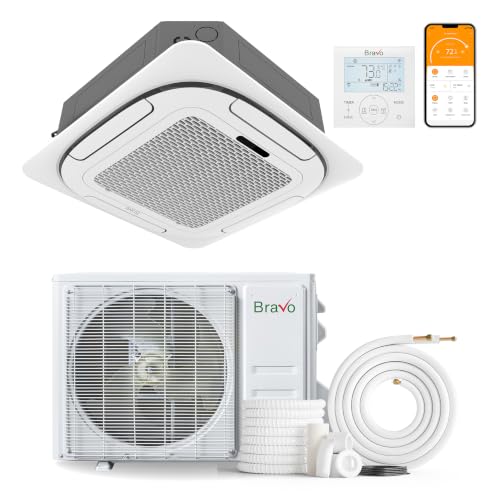
What Is a Mini Split Cassette?
A mini split cassette is a ductless indoor unit designed to be recessed into a ceiling. Instead of blowing air from a wall-mounted head, the cassette sits flush or slightly proud of the ceiling plane and distributes air through two, three, or four adjustable louvers. The system still relies on a separate outdoor condenser connected by a refrigerant line set, which is why it belongs to the broader mini split AC system family.
The defining feature is airflow geometry. A wall-mounted head pushes air in one primary direction, while a cassette spreads it outward in a wide pattern. That makes cassette units well suited to rooms where air needs to reach several sides of the space without pointing a single strong stream at one area.
How the Ceiling Cassette Works
The indoor chassis contains an evaporator coil, a blower, a condensate drain pan, and a drain pump. Return air is drawn up through a central grille, cooled across the coil, and then discharged through the perimeter vents. Most cassettes use a condensate pump because the drain line cannot always rely on gravity inside a ceiling cavity. The outdoor unit handles compression and heat rejection, and the two are linked by insulated refrigerant lines and communication wiring.
Key Takeaway
A cassette is not a different cooling technology. It is the same ductless vapor-compression cycle as any other mini split, presented in a ceiling-recessed form factor with multi-directional air distribution.
Cassette vs Wall Mounted vs Floor Mounted Indoor Units
The indoor head style is the main decision point once you commit to ductless. Each format has a distinct set of strengths, and the right pick depends on room layout, ceiling conditions, and how occupants use the space.
| Indoor Unit Style | Airflow Pattern | Best For | Installation Consideration |
|---|---|---|---|
| Ceiling cassette | 2-way, 3-way, or 4-way directional discharge | Open-plan living areas, offices, retail floors | Requires ceiling cavity and drain pump |
| Wall mounted | Single primary throw, adjustable louver | Bedrooms, small rooms, simple retrofits | Needs clear wall space and line-set route |
| Floor mounted | Low discharge, upward sweep | Rooms with low or sloped ceilings | Occupies floor footprint near wall |
| Ducted mini split | Through short duct runs to registers | Multiple small rooms, concealed installs | Needs duct routing and more design work |
If ceiling depth is limited or the room has a sloped ceiling, a mini split head in a wall or floor configuration may be more practical. Cassettes reward spaces that already have a plenum or a planned soffit.
Where Ceiling Cassettes Perform Best
Cassette units are not a universal upgrade. They deliver the most value in specific room types where even air distribution and ceiling placement solve real problems.
Open-Plan Living and Dining Areas
A single cassette can cover a central zone with air thrown in four directions, reducing the temperature stratification that often occurs when one wall-mounted head has to push across a long room. For larger connected spaces, pairing cassettes with a zoned layout or a higher-capacity mini split can keep the whole area balanced.
Offices and Commercial Interiors
Ceiling placement keeps the unit out of sight and out of the way of furniture layouts. Multi-directional discharge avoids blasting a single workstation. Commercial-grade cassettes are also built for longer duty cycles and easier filter access. If you are planning a larger project, reviewing residential and light commercial HVAC considerations early can prevent mismatched assumptions about load and controls.
Rooms With Limited Wall Space
In rooms dominated by windows, built-ins, or artwork, a wall head can be awkward. A cassette frees the walls entirely. This is a common reason homeowners choose cassette indoor units even when a wall-mounted unit would technically fit.
Advantages of Cassette Units
- Even, multi-directional air distribution
- Frees wall and floor space
- Clean, recessed appearance
- Works well in open layouts
- Available in multi-zone configurations
Trade-offs to Consider
- Needs a ceiling cavity or framed soffit
- Condensate pump adds a service point
- Filter cleaning requires ceiling access
- Installation is more involved than wall units
- Not ideal for very low ceilings
Sizing and Capacity: Matching the Cassette to the Room
Capacity is expressed in BTU per hour, and it should come from a room-by-room load calculation rather than a rule of thumb. Ceiling height, window area, insulation, occupancy, and internal heat gains all matter. A cassette that is undersized will run continuously; an oversized one will short-cycle and leave the room feeling clammy.
Cassette indoor units typically pair with outdoor condensers across a range of capacities. Rather than picking a number, start with a load estimate and then match the indoor head to the zone. For compact spaces, a smaller mini split may be the better fit than a cassette paired with an oversized condenser.
Sizing Checklist
- Measure square footage and ceiling height for each zone
- Note window orientation, glazing type, and shading
- Count occupants and heat-generating equipment
- Identify whether the cassette will serve one open area or a partitioned zone
- Confirm the selected outdoor unit matches the combined indoor capacity
Inverter vs Single-Speed Cassette Systems
Most modern cassette systems use inverter-driven compressors that modulate speed instead of cycling on and off. The practical result is steadier room temperature and quieter low-speed operation. Single-speed systems still exist in entry-level and some commercial configurations, but inverter control is now the default expectation for residential comfort. If you want to compare the two control strategies in more depth, this inverter vs non-inverter comparison covers the operating differences clearly.
Installation Requirements and Planning
Cassette installation is a coordinated effort between the ceiling plan and the refrigerant line route. The indoor chassis needs a cavity deep enough for the body, insulation, and drain path. A condensate pump is usually required, and it needs a discharge route that will not freeze or back up.
Ceiling Cavity and Structural Considerations
Drop ceilings, soffits, and framed bulkheads are common solutions when the structural ceiling is too shallow. The unit must be supported independently of lightweight ceiling tiles, and access panels should be planned for filter service and pump maintenance. On multi-story projects, the line set route often determines where the cassette can realistically go.
Electrical and Line Set Routing
A dedicated circuit is typical, and the line set should be kept as short and direct as practical within the manufacturer's limits. Proper flaring, vacuum evacuation, and leak testing are non-negotiable. These steps matter more than the indoor style, and they are a good reason to work with experienced HVAC service technicians rather than a general handyman.
Working With an Installer
Ask for a load calculation, a ceiling plan showing the cassette position and service access, and a clear line-set route. A well-planned install avoids the two most common cassette complaints: uneven airflow caused by poor placement and water issues caused by a marginal drain path. If you are still gathering bids, comparing HVAC quotes side by side makes it easier to spot which proposals include proper commissioning.
Features Worth Comparing Across Cassette Tiers
Cassette systems span from entry-level residential units to professional-grade commercial models. The differences are less about raw cooling and more about control, serviceability, and build quality. The table below uses universal tier descriptors rather than any figures.
| Tier | Typical Strengths | Best For |
|---|---|---|
| Entry-level | Basic remote control, standard filtration, straightforward louver adjustment | Single rooms with modest demands |
| Mid-range | Improved inverter modulation, quieter low-speed fan, better filter access | Everyday residential comfort |
| Premium | Advanced controls, refined airflow settings, stronger drain pump options | Primary living spaces and design-sensitive rooms |
| Commercial-grade | Heavy-duty components, service-friendly chassis, multi-zone controllers | Offices, retail, and continuous-duty spaces |
Controls and Smart Features
Wired wall controllers are common in commercial cassette installs because they keep settings accessible without pointing a remote at the ceiling. Residential units often include a handheld remote and may support app-based scheduling. Multi-zone systems need a controller or app that can manage each indoor head independently.
Filtration and Maintenance Access
Cassette filters are reached through the central return grille. Some models use washable mesh filters; others add pleated or electrostatic layers. Check how the grille opens and whether the filter can be removed without tools. This small detail determines whether routine maintenance actually happens.
Maintenance and Common Issues
Cassette systems are reliable when the basics are respected. The most frequent issues are airflow restriction from clogged filters, condensate pump failures, and drain line clogs. Cleaning filters on a regular schedule and confirming the pump discharges freely will prevent most service calls.
If you notice water staining on the ceiling, stop using the unit and have the drain path inspected before running it again. Water intrusion inside a ceiling cavity can damage insulation and drywall quickly. For ongoing care, HVAC maintenance guidance is a useful reference for seasonal checklists.
Cassette Mini Splits in Multi-Zone and Whole-Home Plans
A cassette can serve as one zone in a larger ductless plan. Multi-zone outdoor units let you combine a cassette in the main living area with wall heads in bedrooms, or several cassettes across an office floor. This approach keeps each space independently controlled without adding ductwork. If you are evaluating broader system choices, the mini split HVAC systems overview puts cassettes in context alongside other ductless configurations.
When a Cassette Might Not Be the Best Fit
Low ceilings, historic interiors with fragile plaster, and rooms without any viable ceiling cavity are cases where a wall-mounted or floor-mounted indoor unit is usually the more sensible route. Cassettes reward planning; they punish improvisation.
Frequently Asked Questions
What is a mini split cassette air conditioner?
A mini split cassette is a ductless system whose indoor unit is recessed into the ceiling and distributes conditioned air through multiple directional vents. It pairs with an outdoor condenser and is popular in rooms where wall space is limited.
Do ceiling cassette units require a drop ceiling?
Most cassette units need a ceiling cavity deep enough to house the chassis, drain pump, and refrigerant connections. In a room without a drop ceiling, a framed soffit or bulkhead can create the required space.
How many square feet can a single cassette cool?
Coverage depends on capacity and room conditions. Smaller cassettes suit compact rooms or zones, while higher-capacity units handle larger open-plan areas. A room-by-room load calculation is the most reliable way to size a system.
Are cassette mini splits noisy?
Modern inverter-driven cassette units operate quietly at low fan speeds. Noise levels rise at higher fan settings, and drain pumps or vibration from poor mounting can add unwanted sound if installation is not done carefully.
Can one outdoor unit serve multiple cassettes?
Yes. Multi-zone outdoor units can connect to several indoor heads, including cassettes of different capacities. Each zone is controlled independently through its own thermostat or remote.
Ready to Compare Cassette Options?
Review the recommended ceiling cassette systems below and compare features, tier, and configuration for your space.