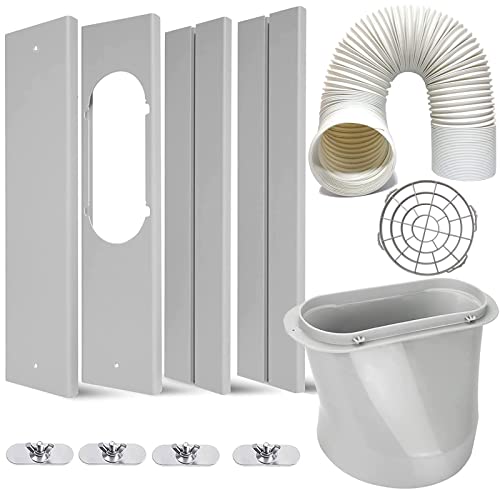
Portable Air Conditioner for Small Window Openings
Everything you need to know about cooling a room when your window is narrow, tall, or awkwardly shaped
EXPLORE THE GUIDEQuick answer: Yes, a portable air conditioner can work with a small window opening. The key is matching the exhaust hose and window kit to your opening's actual dimensions, then sealing the remaining gap properly. This guide explains exactly how to do that without losing cooling efficiency.
Why Small Window Openings Are a Challenge
Portable air conditioners work by pulling heat and moisture out of the room and pushing it through an exhaust hose that must vent outside. That hose needs a secure opening to the exterior. When your window is small, the standard window kit may not fit, and an improperly sealed gap lets hot outdoor air rush back in — defeating the purpose of the unit.
Small openings appear in many forms: narrow vertical sliders, tall basement windows, casement windows, and older homes with compact frames. Each shape needs a different sealing approach. Before buying anything, measure your opening's width and height precisely, then compare those numbers against the window kit specifications listed for each model. For related window styles, see our guidance on casement window setups and vertical window configurations.
Window Types and What Works Best
The table below maps common small-opening window types to the accessory or kit that typically solves the venting problem. Use the "Best For" column to match your situation.
| Window Type | Typical Opening Shape | Recommended Accessory | Best For |
|---|---|---|---|
| Vertical sliding window | Tall and narrow | Vertical window kit with adjustable panels | Bedrooms, apartments |
| Horizontal sliding window | Wide and short | Sliding window kit with foam seal | Living rooms, basements |
| Casement window | Crank-out sash | Casement window adapter or custom acrylic panel | Older homes, bay windows |
| Awning / push-out window | Top-hinged sash | Push-out window adapter plate | Modern construction |
| Basement hopper window | Small and low to floor | Compact kit plus insulated hose cover | Basement rooms |
What to Look For in a Portable AC for a Small Window
Beyond cooling capacity, four specifications determine whether a unit will actually work with your window. Check these before you commit to any model.
- Window kit range: Every portable AC ships with an adjustable panel kit. The listed minimum and maximum opening dimensions must bracket your actual opening size. A kit that starts at 20 inches will not seal a 14-inch window.
- Hose diameter and length: A thinner hose is easier to route through a small gap, but it can reduce airflow. A 5-inch hose is common on compact models; a 6-inch hose moves more air. Keep hose runs short and avoid sharp bends.
- Single-hose vs dual-hose design: Single-hose units are simpler and fit small kits more easily, but they create negative pressure that pulls outdoor air in. Dual-hose models balance pressure better but need a larger kit. For small openings, single-hose with a well-sealed kit is usually the practical choice. Compare both in our single-hose portable AC overview.
- Condensate handling: In humid conditions, water accumulates. A self-evaporating system or built-in condensate pump reduces manual draining. See our notes on units that need no manual draining.
If you are still narrowing down models generally, the broader portable AC buying checklist covers capacity, noise, and features in more detail.
Step-by-Step Installation for a Small Opening
Installation is straightforward once you have the right kit. Follow these five steps in order.
Measure the Opening
Record the exact width and height at the narrowest point. Measure twice — frames are rarely perfectly square. Note the depth of the sill as well.
Assemble the Window Kit
Slide the adjustable panels to match your opening. If the kit is larger than the window, trim the panel with a fine-tooth saw and file the edges smooth.
Fit the Hose Adapter
Attach the hose connector to the kit panel opening. Twist until it locks. Confirm the hose collar seats firmly with no play.
Seal Every Gap
Use foam weatherstripping, insulation tape, or a hose insulation cover to close remaining space. Even a quarter-inch gap leaks significant heat.
Test and Adjust
Close the window against the kit so it compresses the seal. Run the unit and check for warm air escaping around the panel edges.
Getting the Most Cooling From a Small Vent
A small opening restricts exhaust airflow, which can reduce cooling performance. These practices compensate for that limitation:
- Keep the exhaust hose as short and straight as possible. Every bend reduces airflow.
- Insulate the hose if it passes through a hot area, so heat does not radiate back into the room.
- Choose a unit sized correctly for the room. An oversized unit in a small room short-cycles and removes humidity poorly. Match capacity to square footage using our small bedroom sizing guide.
- Shade the window during the hottest hours to reduce radiant heat load.
- If the room is very compact, compare compact models in our very small room recommendations.
Ready to Compare Options?
Browse our recommended portable air conditioners that suit narrow and awkward window openings.
VIEW RECOMMENDED UNITSCommon Problems With Small-Window Setups
If your unit runs but the room stays warm, the venting setup is usually the cause. The most frequent issues and their fixes:
| Symptom | Likely Cause | Fix |
|---|---|---|
| Room stays warm despite running unit | Unsealed gaps around window kit | Add weatherstripping and re-seat the panel |
| Unit short-cycles frequently | Oversized for the room | Use a smaller-capacity model or run in dehumidify mode |
| Weak airflow from vents | Kinked or overly long exhaust hose | Straighten the hose and shorten the run |
| Water pooling inside unit | High humidity, no self-evaporation | Drain manually or add a condensate pump |
| Unit not blowing cold air | Blocked intake, dirty filter, or refrigerant issue | Clean the filter; see our diagnostic guide |
If cooling is weak across the whole room rather than just near the unit, the capacity may simply be too low. Our guide to insufficient cooling walks through the checks in order.
Frequently Asked Questions
Can a portable air conditioner work with a very narrow window?
Do I need a special window kit for a small opening?
Will a small vent opening reduce cooling performance?
How do I stop hot air from leaking around the window kit?
Can I use a portable AC with a basement hopper window?
Bottom line: A small window opening does not rule out portable air conditioning. Match the kit to your window's exact dimensions, seal the perimeter thoroughly, and choose a unit sized for your room. Done correctly, a compact setup cools as effectively as a standard one.