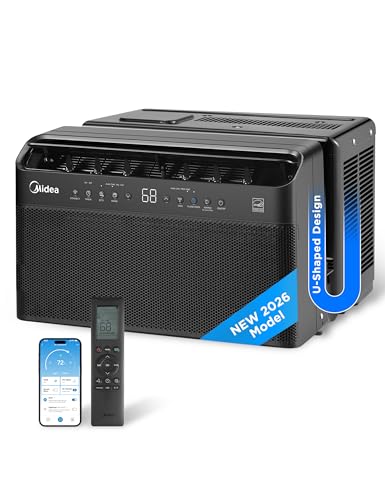
Smart Inverter U-Shaped Window Air Conditioner: The Complete Guide
Everything you need to know about the window AC that cools quietly, saves energy, and lets you open your window — before you decide which model to bring home.
EXPLORE THE GUIDEWhy this unit deserves a closer look: If you are researching a smart inverter U-shaped window air conditioner, you probably already know it is different from a conventional window unit. This guide explains exactly what that difference means in daily use — the cooling behavior, the noise profile, the installation quirks, and the maintenance routine — so you can decide with confidence whether this category fits your room, your window, and your expectations.
What Is a U-Shaped Window Air Conditioner?
A U-shaped window air conditioner is a window unit whose chassis is split into two sections joined by a saddle that rests on the window sill. The indoor portion sits inside the room, the outdoor portion hangs outside, and the connecting bridge passes through the window opening. The key consequence is that the window sash can close down onto the saddle, so the window is sealed and lockable while the unit runs.
This architecture is fundamentally different from a conventional window AC, where the entire chassis sits in the window frame and the sash rests on top of the unit. With a U-shaped design, the unit is effectively mounted around the window rather than blocking it.
When you add a smart inverter compressor and Wi-Fi controls, you get a unit that modulates cooling output continuously instead of switching on and off at full power. The result is steadier temperature, lower vibration, and a quieter operating experience — the three qualities most often cited by owners of this category.
Design Advantages That Matter in Real Rooms
The U-shaped form factor is not a cosmetic choice. Each design element translates into a practical benefit that you will notice every day during cooling season.
1. The Window Can Close and Lock
Because the sash closes onto the saddle, the window remains functional and secure. You do not sacrifice ventilation entirely — in mild weather you can raise the sash to let fresh air in while the unit stays mounted. This is a meaningful quality-of-life difference for bedrooms, home offices, and apartments where the window is the only source of outside air.
2. Lower Vibration and Noise
Conventional window units transmit compressor vibration directly into the window frame, which acts like a sounding board. The split chassis of a U-shaped unit decouples the indoor and outdoor sections, and the saddle absorbs much of the vibration before it reaches the room. Combined with an inverter compressor that avoids hard start-and-stop cycling, the operating noise profile is noticeably smoother.
If noise is your primary concern, our guide to the most efficient small window air conditioner explores related quiet-operation options in compact sizes.
3. Better Sealing and Fewer Air Leaks
The saddle design lets the window close tightly against a gasket, reducing the drafts and energy losses common with conventional window installations. Fewer leaks mean the unit works less to hold temperature, which complements the efficiency of the inverter compressor.
4. Easier Cleaning and Service Access
On most U-shaped models, the indoor section can be lifted out of the saddle for filter cleaning and evaporator coil access without removing the outdoor half. That makes routine maintenance faster and safer than leaning out of a window with a full chassis.
How the Inverter Compressor Changes the Experience
A standard window AC compressor runs at one fixed speed: it switches on at full power, cools until the thermostat is satisfied, then shuts off. Room temperature oscillates around the setpoint, and the repeated start-stop cycles are the main source of noise, vibration, and electrical draw spikes.
An inverter compressor varies its speed continuously. It starts gently, ramps up only as much as needed, and then settles into a low, steady output to hold the setpoint. In practice this produces three benefits:
- Steadier temperature. Less overshoot and undershoot, so the room feels more comfortable.
- Quieter operation. No hard start-stop thumps; the compressor hums at low speed most of the time.
- Better long-session efficiency. Inverter units tend to be more efficient in the long run during extended cooling periods, which is why they are common in top-rated energy-efficient air conditioners.
For a broader comparison of compressor technologies, see our article on inverter versus non-inverter AC systems.
Smart Features: What They Actually Do for You
The "smart" label covers a range of capabilities. Here is what each typically means in daily use, so you can judge which ones are essential tier for your needs and which are nice-to-have.
Wi-Fi App Control and Scheduling
You can turn the unit on before you arrive home, adjust the setpoint from your phone, and build schedules that match your routine. This pairs naturally with a programmable thermostat strategy — the goal is to avoid cooling an empty room.
Voice Assistant Compatibility
Integration with major voice assistants lets you adjust temperature hands-free. Useful in a bedroom or kitchen, less critical in a room where you already have your phone nearby.
Energy Monitoring and Eco Modes
Many smart models report estimated energy use and offer an eco mode that biases the setpoint slightly upward to reduce compressor load. These features are most valuable if you want visibility into how the unit behaves over a full month.
Self-Cleaning and Humidity Control
Some units run a drying cycle after shutdown to reduce moisture on the evaporator coil, which helps prevent musty odors. If that matters to you, explore AC units with self-cleaning features for a fuller explanation.
Sizing: How Much Cooling Capacity Do You Need?
Most smart inverter U-shaped window AC units fall in the 8,000 to 12,000 BTU range. That covers a typical bedroom, home office, or small living area. But capacity selection should always start from a calculation rather than a guess.
The basic rule of thumb is roughly 20 BTU per square foot for an average room with standard ceiling height, then adjusted for sun exposure, occupancy, and heat-producing appliances. A west-facing room with large windows needs more capacity than a shaded interior room of the same size.
Two common mistakes:
- Oversizing. A unit that is too large cools quickly but short-cycles, which undermines the inverter advantage and leaves the room feeling clammy because humidity is not removed properly.
- Undersizing. A unit that is too small runs continuously at high output, which is loud and inefficient.
For a detailed method, use our guide to sizing an air conditioner and the BTU calculator by room size.
Installation: Window Compatibility and Practical Steps
This is the single most important pre-purchase check. U-shaped units are designed for double-hung windows with a specific opening width and sill depth. Sliding and casement windows generally require a special bracket or are simply incompatible.
Before You Order
- Measure the window opening width and the available sill depth.
- Confirm the window type: double-hung is the intended target.
- Check the electrical circuit: most units in this class run on 115V, but verify the amperage and breaker rating.
- Review the manufacturer's minimum window requirements, which are usually stricter than the nominal dimensions.
The Installation Sequence
Most U-shaped units install in a straightforward sequence: mount the saddle and support bracket, slide the outdoor section into place, seat the indoor section, close the window onto the gasket, and secure the side panels. The split design often makes this a two-person job rather than a three-person job, but the bracket must be anchored properly to carry the outdoor weight.
If your home has older window frames or you are unsure about structural support, review our guide on installing air conditioning in an old house. For a general walkthrough, see the installation guide.
Permit note: Many municipalities do not require a permit for a plug-in window unit, but some HOAs and historic districts have restrictions. Check before you drill. See how to get an AC permit if you are unsure.
U-Shaped Inverter vs. Conventional Window AC: Side-by-Side
The table below compares the two categories on the dimensions that matter most during daily use. Tier descriptors replace any numeric figures.
Maintenance Routine for Long-Term Performance
A smart inverter U-shaped window AC is a long-term investment, and it rewards a simple maintenance routine. The split chassis makes some tasks easier, but the fundamentals are unchanged.
Monthly During Cooling Season
Remove and rinse the air filter. A clogged filter forces the compressor to work harder and degrades cooling. See how to clean an AC filter for the step-by-step method.
Annually
Clean the condenser coils, check the drain path for clogs, and inspect the window gasket and side seals for gaps. Our guide on cleaning condenser coils covers the safe approach. If the unit is not cooling well after cleaning, review why an air conditioner is not blowing cold air before assuming a refrigerant issue.
Seasonal Shutdown
Before cold weather, clean the unit, dry it thoroughly, and consider a cover. Many owners leave the unit in place year-round because the closed window seals well. If you remove it, store the indoor section upright.
When to Call a Professional
Refrigerant work and compressor diagnostics require licensed technicians. If the unit is short-cycling, tripping breakers, or losing cooling capacity after basic maintenance, a professional inspection is the safe next step. A maintenance plan can spread the annual service across the year.
Who Should Choose This Category?
This unit is a strong fit if you recognize yourself in one or more of the following situations:
- You need the window to remain functional. Bedrooms, home offices, and apartments where the window is the only ventilation source.
- Noise is a priority. Light sleepers, shift workers, and anyone cooling a room where conversation or concentration matters.
- You want smart scheduling. If you already use a smart thermostat or voice assistant, the integration is natural. Our overview of the smart window air conditioner category covers the broader feature landscape.
- You run long cooling sessions. The inverter advantage is strongest when the unit runs for hours rather than minutes.
- You have a double-hung window with adequate sill depth and a nearby 115V outlet.
It may be a weaker fit if you have sliding or casement windows, if the window opening is unusually narrow, or if you only need occasional short bursts of cooling in a room where noise is not a concern.
Pre-Purchase Checklist
Use this checklist to confirm the unit fits your room and your expectations before you finalize a decision.
- Capacity: Calculated from room size, ceiling height, sun exposure, and occupancy.
- Window type: Double-hung with adequate opening width and sill depth.
- Electrical: 115V circuit with adequate amperage; confirm breaker rating.
- Smart features: Wi-Fi, app, voice assistant, scheduling — pick the combination you will actually use.
- Noise expectations: Inverter models are quieter, but all window units produce some compressor sound.
- Maintenance access: Confirm the indoor section is removable for cleaning.
- Warranty and support: Check the compressor and parts coverage terms.
- HOA or local rules: Confirm no restriction on exterior window units.
If you are comparing this category against alternatives, our guides on window air conditioner replacement and window AC for casement window installation cover adjacent scenarios.
Frequently Asked Questions
What makes a U-shaped window air conditioner different from a standard window AC?
A U-shaped unit has a split chassis that straddles the window sill, leaving a gap so the window can close and lock behind the unit. This reduces vibration, lowers noise, and allows the window to be opened in mild weather. A conventional unit blocks the window entirely.
Is a smart inverter U-shaped window AC more energy efficient than a non-inverter model?
Yes, in typical long-session use. The inverter compressor modulates speed continuously instead of cycling on and off, holding temperature more steadily and reducing hard-start draw. The U-shaped design also reduces vibration losses and improves sealing around the window opening.
Can a U-shaped window AC be installed in a sliding or casement window?
U-shaped units are designed primarily for double-hung windows. Sliding and casement windows usually require a special bracket kit or are not compatible. Check the manufacturer's window requirements before ordering.
What size room does a typical smart inverter U-shaped window AC cool?
Most models fall in the 8,000 to 12,000 BTU range, suitable for rooms roughly 250 to 550 square feet. Always run a BTU calculation based on room size, ceiling height, sun exposure, and occupancy rather than relying on a single square-footage number.
Does a U-shaped window AC need special maintenance compared with a regular window unit?
Routine maintenance is similar: clean or replace the filter monthly during peak season, clean the condenser coils annually, and check the drain path. The split chassis makes it easier to lift the indoor section out for deeper cleaning without removing the entire outdoor portion.
Final Thoughts
The smart inverter U-shaped window air conditioner is a genuinely different product category, not just a cosmetic variation on the window AC. The closed-window design, the smoother inverter compressor, and the smart controls combine to solve three common complaints at once: blocked windows, noisy operation, and temperature swings.
Before you decide, confirm the three non-negotiables: a compatible double-hung window, a correctly calculated capacity, and an electrical circuit that can carry the load. Get those right and the rest of the decision becomes much simpler.
Explore the recommended models below to see how the mid-tier and premium options in this category compare on features, or return to our U-shaped smart inverter window air conditioner overview for related buying guidance.