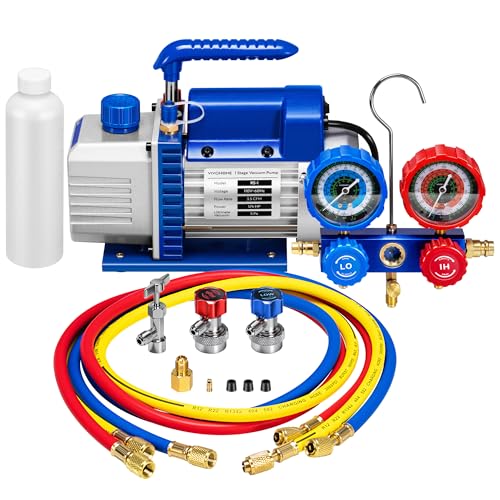
Vacuum Pump for AC System: The Complete Guide
Understand why proper evacuation is the most important step in AC installation, how to select the right pump, and how to use it correctly for reliable, long-lasting cooling performance.
START LEARNINGWhy this matters: A vacuum pump is one of the few tools that directly determines whether an air conditioning system will last for years or fail prematurely. Every time refrigerant lines are opened for installation or repair, air and moisture enter the circuit. Removing them completely is the job of a properly sized, well-maintained vacuum pump. This guide explains the science, the selection criteria, and the practical steps so you can make informed decisions.
What Is a Vacuum Pump and Why Does an AC System Need One?
A vacuum pump is a mechanical device that removes air and non-condensable gases from a sealed refrigeration circuit. When technicians install or repair a split system or mini-split air conditioner, the refrigerant lines are exposed to the atmosphere. Even a small amount of air trapped in the system raises condensing pressure, reduces cooling capacity, and forces the compressor to work harder.
Moisture is even more damaging. Water vapor inside a refrigerant circuit combines with refrigerant oil and heat to form acidic compounds. These acids attack motor windings and bearings, while residual moisture can freeze at the metering device and block refrigerant flow. A vacuum pump lowers the pressure inside the system so that moisture boils off as vapor and is expelled, leaving the circuit clean and dry before charging.
Key reasons a vacuum pump is essential
- Removes moisture: Prevents acid formation, ice blockage, and compressor damage.
- Removes air: Restores designed condensing pressures and full cooling capacity.
- Validates the circuit: A pump that cannot reach a deep vacuum reveals leaks or poor connections.
- Protects the compressor: Clean, dry refrigerant oil extends compressor life.
- Supports warranty compliance: Most manufacturers require documented evacuation before charging.
How a Vacuum Pump Works in an AC System
The pump is connected to the service ports of the outdoor unit through a manifold gauge set and vacuum-rated hoses. As the pump runs, it draws air and vapor out of the circuit and exhausts them to the atmosphere. The goal is to reduce the internal pressure below the vapor pressure of water at ambient temperature, which causes any trapped moisture to evaporate and be carried out with the air.
Technicians measure progress with a micron gauge. Atmospheric pressure is about 760,000 microns, and a properly evacuated residential system typically holds below 500 microns after the pump is isolated. Reaching that level confirms both that the pump is working and that the circuit is leak-free. This process is closely tied to the refrigerant line set length and the quality of the flare or brazed connections.
Types of Vacuum Pumps Used in HVAC Work
HVAC vacuum pumps are broadly divided by stage count and by application. Understanding the differences helps you match the tool to the job and avoid over- or under-specifying.
| Type | Best For | Characteristics |
|---|---|---|
| Single-stage | Entry-level and occasional service work | One pumping chamber; adequate for short line sets and basic maintenance; simpler internal design. |
| Two-stage | Mid-range to professional-grade installation and repair | Two chambers in series; reaches deeper vacuum faster; better moisture tolerance; the standard choice for residential and light commercial work. |
| Rotary vane | General HVAC and refrigeration service | Most common design; oil-lubricated vanes create the seal; reliable and widely supported. |
| Oil-free / dry | Specialty or clean-room applications | No oil mist; lower maintenance; typically lower ultimate vacuum; less common in routine AC service. |
For most residential and light commercial AC work, a two-stage rotary vane pump is the balanced choice. It delivers deeper vacuum and handles moisture better than single-stage models, which matters when evacuating whole-house mini-split systems with long refrigerant runs.
How to Choose the Right Vacuum Pump for Your AC System
Selection comes down to four variables: capacity in cubic feet per minute (CFM), ultimate vacuum, motor type, and build quality. Each influences how quickly and reliably the pump can evacuate a given system.
Capacity (CFM)
CFM describes how much volume the pump moves per minute. A pump that is too small will take a long time to evacuate a large system, and prolonged run times increase oil contamination and wear. As a general guideline, a 3 CFM pump suits small one-ton mini-split installations, while 5 to 6 CFM pumps handle typical residential split systems comfortably. Larger multi-zone or commercial systems call for higher-capacity professional-grade pumps.
Ultimate Vacuum
Ultimate vacuum is the lowest pressure the pump can achieve, usually stated in microns. Two-stage pumps commonly reach 15 to 25 microns, which is more than sufficient for HVAC service. A pump rated at 50 microns or higher may struggle to pull a system below the 500-micron target within a reasonable time.
Motor and Power
Pumps are available in 120V and 240V versions, with some dual-voltage models. For field service where standard outlets are available, a 120V unit is convenient. Larger 240V pumps are common in commercial work. Motor horsepower should match the pump’s rated capacity; a well-built pump with a properly matched motor runs cooler and lasts longer.
Build Quality and Serviceability
Look for reinforced housings, high-grade steel components, and easily accessible oil fill and drain ports. A sight glass for oil level and condition is a practical feature that helps you spot contamination early. Pumps designed for professional use typically include an isolation valve and a sturdy base with vibration dampening.
Tier Classification
To compare models without focusing on numbers, think in terms of market tier. Entry-level pumps are suitable for occasional maintenance and short line sets. Mid-range two-stage pumps are the solid choice for regular residential installation work. High-end and professional-grade pumps add larger motors, deeper vacuum capability, and ruggedized construction for daily commercial use. For a broader view of tools and equipment that pair with a pump, see the HVAC pump reference page.
Step-by-Step: Proper Evacuation Procedure
Correct technique matters as much as the pump itself. The following sequence reflects standard field practice for residential and light commercial systems.
- Inspect and prepare. Confirm all connections are tight and that the system has no known leaks. Use nitrogen for pressure testing if required before evacuation.
- Connect the equipment. Attach vacuum-rated hoses from the pump to the manifold gauge set and then to the service ports. Keep hose lengths as short as practical to minimize restriction.
- Open the valves. Open the manifold valves and the pump’s isolation valve so the full circuit is exposed to the pump.
- Start the pump and monitor. Watch the micron gauge. A rapid drop indicates good flow; a slow drop suggests a leak or a restriction in the hoses.
- Isolate and hold. Once the gauge reads below 500 microns, close the isolation valve and stop the pump. Wait at least 10 to 15 minutes. If the reading rises significantly, there is a leak or residual moisture.
- Repeat if needed. If moisture is suspected, use the triple evacuation method: pull a vacuum, break it with dry nitrogen, and repeat. This is especially useful on older systems or after a compressor replacement.
- Charge the system. After a successful hold test, charge with refrigerant according to the manufacturer’s specifications.
Important: Never use the compressor itself to evacuate a system. Doing so can draw moisture and contaminants into the compressor and void the warranty. Always use a dedicated vacuum pump.
Vacuum Pump Maintenance for Long-Term Reliability
A vacuum pump is a long-term investment, and its performance depends on routine care. Oil is the most critical consumable: it lubricates the vanes, seals clearances, and absorbs moisture drawn from the system. Contaminated oil reduces ultimate vacuum and accelerates wear.
- Change oil regularly. Replace oil after every significant evacuation, or more often if the oil appears cloudy or dark. Always use the grade specified by the manufacturer.
- Check the oil level. Keep the level between the marked lines on the sight glass. Low oil causes overheating and poor vacuum.
- Run the pump briefly before use. A short warm-up with the intake capped helps circulate oil and confirm operation.
- Store properly. Cap the intake and exhaust ports to keep dust and moisture out. Store the pump upright in a dry location.
- Inspect hoses and fittings. Replace cracked or stiff hoses; vacuum leaks in hoses are a common cause of slow evacuation.
- Service the motor. Keep vents clear and check the power cord for damage. Follow the manufacturer’s schedule for vane inspection.
For a broader view of system upkeep, the maintenance of HVAC system guide covers seasonal checks that complement pump care. If you are evaluating whether to handle work yourself or hire a technician, the licensed HVAC overview explains what credentials to look for.
Common Mistakes to Avoid
- Relying on time instead of microns. Ten minutes of evacuation means nothing if the system never reaches the target vacuum.
- Using standard hoses. Non-vacuum-rated hoses can collapse or permeate, slowing evacuation and skewing readings.
- Skipping the hold test. A rising micron reading after isolation reveals leaks that would otherwise be charged over.
- Neglecting oil changes. Dirty oil is the most common reason a pump fails to reach deep vacuum.
- Oversized line sets without adjustment. Long runs require additional evacuation time and sometimes a larger pump. See the refrigerant line set guidance for details.
- Ignoring moisture signs. If the pump oil turns milky, stop and change it before continuing.
When to Call a Professional
Evacuation is a straightforward procedure, but it sits inside a process that involves refrigerant handling, electrical work, and warranty requirements. If you are not comfortable with manifold gauges, micron readings, or refrigerant charging, a qualified technician is the safer choice. The HVAC quotes resource explains how to compare estimates, and the questions to ask installer guide helps you verify that proper evacuation will be performed and documented.
Homeowners planning a larger project may also benefit from reviewing residential air conditioning options and HVAC systems for residential properties before committing to an installation scope.
Frequently Asked Questions
Why is a vacuum pump necessary for an AC system?
It removes air and moisture from the refrigerant circuit before charging. Moisture can form acids and ice that damage the compressor, while trapped air reduces efficiency and cooling capacity.
What size vacuum pump do I need for a residential AC system?
For most residential split systems, a pump rated between 3 and 6 CFM is appropriate. Larger systems or longer line sets benefit from higher CFM ratings and a two-stage design.
How long should I vacuum an AC system?
Duration depends on line length and pump capacity. The correct approach is to evacuate until the system holds below 500 microns, not to rely on a fixed time.
Can I use a vacuum pump for other HVAC tasks?
Yes. The same pump is used for evacuating mini-splits, central systems, and refrigeration equipment. Always use fresh oil and dedicated hoses to avoid cross-contamination.
How often should I change the vacuum pump oil?
Change oil after every significant evacuation, or sooner if it appears cloudy or dark. Clean oil is essential for reaching deep vacuum and protecting the pump.
Final Thoughts
A vacuum pump for AC system work is not a glamorous tool, but it is one of the most consequential. Proper evacuation protects the compressor, preserves cooling capacity, and supports warranty compliance. Choose a pump that matches your system size and service frequency, maintain it diligently, and always verify results with a micron gauge rather than a clock. If you are ready to explore equipment options, the recommendations below are organized by tier and use case.