
Window Mounted Air Conditioning Unit: The Complete Guide
Everything you need to know before buying a window AC — sizing, efficiency ratings, installation requirements, maintenance, and how to match the right unit to your room, climate, and window type.
START WITH SIZINGWho this guide is for: If you already know you want a window mounted air conditioning unit but are unsure which capacity, efficiency tier, or feature set fits your home, this guide walks you through every decision point. By the end, you will know exactly what to look for and why — so you can compare models with confidence.
What Is a Window Mounted Air Conditioning Unit?
A window mounted air conditioning unit is a self-contained cooling system designed to sit inside a window frame, with the bulk of the unit resting outside and the front panel facing into the room. Unlike a central system, a window unit does not require ductwork, professional refrigerant lines, or a dedicated outdoor condenser pad. Everything — compressor, condenser coils, evaporator coils, and blower — is packaged in a single chassis.
This design makes window units the most straightforward path to room-level cooling. They are common in bedrooms, home offices, apartments, older homes without ductwork, and as supplemental cooling for hot rooms that a central system struggles to reach. Because the unit is installed in an existing window opening, there is no structural modification beyond a mounting bracket and, in some cases, a support frame.
Window units differ from ductless mini-split systems in one important way: the entire mechanical assembly lives in the window, so there is no separate indoor air handler and no wall penetration. They also differ from portable units, which sit on the floor and vent through a hose. The window-mounted format remains the most space-efficient option for single-room cooling because it takes up no floor space at all.
Why Homeowners Choose Window Mounted Units
Window units occupy a specific niche that larger systems do not serve well. Understanding the trade-offs helps you decide whether this format is right for your situation.
- No ductwork required. Ideal for older homes, rentals, and additions where running ducts is impractical or prohibited by the lease.
- Room-by-room control. You cool only the rooms you use, which avoids conditioning an entire house for one occupied bedroom or office.
- Straightforward installation. Most units install in a standard double-hung window with a bracket and side panels. No refrigerant handling or electrical work beyond plugging into a dedicated circuit.
- Immediate availability. Units are stocked at retail and ship quickly, so cooling can begin the same week — useful when a central system fails during a heat wave.
- Compact footprint. No floor space is consumed, unlike portable units that need clearance and a venting path.
On the other side of the ledger, a window unit cools one room rather than a whole home, and the installation blocks part of the window. For multi-room coverage, a multi-zone ductless system or central air is the better long-term architecture. But for single-room cooling, window units remain one of the most practical formats available.
How to Size a Window Mounted Air Conditioning Unit
Sizing is the single most consequential decision. An undersized unit runs continuously and never reaches the set temperature. An oversized unit cools the air too quickly, cycles off before it can remove humidity, and leaves the room feeling cold and clammy. Both outcomes waste energy and shorten the compressor's service life.
Start with the room's square footage, then adjust for the conditions that change the cooling load. The table below gives a practical baseline for typical residential rooms with standard 8-foot ceilings.
| Room Area | Recommended Capacity | Typical Room | Positioning |
|---|---|---|---|
| Up to 150 sq ft | 5,000 – 6,000 BTU | Small bedroom, studio nook | entry-level |
| 150 – 250 sq ft | 8,000 – 10,000 BTU | Standard bedroom, home office | essential tier |
| 250 – 400 sq ft | 12,000 – 14,000 BTU | Living room, large master bedroom | mid-tier |
| 400 – 600 sq ft | 18,000 – 24,000 BTU | Open-plan living area, large studio | high-end tier |
| 600+ sq ft | 24,000 BTU+ or multiple units | Whole-floor cooling | top-tier |
After the baseline, adjust for these real-world factors:
- Sun exposure: A west- or south-facing room with large unshaded windows can require 10–20% more capacity. Shaded, north-facing rooms may need slightly less.
- Ceiling height: Rooms with ceilings above 8 feet hold more air volume; add roughly 10% capacity per additional foot of height.
- Occupancy: Each additional person adds a small but real heat load. A room regularly used by a family needs more capacity than a solo office.
- Kitchen adjacency: A unit cooling a room next to an active kitchen should be sized up to handle appliance heat.
- Insulation and window quality: Poorly insulated rooms or single-pane windows increase the load. Older homes often need a step up in capacity.
For a more precise calculation, use a BTU-per-square-foot reference and cross-check against the manufacturer's sizing chart. If the room sits at the boundary between two tiers, choose the larger capacity only if the room has strong sun exposure or heavy occupancy; otherwise, the smaller unit will dehumidify more effectively.
Understanding Efficiency Ratings
Window units are rated using CEER (Combined Energy Efficiency Ratio), which replaced the older EER metric for this product category. CEER accounts for standby power and seasonal operation, giving a more realistic picture of annual energy use. A higher CEER means more cooling per unit of electricity.
Modern window units generally range from 10 to 15 CEER. Units in the upper range of that band are the most efficient available for the format and are typically ENERGY STAR certified. The efficiency difference between a 10 CEER and a 14 CEER unit is meaningful over a multi-year cooling season, especially in climates with long, hot summers.
Efficiency also interacts with sizing. A correctly sized, higher-CEER unit will use less energy than an oversized unit with a lower rating, because the oversized unit short-cycles and wastes capacity. For a deeper explanation of how efficiency ratings compare across formats, see the guide to window air conditioner energy efficiency ratings.
Efficiency Tiers at a Glance
Essential tier: 10–11 CEER, suitable for occasional use in mild climates. Balanced tier: 11–12 CEER, a solid middle ground for regular seasonal use. High-efficiency tier: 12–14 CEER, ENERGY STAR certified, best for hot climates and daily operation. Top-tier: 14+ CEER, the most efficient window units available, with inverter compressors and advanced fan control.
Window Types and Installation Compatibility
Not every window accepts every unit. Before shortlisting models, confirm that your window opening matches the unit's minimum and maximum width and height specifications. The most common installation is a double-hung window, where the lower sash closes down onto the top of the unit.
- Double-hung windows: The standard fit. Most window units ship with side panels and a sash lock that secures the lower sash against the unit.
- Sliding windows: Horizontal sliders require a specific window kit and, often, a support bracket. See the guide to window air conditioners for sliding windows for the correct mounting approach.
- Sideways or casement windows: These open outward on a hinge and generally cannot accept a standard window unit without a specialized bracket. The guide to window air conditioners for sideways windows covers the limited options.
- Sliding glass doors: A dedicated door kit and a floor-standing bracket are needed; standard window units are not designed for this opening. See window air conditioners for sliding glass doors.
Also verify the electrical requirement. Smaller units run on a standard 115V household circuit, while larger capacities often require a 230V dedicated circuit. Check the amperage on the unit's rating plate and confirm the outlet and breaker match before installation. The guide to 220 air conditioners explains when a higher-voltage circuit is necessary.
Installation Requirements and Best Practices
A window mounted air conditioning unit is heavy and cantilevered outside the building envelope. Proper support is not optional — it protects the unit, the window frame, and anything below.
- Use a support bracket. Most manufacturers require an exterior bracket for units above a certain weight, and many local codes require one regardless. The bracket transfers load to the exterior wall rather than the window sill alone.
- Maintain a slight downward tilt. The unit should tilt slightly toward the outside so condensate drains away from the room. Most brackets are designed to set this angle automatically.
- Seal the gap. Side panels and weather stripping close the space between the unit and the window frame. A poor seal lets hot air in and undermines efficiency.
- Check the circuit. Plug the unit directly into a grounded outlet on a dedicated circuit. Avoid extension cords, which can overheat under continuous load.
- Secure the sash. Use the included sash lock or a bracket to prevent the window from opening above the unit, which is both a cooling loss and a safety issue.
Installation is within reach for a confident DIYer, but larger units and higher-voltage models are best handled by a professional. If the window frame is deteriorated or the opening is non-standard, address that before installation rather than after.
Features Worth Prioritizing
Window units have converged on a core feature set, but the details matter for daily usability.
- Inverter compressor: Varies speed continuously instead of cycling on and off. Quieter, more efficient, and better at holding a steady temperature. Inverter models sit in the upper efficiency tiers.
- Programmable or smart thermostat: Scheduling reduces runtime when the room is empty. Wi-Fi control lets you pre-cool before arriving home.
- Sleep mode and fan-only mode: Sleep mode raises the setpoint gradually overnight; fan-only circulates air without cooling.
- Washable filter: A removable, washable filter is easier to maintain than a disposable one and keeps airflow strong.
- Heating function: Some units include a heat pump or electric heat element for shoulder-season warmth. See window units with heaters for models that combine both functions.
- Noise level: Measured in decibels, noise varies widely. Bedroom installations benefit from units rated in the lower 50s dB on low fan speed.
Maintenance That Extends Unit Life
A window unit is exposed to weather, pollen, and dust on both sides, so routine maintenance pays off faster than on indoor equipment.
- Clean the filter every two to four weeks during peak season. A clogged filter restricts airflow, reduces cooling, and forces the compressor to work harder.
- Clean the condenser coils annually. Outdoor coils collect debris and reduce heat rejection. A soft brush and coil cleaner restore performance.
- Check the drain path. The condensate drain can clog with algae or debris, causing water to back up into the room. Flush it at the start of each season.
- Inspect the seal and bracket each spring. Re-caulk gaps and confirm the bracket is secure and rust-free.
- Remove and store the unit in climates with freezing winters, or cover it with a fitted weather cover if it stays installed year-round.
For a season-by-season checklist that applies across cooling formats, see the AC maintenance guide. If the unit stops cooling despite clean filters, the troubleshooting steps in things to check when AC is not cooling cover the common causes before you call a technician.
How to Compare Models Before You Buy
With sizing and efficiency settled, the remaining comparison comes down to fit and features. Use this sequence to narrow the field:
- Confirm the window fit first. Check the unit's minimum and maximum window width and height against your opening. A perfect unit that does not fit is no unit at all.
- Lock in capacity. Use the sizing table above and choose the capacity band that matches your room, then adjust only for sun exposure and occupancy.
- Set an efficiency floor. In hot climates, target the high-efficiency tier (12 CEER and above). In mild climates, the balanced tier is a reasonable target.
- Choose the feature set. Inverter compressor for quiet, steady cooling; smart control for scheduling; heating function only if you need shoulder-season warmth.
- Check the electrical requirement. Match the unit's voltage and amperage to an available circuit. Larger capacities usually need 230V.
- Read the noise and reliability notes. Owner reviews and professional reviews reveal real-world noise and durability that specifications alone do not.
The recommended models below are organized by tier so you can see how each option positions itself in the market relative to the others, rather than by any single attribute.
Recommended Window Mounted Air Conditioning Units
⚠️ AFFILIATE DISCLOSURE: This website contains affiliate links. As an Amazon Associate, we earn from qualifying purchases. If you make a purchase through these links, we may receive a small commission at no additional cost to you. Read our full affiliate policy.

Frigidaire 5,000 BTU Window-Mounted Air Conditioner, Cools Up to 150 Sq. Ft., Quiet Operation, Effortless Temperature Control, 2 Fan Speeds, Auto Restart, White
Check price on Amazon
Midea 8,000 BTU Smart Inverter Air Conditioner Window Unit with Heat and Dehumidifier – Cools up to 350 Sq. Ft., Energy Star Rated, Quiet Operation, Electronic Controls, Remote Control, White
Check price on Amazon
Midea 6,000 BTU Window Air Conditioner, Electronic Control, 250 Sq Ft, New | 3-In-1 Cool/Fan/Dehumidifier Modes, Easy-To-Use Controls, Remote Control, And Cooling For Bedrooms, Studies and Home Offices
Check price on Amazon
ROVSUN 8000 BTU Air Conditioner Window Unit with Heat, 4-in-1 Window AC Unit Cooler, Heater, Dehumidifier & Fan with Timer, Remote Control & Installation Kit for Rooms up to 350 Sq. Ft, 115V/60Hz
Check price on Amazon
Windowless Air Conditioner & Heater Combo Unit 2000W White,55cm | Ductless Wall Mount AC for Garage & Apartment, No Hose Needed, Portable Heating Fan with Touch & 2-8H Timer
Check price on Amazon
Midea 5,000 BTU EasyCool Small Window Air Conditioner - Cool up to 150 Sq. Ft. with Easy-to-Use Mechanical Controls and Reusable Filter, Perfect for Small Bedroom, Living Room, Home Office
Check price on Amazon
Midea 6,000 BTU U Shaped Window Air Conditioner, Cools up to 250 Sq Ft | Ultra Quiet U-Shaped Design, Inverter Control, Open Window Flexibility, Alexa/Google Assistant, 37% Energy Savings, 2026 New
Check price on Amazon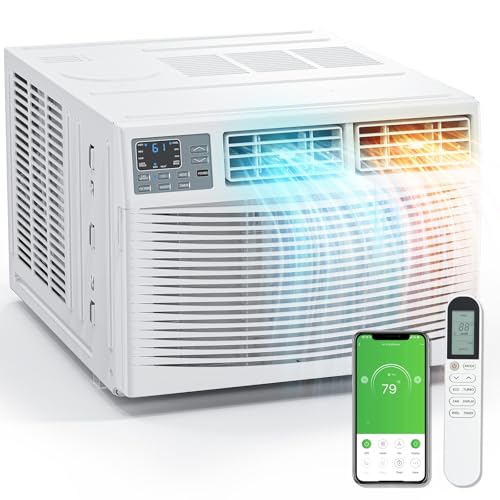
Bonnlo 8000BTU Window Air Conditioner with Heat & Timer, Wi-Fi Enabled Window AC Unit Compatible with Alexa & Google Assistant & Easy Installation Kit for Rooms up to 350 Sq.Ft, 115V/60Hz
Check price on AmazonFrequently Asked Questions
How do I choose the right BTU size for a window mounted air conditioning unit?
Measure the room's square footage and match it to a capacity band: roughly 5,000–6,000 BTU for up to 150 sq ft, 8,000–10,000 BTU for 150–250 sq ft, 12,000–14,000 BTU for 250–400 sq ft, and 18,000–24,000 BTU for larger rooms. Then adjust upward for strong sun exposure, high ceilings, or heavy occupancy. A correctly sized unit dehumidifies better than an oversized one.
Can a window mounted unit be installed in a sliding window?
Yes, with the correct window kit and, in most cases, a support bracket. Horizontal sliding windows require a different mounting approach than double-hung windows, and the side panels must be sized to the opening. Always confirm the manufacturer lists your window type as compatible.
What efficiency rating should I look for?
Window units are rated in CEER. Modern units range from about 10 to 15 CEER. In hot climates or for daily use, target 12 CEER or higher, which typically corresponds to ENERGY STAR certification. In mild climates, a balanced-tier unit around 11–12 CEER is adequate.
Do window units need a dedicated electrical circuit?
Smaller units (5,000–8,000 BTU) often run on a standard 115V household circuit, but sharing that circuit with other loads can trip the breaker. Larger capacities typically require a dedicated 230V circuit. Check the unit's rating plate and match it to your panel before installation.
How much maintenance does a window mounted AC need?
Clean or replace the air filter every two to four weeks during peak season, clean the condenser coils annually, flush the condensate drain at the start of each season, and inspect the bracket and window seal each spring. This routine keeps airflow strong and extends the compressor's service life.
Can I use a window unit as a whole-home cooling solution?
A single window unit is designed for one room. For whole-home cooling, multiple window units or a central system is required. Central air and efficient whole-house systems distribute cooling across the entire home and are the better architecture for multi-room coverage.
Ready to Compare Window Units?
Review the recommended models above by tier and window fit. Confirm your room size, efficiency target, and electrical circuit first — then choose the unit that matches all three.
VIEW RECOMMENDED UNITS