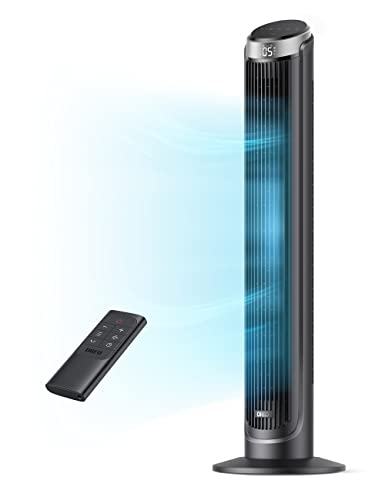
Cooling Tower Fans: The Complete Guide to Smarter Evaporative Cooling
Everything you need to know about cooling tower fans — how they work, where they perform best, how to size one for your room, and which tier of model fits your needs. Research first, then choose with confidence.
Explore Recommended ModelsWhy this guide matters: A cooling tower fan is not simply a fan with water. It is an evaporative cooling appliance whose performance depends on humidity, airflow, and correct sizing. Buyers who understand these three variables consistently end up with a unit that cools well, runs quietly, and lasts for years. This guide gives you exactly that understanding — no guesswork.
What Is a Cooling Tower Fan?
A cooling tower fan is a portable evaporative cooler built in a tall, slim tower form factor. Inside the unit, a pump circulates water over a honeycomb-style cooling pad while a fan draws warm room air through that pad. As the air passes the wet pad, water evaporates and absorbs heat, and the fan blows out cooler, slightly more humid air. The result is a gentle, continuous stream of cooler air from a footprint no larger than a floor lamp.
Unlike a compressor-based air conditioner, a cooling tower fan does not use refrigerant. It relies on the physics of evaporation, which is why it uses far less energy than a conventional AC unit and why it only performs well in specific conditions. If you have been comparing cooling fans for a room and wondering where evaporative units fit in, this is the category to understand before you commit.
How Evaporative Cooling Works
The core principle is simple: when water evaporates, it absorbs heat from the surrounding air. A cooling tower fan maximizes this effect in three steps:
- Water distribution: A pump lifts water from the tank and trickles it evenly across the cooling pad.
- Airflow through the pad: The fan pulls hot, dry room air through the saturated pad, where evaporation cools the air stream.
- Delivery: The cooled air is pushed into the room through the front grille, while warm, humid exhaust air escapes through open windows or doors.
Because the process adds moisture to the air, cross-ventilation is essential. A closed room becomes humid and the cooling effect fades quickly. If your space is sealed and you need true temperature control regardless of humidity, a compressor-based solution such as a cooling unit for a room is the more appropriate path — and our guide on cooling options for homes without ductwork compares the alternatives in detail.
Cooling Tower Fan vs Standard Tower Fan
The names sound similar, but the two products are fundamentally different. A standard tower fan only moves air — it can make you feel cooler through the wind-chill effect, but it does not lower the air temperature. A cooling tower fan adds an evaporative pad and water system, so it genuinely lowers the temperature of the air it delivers, provided humidity is low enough.
Standard Tower Fan
Moves air only. Works in any humidity. Very low energy draw. Best for air circulation and personal comfort in already-conditioned rooms.
Cooling Tower Fan
Moves air and cools it via evaporation. Requires low humidity and ventilation. Slightly higher energy draw due to the water pump. Best for dry climates and open, airy spaces.
When to Choose Which
Choose a standard fan for humid rooms or air-conditioned spaces. Choose a cooling tower fan when the air is dry and you want a noticeable temperature drop without installing an AC system.
Best Conditions & Limitations
Cooling tower fans shine in specific environments and underperform in others. Setting the right expectation before buying is the single most important step in avoiding disappointment.
- Ideal climate: Hot and dry, where relative humidity stays low. The drier the air, the stronger the cooling effect.
- Ideal space: Rooms with open windows or doors that allow humid exhaust air to escape. Cross-ventilation is not optional.
- Poor fit: Humid climates, sealed rooms, and spaces where moisture is already a problem. In these cases the unit becomes an ordinary fan with extra maintenance.
- Supplementary use: Many households pair a cooling tower fan with a conventional AC to reduce AC runtime during mild weather. If you are exploring standalone fan options, our cooling fan for bedroom guide covers quieter alternatives.
How to Size a Unit for Your Room
Sizing a cooling tower fan is about airflow and air changes per hour, not just square footage. A unit that is too small for a large open living area will feel ineffective, while an oversized unit in a small bedroom can feel blustery and noisy. Use this practical framework:
- Measure the room volume: Multiply length × width × ceiling height to get cubic feet.
- Estimate air changes per hour: For typical residential comfort, aim for a fan airflow that supports several air changes per hour in the target space.
- Match the fan's airflow rating: Compare the unit's cubic-feet-per-minute rating against your calculated requirement, and choose a model with headroom for the hottest days.
- Account for open floor plans: Open-plan spaces and rooms connected to hallways need noticeably more airflow than a closed bedroom of the same square footage.
If your space is large and you are also weighing compressor-based options, the sizing logic in our cooling down a room without air conditioning guide will help you compare approaches side by side.
Key Features That Matter
Cooling Pad Quality
Honeycomb cellulose pads offer the best balance of evaporation efficiency and airflow. Thicker pads cool more effectively but restrict airflow slightly; high-grade pads resist mineral buildup longer.
Tank Capacity
A larger tank means fewer refills and longer continuous operation. For overnight use, prioritize a tank that comfortably covers a full night at your preferred fan speed.
Fan Speed & Oscillation
Multiple speeds let you balance cooling and noise. Wide oscillation distributes cooled air across a room instead of focusing it on one spot.
Noise Level
Evaporative units are generally quieter than compressor AC, but pump hum and high fan speeds add up. For bedrooms, look for models with a dedicated low-noise night mode.
Remote & Timer
A remote control and programmable timer make it easy to run the unit only when needed, which extends pad life and reduces water consumption.
Portability & Build
Casters and a balanced base matter more than they seem — a full water tank is heavy. Reinforced housings and rust-resistant finishes extend service life in humid environments.
Quality Tiers Explained
Cooling tower fans are commonly grouped into three broad tiers. Rather than quoting figures that change constantly, this guide uses a stable classification system so the comparison stays useful over time.
| Tier | Typical Characteristics | Best For |
|---|---|---|
| Essential | Entry-level construction, basic two- or three-speed fan, smaller tank, manual controls. Good value for its tier and easy to store. | Occasional use, small bedrooms, and buyers testing whether evaporative cooling suits their climate. |
| Balanced | Mid-range build with a larger tank, improved pad design, remote control, timer, and quieter operation. Feature-rich for its class. | Daily use in living rooms and bedrooms, and households that want a long-term investment without moving to the top tier. |
| Premium | Heavy-duty housing, high-grade cooling pads, advanced airflow design, smart controls, and low-noise engineering. Professional-grade feel. | Large open-plan spaces, extended daily runtime, and buyers who prioritize durability and quiet operation. |
As a rule, balanced-tier models offer a noticeably smoother ownership experience than entry-level units — better pads, quieter fans, and fewer refills — while premium-tier units justify themselves mainly through build quality and long-term reliability in demanding use.
Maintenance & Longevity
A cooling tower fan is a wet appliance, and moisture is what determines how long it lasts. Consistent, simple maintenance keeps airflow strong and prevents the two most common failure points: clogged pads and mineral scale.
- Drain and refill regularly: Never let water sit for days. Stagnant water encourages odor and bacterial growth.
- Clean the cooling pad: Rinse or replace the pad according to the manufacturer's schedule. In hard-water areas, descale more often.
- Wipe the tank: Mineral film on the tank walls reduces pump life. A periodic wipe-down prevents buildup.
- Store dry: Before seasonal storage, drain the tank, remove and dry the pad, and run the fan briefly to dry internal components.
- Check the pump: A weak or noisy pump is the earliest sign of scale buildup. Addressing it early avoids pad damage.
Maintenance is also where cooling tower fans differ most from sealed compressor appliances. If you prefer a system with less routine upkeep, compare the trade-offs in our guide to cooling and heating systems before finalizing your choice.
Frequently Asked Questions
What is a cooling tower fan?
A cooling tower fan is a portable evaporative cooling appliance that draws air through a water-soaked pad and blows out cooler, moister air. It combines a tower fan's vertical form factor with the cooling effect of evaporation, making it a popular choice for dry climates and well-ventilated spaces.
Do cooling tower fans work in humid climates?
Evaporative cooling relies on dry air to absorb moisture. In humid climates, the air is already saturated, so the cooling effect is much weaker. Cooling tower fans perform best where relative humidity is consistently low, and they need cross-ventilation to exhaust humid air.
How do I size a cooling tower fan for a room?
Match the fan's airflow rating in cubic feet per minute to the room volume and air changes per hour. As a rough rule, choose a unit rated for the square footage of the space and confirm it delivers enough air changes per hour for comfortable cooling. Larger open areas need higher airflow.
How much maintenance does a cooling tower fan need?
Routine maintenance includes draining and refilling the water tank, cleaning or replacing the cooling pad, wiping the tank to prevent mineral buildup, and storing the unit dry when not in use. In hard-water areas, descaling the pad and tank more frequently keeps airflow and cooling performance strong.