
Crank Out Window Portable Air Conditioner: The Complete Buyer’s Guide
Casement and crank out windows are common in modern homes, but they are not compatible with standard sliding-window AC panels. This guide explains how a crank out window portable air conditioner setup works, which kits and unit types fit best, and how to seal the opening so your room stays genuinely cool.
Explore Recommended UnitsQuick summary: A portable air conditioner can be used with a crank out window, but only when paired with a dedicated casement window kit. The kit replaces the standard flat panel, seals the vertical opening around the exhaust hose, and keeps outside air from leaking in. Choose a kit that matches your window’s opening dimensions and your unit’s hose diameter.
What Is a Crank Out Window Portable Air Conditioner Setup?
A crank out window portable air conditioner setup is not a separate appliance category. It is a portable AC unit paired with a casement window adapter kit. Casement windows open outward on a hinge, usually operated by a hand crank, so the opening is vertical and irregular compared with a double-hung or sliding window. A standard portable AC window panel is designed for a horizontal or vertical sliding sash, which means it cannot seal a crank out opening properly.
The casement kit solves that problem. It typically consists of a flexible fabric panel, a rigid frame, or a combination of both, with a port for the exhaust hose. The panel is secured to the window frame, the window is cranked shut against it, and the hose is routed outside. The result is a sealed passage for hot exhaust air without leaving the room open to the outdoors.
If you are still comparing portable AC formats in general, our overview of different types of portable air conditioners is a useful starting point before narrowing down to casement-compatible options.
Why Crank Out Windows Need a Special Kit
The geometry of a casement window is the main challenge. The sash swings outward, so the opening is a tall, narrow gap rather than a flat track. A conventional window panel cannot bridge that gap, and forcing one into place usually leaves large air leaks. Those leaks undermine cooling performance and can let insects and warm outdoor air into the room.
A dedicated casement adapter addresses three things at once:
- Hose support: it holds the exhaust hose at the correct angle and prevents it from sagging or disconnecting.
- Sealing: it closes the irregular gap between the window sash and the frame so cooled air stays inside.
- Weather and pest protection: a proper seal keeps rain, dust, and insects out while the unit runs.
For a focused look at the hardware itself, see our guide to the crank out window kit for portable air conditioner units, which covers panel materials, hose ports, and fit considerations in more detail.
How the Setup Works Step by Step
Understanding the installation sequence helps you judge whether a kit will actually work in your home. The process is straightforward but depends on accurate measurements and a tight seal.
- Measure the window opening. Record the clear height and width of the opening, the frame depth, and the distance from the sill to the crank mechanism. These figures determine which kits are compatible.
- Check the hose diameter. Portable AC exhaust hoses vary in diameter. The kit’s hose port must match your unit, or you will need an adapter.
- Install the panel or fabric seal. The kit is fitted into the window frame so the exhaust port faces outward.
- Close the window against the seal. Crank the sash shut so it compresses the panel and creates a snug fit.
- Connect the exhaust hose. Route the hose from the unit to the kit port, keeping it as short and straight as possible.
- Test the seal. Run the unit and check for air leaks around the edges. Seal any gaps with weatherstripping or foam tape.
If your unit is a dual-hose model, the intake hose also needs a port. Confirm that the kit supports two hoses before buying. Our article on the dual hose portable air conditioner dehumidifier format explains why dual-hose designs generally handle sealing and efficiency better in challenging window configurations.
Single-Hose vs Dual-Hose Units for Casement Windows
Both configurations can work with a crank out window, but they behave differently in practice. The table below summarizes the trade-offs using neutral tier descriptors rather than figures.
| Feature | Single-Hose Unit | Dual-Hose Unit |
|---|---|---|
| Typical market tier | Entry-level to mid-range | Mid-range to premium |
| Kit complexity | One hose port; simpler adapter | Two hose ports; needs a compatible dual-hose kit |
| Pressure balance | Can draw warm air in through gaps | Balanced intake and exhaust reduce backflow |
| Cooling consistency | Acceptable in well-sealed rooms | More stable in larger or warmer rooms |
| Best for | Smaller bedrooms and home offices | Living rooms and spaces with strong sun exposure |
For a broader look at the two-hose format, including inverter and heater variants, see our pages on the dual hose portable air conditioner inverter and the dual hose portable air conditioner with heater. Both formats are increasingly common in mid-tier and high-end tier catalogs.
Key Features to Evaluate Before Buying
Window Kit Compatibility
This is the single most important factor. Confirm that the unit ships with, or is compatible with, a casement adapter. Some manufacturers include a standard sliding panel only, which means you will need to source a separate kit. Check the supported window opening range and the hose diameter before committing.
Cooling Capacity and Room Size
Undersizing a unit leads to constant running and poor comfort. Oversizing can short-cycle and leave the room humid. Match capacity to room size, ceiling height, sun exposure, and occupancy. Bedrooms and home offices generally need less capacity than open-plan living areas.
Noise Level
Portable units are noisier than window or mini-split systems because the compressor sits inside the room. If the unit will run at night, look for models with lower decibel ratings and a sleep mode. Mid-range and premium tiers generally offer quieter operation than entry-level models.
Drainage and Self-Evaporation
Portable ACs produce condensate. Some units evaporate most of it automatically, while others require manual draining or a hose connection. In humid climates, self-evaporating designs reduce maintenance. Our guide to fully self evaporating portable air conditioners explains how this works and when it matters.
Smart Controls and Programmability
Wi-Fi control, scheduling, and remote thermostats are now common in mid-tier and high-end tier units. These features help you run the unit only when needed, which supports more efficient long-term operation.
Pros and Cons of This Setup
Advantages
- Makes portable AC usable in homes with casement windows
- No permanent structural modification required
- Works well for renters and temporary installations
- Wide range of units and kits available across tiers
- Can be removed and stored seasonally
Limitations
- Requires a dedicated casement kit; standard panels do not fit
- Seal quality strongly affects performance
- Portable units are generally louder than fixed systems
- Condensate management adds some maintenance
- Floor space is occupied by the unit and hose
Sizing and Placement Tips
Placement matters as much as capacity. Keep the unit on a level surface, leave clearance around the intake and exhaust, and avoid direct sunlight on the unit body. Shade the window if possible, since solar gain through glass increases the cooling load significantly.
Keep the exhaust hose as short and straight as the kit allows. Long, kinked hoses trap heat and reduce airflow. If the hose must bend, use a gentle curve rather than a sharp angle. Seal the window panel edges with weatherstripping and consider a foam insert for the crank mechanism gap.
For rooms that are difficult to cool with a portable unit alone, compare the setup with alternatives. Our guide to energy efficient window air conditioner options explains when a window unit may be the more practical choice, and our overview of crank out casement window air conditioner models covers units designed specifically for this window style.
Maintenance Checklist for Casement Setups
- Clean or replace the air filter every two to four weeks during heavy use.
- Inspect the window kit seal monthly for gaps, wear, or sagging fabric.
- Drain the condensate tank or confirm the self-evaporation function is working.
- Check the exhaust hose for kinks, cracks, or loose connections.
- Wipe down the intake grille and keep the unit clear of dust.
- Store the kit and hose cleanly during the off-season to extend their life.
Routine care keeps cooling performance stable and avoids the most common complaints associated with portable units, such as weak airflow, musty odors, and water leakage.
Common Mistakes to Avoid
- Buying a unit before checking kit compatibility. Confirm the hose diameter and window range first.
- Leaving gaps around the panel. Even small leaks let warm air in and reduce cooling.
- Using an overly long exhaust hose. Keep it short and direct.
- Ignoring drainage. A full tank or blocked drain will shut the unit down.
- Oversizing for a small room. Match capacity to the actual load, not the maximum the unit can deliver.
Frequently Asked Questions
Can a portable air conditioner work with a crank out window?
Yes. A portable AC can work with a crank out or casement window, but it requires a dedicated casement window kit. Standard sliding-window panels will not fit, so the kit is the key component that makes the setup possible.
What is a crank out window kit for a portable air conditioner?
A crank out window kit is a fabric or rigid panel assembly that seals the open gap of a casement window around the portable AC exhaust hose. It holds the hose in place, blocks outside air and insects, and keeps the cooling inside the room.
Do I need a special portable AC for a casement window?
Not necessarily. Most single-hose and dual-hose portable AC units can be adapted with a casement window kit. The important factors are hose diameter, hose length, and whether the kit matches the window’s vertical or horizontal crank configuration.
Is a crank out window portable AC setup efficient?
Efficiency depends on sealing quality. A well-installed casement kit with a tight seal, a dual-hose unit, and proper sizing will perform far better than a loose panel. Single-hose units are simpler but can draw warm air back into the room if the seal is poor.
How do I measure a crank out window for a portable AC kit?
Measure the window’s clear opening height and width, the depth of the frame, and the distance from the sill to the crank handle. Also measure the exhaust hose diameter. Compare these figures with the kit’s supported range before buying.
Final Thoughts
A crank out window portable air conditioner setup is a practical solution for homes that cannot use standard window panels. The unit itself matters, but the kit and the seal matter just as much. Measure carefully, choose a kit that matches your window and hose, and seal every gap. With those steps done, a portable AC can deliver reliable cooling in a casement-window room without permanent modifications.
Recommended Portable AC Units for Crank Out Windows
⚠️ AFFILIATE DISCLOSURE: This website contains affiliate links. As an Amazon Associate, we earn from qualifying purchases. If you make a purchase through these links, we may receive a small commission at no additional cost to you. Read our full affiliate policy.

VOSE-FLO AC Window Seal Kit 157" for Casement Crank Out Windows, No-Drill | Portable AC Window Vent Kit, Adjustable, for Crank Casement, Push-Out Casement & Crank Skylight Windows, Waterproof
Check price on Amazon
IKSTAR Portable AC Window Seal Kit 400CM/157 for Casement, Crank-Out & Skylight Windows, No-Drill Window Vent Kit with Adjustable Zipper, Fits Single & Dual Hose Portable Air Conditioners
Check price on Amazon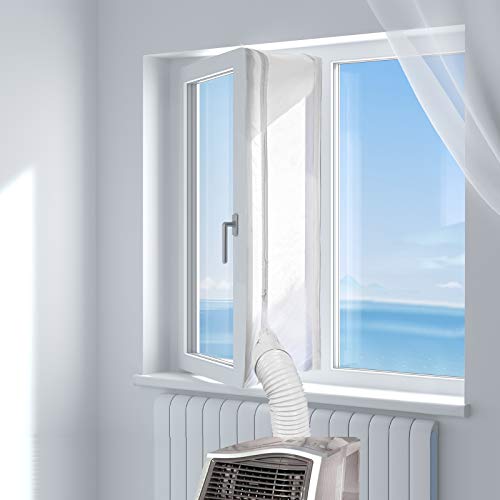
HOOMEE 118”(300CM) Universal Window Seal for Mobile Air Conditioner and Tumble Dryer – Window Kit Works with Portable AC, Easy to Install - Air Exchange Guards with Zip and Adhesive Fastener
Check price on Amazon
HOOMEE 157”(400CM) Universal Window Seal for Mobile Air Conditioner and Tumble Dryer – Window Kit Works with Portable AC, Easy to Install - Air Exchange Guards with Zip and Adhesive Fastener
Check price on Amazon
SPONDWILD 157"/400CM Portable AC Window Seal Kit for Casement Windows | No-Drill Window Vent Kit, Fit 5" and 6" Single Hose Portable Air Conditioners, Waterproof Window Seal Kit, Easy Install
Check price on Amazon
LOVIGA Portable AC Window Vent Kit, 100% Sealing, Adjustable 10x40~60 Inch | For Sliding & Hung Windows, Keep Hot Air/Rian/Bugs Out, No Sealing Strips Needed, Easy Install, Reusable, Renter-Friendly
Check price on Amazon
YAHENLI 400CM (157") Portable AC Window Seal, Casement Window Vent Kit for Portable Air Conditioner and Dryer, Waterproof Seal Kit Easy to Install for Crank Out/Skylights/Awning/Window
Check price on AmazonDisclaimer
Some of the content on this site uses AI assistance. Information is provided for educational purposes only. We are not responsible for any losses resulting from the use of this information. By using this site, you waive any right to bring legal claims against us arising from your use of the information provided. If you do not agree, please do not use this site. Read the full disclaimer.