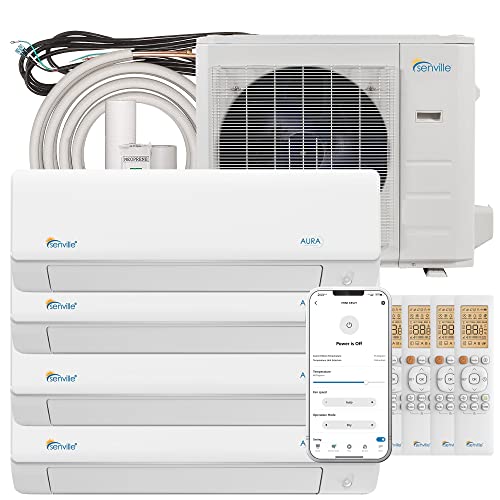
Four Zone Mini Split: The Complete Multi-Zone Cooling Guide
Everything you need to know about a four zone ductless mini split system — how it works, how to size it, which tier fits your home, and what to expect before installation.
START LEARNINGWhat This Guide Covers
- What a Four Zone Mini Split Actually Is
- How a Four Zone System Works
- Who a Four Zone Mini Split Is Best For
- Sizing a Four Zone System Correctly
- Efficiency Ratings and Long-Term Energy Use
- System Tiers: Entry-Level to Commercial-Grade
- Installation Process and What to Expect
- Common Mistakes to Avoid
- Frequently Asked Questions
What a Four Zone Mini Split Actually Is
A four zone mini split is a ductless HVAC system built around a single outdoor condenser that connects to four separate indoor air handlers. Each indoor unit serves its own zone — typically a bedroom, living area, home office, or finished basement — and each zone has its own remote or wall thermostat. That means four rooms can be conditioned independently, without ductwork running through walls or ceilings.
The term "zone" refers to an independently controlled area, not necessarily a separate room. A large open-plan living and dining space could be one zone, while three bedrooms plus a home office could form the remaining three. The flexibility is the core appeal: you get whole-home comfort without the expense and disruption of installing a full ducted system.
Most four zone mini splits are heat pumps, meaning they cool in summer and heat in winter by reversing the refrigerant cycle. This dual capability makes them a genuine year-round comfort solution in moderate and mixed climates, and it is one reason multi-zone systems have become a mainstream choice for retrofits and new construction alike.
Key takeaway: A four zone mini split is one outdoor unit, four indoor heads, four independent thermostats, and zero ducts. It is the most practical ductless layout for a three-bedroom home with an additional living area or office.
How a Four Zone System Works
The outdoor condenser houses the compressor and the outdoor coil. Refrigerant travels through insulated line sets to each of the four indoor air handlers. Inside each head, an evaporator coil absorbs heat from the room air and a blower distributes conditioned air. Because each indoor unit has its own expansion valve and thermostat, the system can modulate output per zone rather than conditioning every room at the same rate.
Independent Zoning in Practice
If one bedroom is unoccupied during the day, you can switch that zone off entirely while the living room and home office run at full comfort. This is the defining advantage over a single-zone system, which must condition the whole connected space whether or not every room is in use. Over a full season, that selective operation translates into meaningful energy savings — not through a discount or a deal, but through reduced runtime.
Inverter Compressor Technology
Nearly all modern four zone systems use inverter-driven compressors. Instead of cycling on and off at full power, an inverter compressor varies its speed to match the combined demand of the active zones. When only one zone calls for cooling, the compressor slows down; when all four are active, it ramps up. This variable-speed operation is smoother, quieter, and more efficient than single-stage cycling.
Heating Mode
In heating mode, the refrigerant flow reverses. The outdoor coil absorbs heat from outside air — even cold air contains usable thermal energy — and the indoor coils release it into each zone. Modern cold-climate heat pumps maintain strong heating output well below freezing, making a four zone system viable as a primary heating source in many regions. If efficiency certifications matter to your decision, our guide to ENERGY STAR mini split heat pumps explains the qualifying thresholds in detail.
Who a Four Zone Mini Split Is Best For
A four zone system is not the right answer for every home. It shines in specific scenarios and becomes an awkward fit in others. Understanding which category your home falls into will save you from an oversized or undersized installation.
Strong Fits
- Homes without existing ductwork. Older homes, additions, and converted attics often have no duct chase. A ductless four zone layout avoids invasive demolition entirely.
- Three-bedroom homes with a bonus room. Four indoor heads map naturally onto three bedrooms plus a living area, office, or finished basement.
- Multi-story homes with uneven temperatures. Zoning solves the classic problem of a hot upstairs and a cold downstairs by giving each level independent control.
- Room additions and converted garages. Extending a ducted system is often impractical; a dedicated zone is not.
- Homeowners replacing window or portable units. A four zone system consolidates several noisy, inefficient standalone units into one coordinated system.
Weaker Fits
- Large open-plan homes needing whole-house coverage. If your home has more than four distinct comfort areas, a five zone mini split may be the better match.
- Homes with excellent existing ductwork. If ducts are already in place and in good condition, a ducted system or a ducted mini split may integrate more cleanly.
- Very small homes. A studio or one-bedroom apartment rarely justifies four zones; a single-zone or two-zone layout is more proportionate.
If you are comparing ductless against ducted options more broadly, our breakdown of ductless versus ducted systems is a useful companion read before committing to a layout.
Sizing a Four Zone System Correctly
Sizing is the single most consequential decision in a four zone project. An undersized system will run continuously and fail to hold setpoint on peak days. An oversized system will short-cycle, dehumidify poorly, and wear out its compressor prematurely. Neither outcome is acceptable, and neither can be fixed later without replacing equipment.
The BTU Baseline
Most four zone systems fall in the 30,000 to 48,000 BTU total capacity range. That total is not simply divided by four — each zone's head is selected for its own load, and the outdoor unit must be able to serve the combined demand when all zones call simultaneously. A common mistake is assuming that because zones rarely run all at once, the condenser can be smaller than the sum of the heads. In practice, most manufacturers allow some diversity, but the limits are specific to each model and must be respected.
What Drives the Load
- Square footage per zone. A 150 sq ft bedroom needs far less capacity than a 400 sq ft living room.
- Ceiling height. Vaulted ceilings increase the air volume that must be conditioned.
- Insulation and air sealing. A leaky, poorly insulated room can require 30% more capacity than a tight, well-insulated one of the same size.
- Window area and orientation. South- and west-facing rooms with large glazing carry a heavier solar load.
- Climate zone. Design temperatures vary substantially across regions, and heating load matters as much as cooling load in colder areas.
- Occupancy and internal gains. Kitchens, home gyms, and rooms with electronics generate additional heat.
Manual J Is the Standard
Professional installers perform a Manual J load calculation for each zone rather than relying on a rule-of-thumb formula. The calculation accounts for envelope performance, infiltration, internal gains, and local design conditions. If a contractor quotes a system without performing a room-by-room load calculation, treat that as a warning sign. For a deeper walkthrough of the methodology, see our guide on how to size an air conditioner.
Sizing rule of thumb: Never size a four zone system by dividing total square footage by four and multiplying by a fixed BTU factor. Each zone must be calculated independently, then the condenser must be verified against the manufacturer's combined-capacity and diversity limits.
Efficiency Ratings and Long-Term Energy Use
Efficiency is where a well-chosen four zone system pays back its investment over time. Because each zone runs only when needed and the inverter compressor modulates rather than cycling, seasonal energy use is typically lower than a comparable single-stage ducted system serving the same floor area.
SEER2 and HSPF2
Modern mini splits are rated under the updated SEER2 and HSPF2 standards, which use more realistic test conditions than the older SEER and HSPF metrics. Higher SEER2 values indicate better cooling efficiency; higher HSPF2 values indicate better heating efficiency. For a four zone heat pump, both numbers matter if you intend to use the system year-round. Our explanation of what the SEER rating means covers the metric in depth.
Why Multi-Zone Systems Score Well
- No duct losses. Ducted systems lose a meaningful percentage of conditioned air through leaks and conduction. Ductless systems deliver air directly into the room.
- Zone-level control. Conditioning only occupied spaces reduces total runtime.
- Variable-speed modulation. Inverter compressors avoid the efficiency penalty of repeated on-off cycling.
- Heat pump operation. In heating mode, heat pumps move heat rather than generating it, which is fundamentally more efficient than resistance heating.
If you want to benchmark specific models against certification thresholds, our overview of ENERGY STAR mini split systems and the broader ENERGY STAR qualified air conditioner listings are useful references. For homeowners focused on the highest available performance, the most efficient ENERGY STAR air conditioners guide highlights where the top tier sits.
System Tiers: Entry-Level to Commercial-Grade
Four zone mini splits span a wide range of build quality, feature depth, and low-temperature performance. Rather than comparing by figure, it is more useful to classify systems by tier. The table below maps each tier to its typical characteristics and the buyer it suits best.
| Tier | Typical Characteristics | Best For |
|---|---|---|
| Entry-level | Standard inverter compressor, basic remotes, moderate SEER2, limited low-temperature heating | Mild climates, budget-conscious retrofits, secondary homes |
| Mid-range | Improved modulation, Wi-Fi control, better cold-climate performance, quieter indoor heads | Primary residences in mixed climates, three-bedroom homes |
| Premium | High SEER2/HSPF2, enhanced low-temperature heating, advanced filtration, smart-home integration | Energy-focused homeowners, cold-climate primary heating |
| High-end tier | Top-tier efficiency, whisper-quiet operation, premium materials, extended warranty coverage | Luxury renovations, whole-home comfort priorities |
| Commercial-grade | Heavy-duty components, longer service intervals, robust controls, higher duty cycle ratings | Light commercial spaces, rental properties, high-usage installations |
Within each tier, the practical differences show up in modulation smoothness, noise levels, and cold-weather heating retention. A mid-range system typically offers noticeably smoother capacity modulation than an entry-level unit, while a premium system adds better low-temperature performance and more sophisticated air filtration. None of these distinctions require quoting figures — they are qualitative shifts in capability that you can evaluate against your climate and usage patterns.
If your priority is long-term efficiency rather than upfront tier, lean toward the premium and high-end tiers. If your climate is mild and the system is a secondary comfort solution, an entry-level or mid-range four zone system is a well-specified choice for the category.
Installation Process and What to Expect
A four zone installation is more involved than a single-zone job because four line sets, four condensate routes, and four electrical connections must be coordinated from one outdoor unit. A professional installation typically takes two to four days, depending on routing complexity and whether the electrical panel needs upgrading.
Pre-Installation Checklist
- Load calculation completed for each of the four zones.
- Indoor head placement confirmed — high on a wall, clear of obstructions, with drain slope available.
- Outdoor unit location selected — shaded, well-ventilated, with clearance for service access.
- Electrical capacity verified — most four zone systems require a dedicated 240V circuit.
- Permits obtained where local code requires them.
- Line set routes planned — the shortest practical runs reduce refrigerant charge and labor.
During Installation
The crew mounts the outdoor condenser, drills wall penetrations for each line set, mounts the four indoor heads, runs insulated refrigerant lines and condensate drains, makes electrical connections, and then evacuates the system with a vacuum pump before releasing refrigerant. Proper evacuation is non-negotiable — moisture left in the lines degrades performance and can damage the compressor. Our guide on how to vacuum an AC system explains why this step matters.
After Installation
Commissioning includes verifying refrigerant charge, testing each zone independently, confirming condensate drainage, and walking the homeowner through controls. The first week after installation is the period to watch for unusual noises, weak airflow, or drainage issues. Our first week after AC installation checklist covers exactly what to monitor.
Ready to Compare Four Zone Systems?
Browse feature-rich four zone mini split options and check availability for your climate and layout.
Explore OptionsCommon Mistakes to Avoid
Most four zone mini split disappointments trace back to a handful of preventable errors. Avoiding them is far easier than correcting them after the equipment is on the wall.
Mistake 1: Oversizing the Condenser
A larger condenser is not automatically better. An oversized unit short-cycles, which reduces dehumidification and accelerates compressor wear. Size the condenser to the calculated load, not to the sum of the indoor heads.
Mistake 2: Ignoring Zone Diversity Limits
Manufacturers specify how much combined indoor capacity a condenser can support. Exceeding that ratio can cause capacity shortfalls when multiple zones call at once. Always verify the diversity allowance for the specific model.
Mistake 3: Poor Indoor Head Placement
Mounting a head above a door, behind furniture, or in direct sunlight compromises airflow and temperature sensing. Placement should follow the manufacturer's clearance requirements and the room's actual use pattern.
Mistake 4: Skipping the Load Calculation
A rule-of-thumb estimate is not a substitute for a room-by-room Manual J calculation. This is the most common cause of undersized or oversized systems.
Mistake 5: Neglecting Condensate Drainage
Each indoor head produces condensate. If drain lines lack proper slope or terminate poorly, water damage follows. Confirm drainage during commissioning, not months later.
Mistake 6: Choosing a Contractor on Availability Alone
Installation quality determines whether a good system performs well. Verify licensing, insurance, and experience with multi-zone systems specifically. Our guide on how to choose an HVAC contractor walks through the vetting process.
For homeowners also weighing repair versus replacement on an existing system, the replace versus repair analysis provides a useful framework before committing to a new four zone installation.
Frequently Asked Questions
What is a four zone mini split?
A four zone mini split is a ductless system with one outdoor condenser connected to four separate indoor air handlers. Each zone has its own thermostat, so four rooms or areas can be cooled and heated independently.
How many BTU does a four zone mini split need?
Most four zone systems range from 30,000 to 48,000 BTU total capacity. The exact capacity depends on the combined square footage, insulation, climate, and window exposure of the four zones being served. A room-by-room load calculation is the only reliable way to determine the correct figure.
Can a four zone mini split heat and cool at the same time?
Standard four zone heat pumps provide cooling or heating to all zones at once. Multi-zone systems with simultaneous heating and cooling capability are a specialized category and typically carry a premium tier designation. If simultaneous operation matters for your layout, confirm the capability explicitly before selecting a model.
How long does a four zone mini split installation take?
A professional four zone installation usually takes two to four days depending on line set routing, electrical work, and whether wall penetrations or condensate drains require additional modification.
Is a four zone mini split suitable as a primary heating system?
In many climates, yes. Modern cold-climate heat pumps maintain strong heating output well below freezing. However, suitability depends on your local design temperature and the specific model's rated low-temperature performance. Mid-range and premium tier systems generally offer better cold-weather retention than entry-level units.
Do all four zones have to be used at the same time?
No. Each zone operates independently. You can switch off unoccupied zones while conditioning the rest, which is one of the primary efficiency advantages of a multi-zone layout.
What maintenance does a four zone system require?
Regular filter cleaning or replacement, periodic coil cleaning, condensate drain inspection, and an annual professional service visit. Because there are four indoor heads, maintenance takes somewhat longer than a single-zone system, but the tasks themselves are straightforward. Our seasonal AC checklist outlines the routine.
Choose the Right Four Zone Mini Split for Your Home
You now understand how these systems work, how to size them, and which tier fits your climate and usage. Browse recommended four zone systems below.
Check Availability