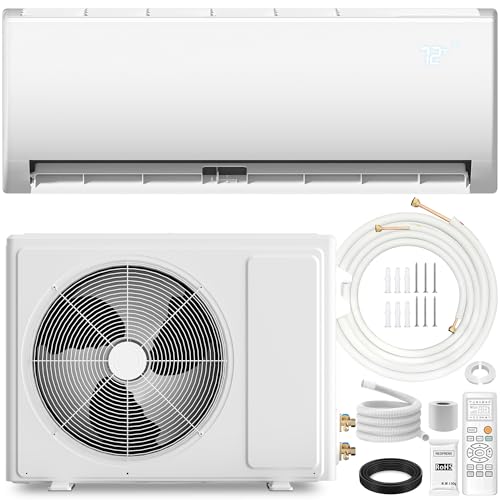
Mini Split Heat Pump for 500 Sq Ft: The Complete Buyer's Guide
Everything you need to know about choosing, sizing, and installing a ductless heat pump for a 500 sq ft space — from BTU calculations to top-tier features and professional installation tips.
START WITH SIZINGWhy a mini split heat pump for 500 sq ft? A 500 sq ft space — whether a studio apartment, a finished basement, a garage conversion, or an addition — is the ideal candidate for ductless heat pump technology. These systems deliver highly efficient heating and cooling without the need for ductwork, giving you precise comfort control and lower energy consumption year-round.
Is a Mini Split Heat Pump Right for Your 500 Sq Ft Space?
A mini split heat pump is an excellent choice for a 500 sq ft area if you answer yes to any of the following:
No Existing Ductwork
If your space lacks ductwork — common in older homes, additions, garages, and converted basements — a ductless system eliminates the need for expensive duct installation.
- Ideal for retrofits and renovations
- No duct sealing or cleaning required
- Minimal structural modifications
Year-Round Comfort Needed
A heat pump provides both heating and cooling from a single system. For a 500 sq ft space, this dual functionality is a major advantage over separate AC and heating units.
- Heating and cooling in one unit
- Reversing valve switches modes
- Efficient in moderate to cold climates
Energy Efficiency Priority
Modern inverter-driven mini split heat pumps achieve high SEER2 and HSPF2 ratings, making them among the most efficient HVAC systems available for spaces of this size.
- Inverter compressors modulate output
- High SEER2 and HSPF2 ratings
- Reduced energy consumption
Zoned Comfort Desired
If your 500 sq ft space is part of a larger home, a mini split allows you to heat or cool only that area — without conditioning unused rooms.
- Zone-specific temperature control
- Ideal for additions and extensions
- Can supplement central HVAC
How to Size a Mini Split Heat Pump for 500 Sq Ft
The most critical decision when selecting a mini split heat pump is sizing. An undersized unit will struggle to maintain comfort, while an oversized unit will cycle frequently, reducing efficiency and lifespan.
Quick BTU Estimate
As a starting point, the general rule of thumb is 20 BTU per square foot of living space. For a 500 sq ft area, this suggests a baseline cooling capacity of approximately 10,000 BTU. However, this is only a rough estimate — several factors can push the actual requirement higher or lower.
| Factor | Impact on BTU Requirement | Recommendation |
|---|---|---|
| Ceiling height above 8 ft | Increases required capacity by 10–20% | Add 1,000–2,000 BTU |
| Poor insulation | Increases required capacity by 15–30% | Add 1,500–3,000 BTU |
| Large windows or direct sun exposure | Increases required capacity by 10–25% | Add 1,000–2,500 BTU |
| High occupancy (more than 2 people) | Increases required capacity by 5–10% per person | Add 500–1,000 BTU per additional person |
| Well-insulated, shaded space | Decreases required capacity by 10–15% | Subtract 1,000–1,500 BTU |
| Kitchen or heat-producing equipment | Increases required capacity by 10–20% | Add 1,000–2,000 BTU |
For most 500 sq ft residential spaces, a heat pump sized for 400 sq ft to a unit rated at 12,000–15,000 BTU covers the range. If your space has multiple unfavorable factors, consider a slightly larger system; if it is well-insulated and shaded, a smaller unit may suffice.
Pro Tip: Always request a Manual J load calculation from a qualified HVAC contractor. This room-by-room analysis accounts for insulation, window performance, air infiltration, and local climate — giving you a precise BTU target rather than an estimate.
Single-Zone vs Multi-Zone: Which Configuration Fits 500 Sq Ft?
The configuration you choose depends on the layout of your 500 sq ft space:
Single-Zone System
Best for open-plan spaces where air can circulate freely — studios, open basements, lofts, and single large rooms.
- One outdoor unit, one indoor head
- Simpler and more energy efficient
- Lower installation complexity
- Ideal for open layouts
Multi-Zone System
Better for divided layouts — a 500 sq ft space split into two or more rooms with separate temperature needs.
- One outdoor unit, multiple indoor heads
- Independent temperature control per zone
- Higher flexibility for divided spaces
- Explore multi-zone mini split options
For most 500 sq ft applications, a single-zone system is the most practical and efficient choice. If your space has distinct rooms with different occupancy patterns — for example, a studio with a separate bedroom — a two-zone multi-zone mini split system may be worth considering.
Key Features to Look For in a Mini Split Heat Pump for 500 Sq Ft
When evaluating ductless heating and cooling systems, prioritize these features for a 500 sq ft application:
Inverter Technology
Inverter-driven compressors modulate speed to maintain consistent temperatures rather than cycling on and off. This is especially important for smaller spaces where temperature swings are more noticeable.
- Precise temperature control
- Quieter operation
- Higher energy efficiency
High SEER2 and HSPF2 Ratings
Efficiency ratings matter for year-round operation. Look for models with competitive SEER2 (cooling) and HSPF2 (heating) ratings within their tier.
- SEER2 indicates cooling efficiency
- HSPF2 indicates heating efficiency
- Higher ratings mean lower energy use
Low-Temperature Heating
If you rely on the heat pump for winter comfort, choose a model rated for cold-climate operation. Some premium-tier units maintain full heating capacity at temperatures well below freezing.
- Cold-climate rated models available
- Base pan heater prevents ice buildup
- Important for colder regions
Quiet Operation
For a 500 sq ft space, the indoor unit is close to living areas. Sound levels matter — premium-tier models often operate below 25 dB in low-speed mode.
- Low decibel ratings for indoor heads
- Sleep modes reduce fan speed
- Outdoor unit noise also worth checking
Smart Controls and Thermostats
Wi-Fi-enabled controls allow scheduling, remote operation, and integration with smart home systems. Many mid-range and premium units include app-based control.
- Wi-Fi and app connectivity
- Compatible with smart thermostats
- Explore remote thermostat options
Filtration and Air Quality
Most indoor heads include washable filters. Some higher-tier models add advanced filtration — anti-allergen, deodorizing, or plasma-based — which can be beneficial in smaller, enclosed spaces.
- Washable primary filters
- Optional advanced filtration
- Regular cleaning maintains airflow
Installation Considerations for a 500 Sq Ft Mini Split Heat Pump
Proper installation is essential to performance, efficiency, and warranty coverage. Here are the key considerations specific to a 500 sq ft application:
Indoor Unit Placement
The indoor head should be mounted high on a wall, ideally 6–8 feet above the floor, with clear airflow in both directions. Avoid direct sunlight and proximity to heat sources.
- High wall mounting for even air distribution
- Clearance from obstructions
- Consider mini split head options
Outdoor Unit Placement
The outdoor unit needs adequate clearance for airflow and should be mounted on a stable surface — a wall bracket or ground pad. Ensure it is level and protected from snow accumulation.
- Wall bracket or ground pad mounting
- Clearance for airflow
- See mini split pad options
Line Set and Drainage
The refrigerant line set connects indoor and outdoor units. Keep the run as short as practical — longer runs reduce efficiency. Condensate drainage must slope properly.
- Short line set runs preferred
- Proper condensate drainage
- Explore mini split line set details
Electrical Requirements
Most 12,000–15,000 BTU mini split heat pumps require a dedicated 220–240V circuit. Confirm your electrical panel capacity before installation.
- Dedicated circuit required
- Licensed electrician recommended
- Verify panel capacity
While DIY mini split installation is possible with pre-charged line sets, professional installation is strongly recommended for optimal performance and warranty validity. If you prefer to hire a pro, consider mini split installation services or find mini split installers in your area.
Tier-Based Recommendations for 500 Sq Ft Mini Split Heat Pumps
Products in this category can be grouped into three broad tiers. The right choice depends on your priorities — essential comfort, balanced features, or top-tier performance and efficiency.
| Tier | Best For | Typical Features |
|---|---|---|
| Essential Tier | Basic heating and cooling needs in mild climates | Single-zone, standard efficiency, basic controls, washable filter |
| Balanced Tier | Year-round comfort with moderate energy efficiency goals | Inverter compressor, higher SEER2/HSPF2, quiet operation, remote control |
| Top-Tier | Maximum efficiency, cold-climate performance, smart features | Cold-climate rated, Wi-Fi control, advanced filtration, ultra-quiet operation |
For a 500 sq ft space, a balanced-tier model typically offers the best combination of features and efficiency for most homeowners. If you live in a colder climate or prioritize smart home integration, a top-tier unit may be worthwhile. Essential-tier systems remain a solid choice for mild climates and basic comfort needs.
Maintenance Tips for Your 500 Sq Ft Mini Split Heat Pump
Regular maintenance keeps your system running efficiently and extends its lifespan. For a 500 sq ft space, these tasks are straightforward:
Clean or Replace Filters Monthly
Indoor unit filters should be cleaned every 2–4 weeks during heavy use. Clogged filters reduce airflow, lower efficiency, and strain the system.
- Remove and rinse washable filters
- Let dry completely before reinstalling
- Replace disposable filters as needed
Keep Outdoor Unit Clear
Remove debris, leaves, and snow from around the outdoor unit. Ensure at least 2 feet of clearance on all sides for proper airflow.
- Clear debris seasonally
- Maintain clearance for airflow
- Check for ice buildup in winter
Schedule Annual Professional Service
A professional tune-up should include refrigerant level checks, coil cleaning, electrical inspection, and a full performance review.
- Annual or biennial service
- Coil cleaning and inspection
- Refrigerant level verification
Monitor Drainage
Check the condensate drain line for clogs or algae growth. Proper drainage prevents water damage and mold growth.
- Flush drain line periodically
- Check for leaks and blockages
- Use drain pan tablets if needed
Common Mistakes to Avoid
Oversizing the System
A larger unit does not mean better comfort. Oversized systems short-cycle, which reduces efficiency, increases wear, and creates uneven temperatures.
Skipping Load Calculation
Relying solely on the 20 BTU per square foot rule can lead to incorrect sizing. A Manual J calculation provides accurate, room-specific data.
Ignoring Cold-Climate Ratings
If you plan to use the heat pump in winter, verify its low-temperature performance. Standard models may lose capacity in freezing conditions.
Choosing the Lowest Tier Without Comparison
Essential-tier units can be a good fit, but always compare features within the tier. Small differences in efficiency ratings can have a meaningful impact over years of use.
Ready to Choose Your Mini Split Heat Pump?
Now that you understand sizing, features, and installation, explore our top recommended products for 500 sq ft spaces below. Compare options across tiers and find the system that fits your comfort goals and energy priorities.
VIEW RECOMMENDATIONS