Air Conditioner Thermostat: Complete Buyer's Guide
Understand thermostat types, compatibility, smart features, and tier levels so you can choose the right control for your AC system with confidence.
START LEARNINGWhy research before you buy? A thermostat is the control center of your air conditioning system. The wrong choice can reduce comfort, limit features, or fail to work with your equipment. Understanding compatibility and tier differences helps you pick a thermostat that delivers reliable performance and worthwhile long-term value.
What Does a Thermostat Do for Your Air Conditioner?
A thermostat for an air conditioner monitors indoor temperature and signals your AC system to turn on or off to maintain your desired comfort level. Modern thermostats do far more than that — they can schedule cooling cycles, respond to occupancy, integrate with smart home platforms, and provide detailed energy usage insights.
Thermostats are a small component of your overall HVAC investment but have an outsized impact on comfort and efficiency. A well-matched thermostat helps your system run at its best, while a poorly chosen one can cause short cycling, uneven cooling, or compatibility headaches. If you are still evaluating your broader system, our guide on air conditioner planning provides helpful context.
Thermostats are available across a wide range of tiers, from basic non-programmable models to premium smart thermostats with advanced sensors and learning capabilities. The right choice depends on your system type, your comfort priorities, and how much convenience you want.
How Thermostats Communicate With Your AC
Thermostats connect to your HVAC equipment through low-voltage wiring. Conventional systems use a set of wires labeled R, Y, G, W, and C, each controlling a different function such as cooling, fan, or heating. Heat pumps and multi-stage systems use additional wires and require compatible thermostats. Modern smart thermostats often need a C-wire for continuous power, or they may use a power-stealing design that works without one.
Understanding your system's wiring and stage configuration is essential before buying. If you are unsure about your system type, an HVAC technician can confirm compatibility and identify the correct replacement model.
Types of Air Conditioner Thermostats
Thermostats fall into several categories based on functionality and control method. Each type fits different needs and budget preferences.
Non-Programmable Thermostats
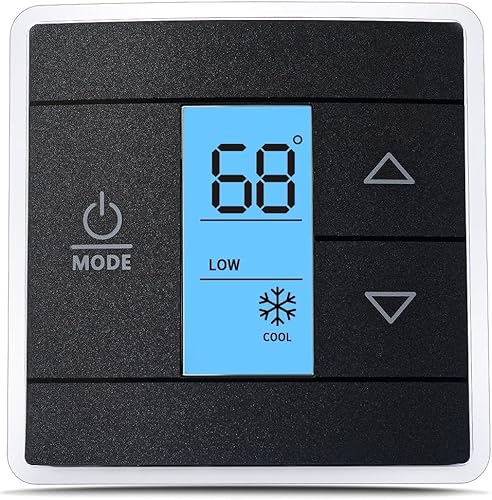
These are the most basic thermostats. You set a temperature and the unit maintains it until you change it manually. They are simple, reliable, and typically fall in the entry-level tier. They are a reasonable choice for spaces where schedules are irregular or where simplicity matters more than features.
Programmable Thermostats
Programmable thermostats let you set schedules for different times of day and days of the week. They are a step up in convenience and are often in the mid-range tier. They work well for households with predictable routines and can help reduce unnecessary cooling when the home is empty. Our guide on programmable thermostats for heating and cooling goes deeper into scheduling strategies.
Smart Thermostats
Smart thermostats connect to Wi-Fi and can be controlled from a smartphone. Many learn your schedule automatically, use occupancy sensors, and integrate with voice assistants and smart home platforms. They typically fall in the premium to top-tier range. Features vary by model, but common capabilities include geofencing, energy reports, and remote diagnostics.
Professional-Grade and Commercial Thermostats
Professional-grade thermostats are designed for reliability and advanced control in complex systems. They may support multi-zone control, remote sensors, and integration with building management systems. They are common in commercial settings and in homes with sophisticated HVAC setups.
Thermostat Compatibility: What to Check First
Compatibility is the most important factor when selecting a thermostat. A thermostat that does not match your system can fail to operate correctly or may not work at all.
System Type
Conventional single-stage systems, multi-stage systems, heat pumps, and dual-fuel systems each require different thermostat capabilities. Heat pump systems, in particular, need thermostats with specific heat pump modes and auxiliary heat control. Confirm your system type before choosing a model.
Wiring and C-Wire
Most smart thermostats require a C-wire for continuous power. If your system lacks one, you may need a power adapter kit or professional installation. Some thermostats use power-stealing technology to work without a C-wire, but compatibility varies. Checking your existing wiring before purchase avoids surprises. Our guide on professional HVAC thermostats covers wiring considerations in more detail.
Voltage and Control Signals
Residential thermostats typically operate on 24-volt low-voltage control. Line-voltage thermostats are used for specific applications such as electric baseboard heating. Mixing the two can damage equipment, so confirm the control voltage of your system.
Additional Components
If your system includes accessories such as a humidifier, dehumidifier, or ventilation control, your thermostat should support those functions. Verify compatibility with all connected components before buying.
Thermostat Tiers and What to Expect
Comparing thermostats by tier helps you understand the relative value of each option. Rather than focusing on numbers, consider the features and capabilities each tier provides.
| Thermostat Tier | Key Features | Control Type | Best For |
|---|---|---|---|
| Entry-level | Basic temperature control, manual adjustment | Non-programmable | Simple setups, irregular schedules, rental units |
| Mid-range | Programmable schedules, backlit display | Programmable | Households with predictable routines |
| Premium | Wi-Fi, app control, occupancy sensing | Smart thermostat | Convenience-focused homes, remote management |
| High-end tier | Learning algorithms, multi-sensor support, energy reports | Advanced smart thermostat | Comfort optimization and efficiency tracking |
| Top-tier / flagship | Deep smart home integration, voice control, diagnostics | Flagship smart thermostat | Tech-forward homes, comprehensive automation |
| Professional-grade | Advanced zoning, remote sensor management, BMS integration | Commercial / pro-grade thermostat | Multi-zone homes, commercial spaces, complex systems |
For context on how thermostats fit into broader system efficiency, see our guide on SEER and SEER2 standards. Better thermostat control often unlocks more value from higher-efficiency equipment.
Key Features to Evaluate
Modern thermostats vary widely in features. Focus on the ones that match your daily habits and your system's capabilities.
Scheduling and Learning
Basic programmable thermostats let you set schedules. Learning thermostats build schedules automatically based on your adjustments. Learning features are most valuable when your routine is somewhat consistent.
Remote Access
Wi-Fi thermostats let you control temperature from a smartphone, whether you are at work, on vacation, or in another room. Remote access is a core benefit of smart thermostats.
Occupancy Sensing
Some thermostats use motion sensors or geofencing to detect when the home is empty and adjust cooling accordingly. This can improve efficiency without sacrificing comfort.
Energy Reports
Many smart thermostats provide insights into runtime and energy use. These reports help you identify patterns and adjust habits. Our guide on ideal AC temperature settings pairs well with thermostat data.
Zoning and Multi-Zone Support
If your home uses an HVAC zoning system, your thermostat must support multiple zones or work alongside zone controllers. Professional-grade thermostats are often required for complex setups.
Smart Home Integration
Integration with platforms such as voice assistants and home automation hubs adds convenience. Check that your preferred ecosystem is supported if this matters to you.
Installation and Setup Considerations
Thermostat installation is often straightforward but can vary with system type and existing wiring. Understanding the process helps you decide whether to install it yourself or hire a technician.
DIY Installation
Replacing a thermostat with a compatible model is often a DIY task. Turn off power to the HVAC system first, photograph the wiring before disconnecting, and follow the manufacturer's instructions. Basic non-programmable and programmable thermostats are usually the easiest to install.
When to Call a Technician
If your system lacks a C-wire, uses a heat pump, or has complex zoning, professional installation is safer and often necessary. Technicians can also verify correct configuration after installation to ensure your system operates as expected. Our guide on when to call an HVAC technician covers related scenarios.
Configuration Best Practices
After installation, configure the thermostat for your system type, stage configuration, and schedule. Incorrect configuration can cause short cycling or reduced efficiency. Take time to set schedules thoughtfully and enable any energy-saving features that fit your routine.
Related System Planning Guides
Thermostat decisions often connect to broader HVAC planning. These related guides help you see the full picture.
- AC system planning overview — broader cooling system context.
- New central AC unit guide — when a full system upgrade is on the table.
- Mini-split planning guide — ductless systems often pair with smart thermostats.
- HVAC replacement planning — system-level replacement considerations.
- HVAC system replacement guide — for comprehensive upgrades.
- Replacing HVAC systems — when both heating and cooling need attention.
- Residential air conditioning overview — home cooling context.
- Ductless air conditioning pros and cons — thermostat considerations for mini-splits.
Ready to Compare Thermostat Options?
Browse our curated selection of thermostats for air conditioners and find the right fit for your system and comfort priorities.
VIEW RECOMMENDED MODELSFrequently Asked Questions
Do I need a smart thermostat for my air conditioner?
Not necessarily. Smart thermostats offer convenience, remote access, and potential efficiency gains, but a basic or programmable thermostat can effectively control your AC. Choose based on your habits, comfort priorities, and whether smart features add meaningful value to your daily life.
How do I know if a thermostat is compatible with my AC system?
Check your system type (conventional, heat pump, multi-stage), your existing thermostat's wiring, and whether a C-wire is present. Manufacturer compatibility tools and HVAC technicians can confirm the right model. Heat pump and multi-stage systems often require specific thermostats.
What is a C-wire and do I need one?
A C-wire, or common wire, provides continuous power to a thermostat. Many smart thermostats require one. If your system lacks a C-wire, you can use a power adapter kit or choose a thermostat designed to work without one. Professional installation can resolve wiring challenges.
Can a thermostat improve my AC efficiency?
A thermostat alone cannot change your system's rated efficiency, but smart scheduling and occupancy-aware control can reduce unnecessary runtime. Paired with good habits and regular maintenance, a well-chosen thermostat helps you get more value from your system. Our guide on reducing your AC electricity bill offers more tips.
How often should I replace my thermostat?
Thermostats typically last many years, but they can fail or become outdated. Consider replacement if your thermostat is unreliable, incompatible with new equipment, or missing features that matter to you. Upgrading to a smart thermostat is a common reason for replacement.
Can I install a thermostat myself?
Many basic and programmable thermostats are DIY-friendly. Smart thermostats and heat pump systems often benefit from professional installation, especially if wiring changes are needed. Always turn off power to the HVAC system before starting work.
What is the difference between programmable and smart thermostats?
Programmable thermostats follow schedules you set manually. Smart thermostats add Wi-Fi connectivity, app control, occupancy sensing, and often learning capabilities. Smart thermostats generally fall in higher tiers and offer more automation, while programmable models are simpler and often in the mid-range tier.
Do thermostats work with both heating and cooling?
Most residential thermostats control both heating and cooling. Combination systems and heat pumps require thermostats with specific modes and wiring. Our guide on programmable thermostats for heating and cooling explains how dual-function thermostats work.
Final Thoughts
Choosing the right thermostat for your air conditioner comes down to compatibility, features that match your habits, and the tier that fits your priorities. Whether you choose a simple non-programmable model or a flagship smart thermostat, the goal is the same: reliable comfort and confident control over your cooling system.
Explore related guides to deepen your understanding, including professional HVAC thermostats, programmable thermostats for heating and cooling, and ideal AC temperature settings. When you are ready to compare models, our recommended products section below highlights thermostat options across tiers.