
R22 Freon: Complete Guide for Homeowners
Understand what R22 freon is, why it is being phased out, how it affects older air conditioners, and what your realistic options are when servicing an R22 system.
START THE GUIDEWhy this guide exists: If your air conditioner was installed before the mid-2010s, there is a good chance it runs on R22 freon. The phase-out of R22 has created confusion and misinformation, and homeowners often receive conflicting advice when a system needs service. This guide explains what R22 is, what the phase-out means in practice, and how to make a clear decision about repair, retrofit, or replacement.
What Is R22 Freon?
R22 — also known as chlorodifluoromethane or HCFC-22 — is a refrigerant that was widely used in residential and light commercial air conditioning systems from the 1960s through the 2000s. It is a hydrochlorofluorocarbon (HCFC), a family of chemicals that became standard in cooling equipment before the environmental impact of refrigerants was fully understood.
R22 is a colorless gas at room temperature. In a working air conditioner, it cycles between liquid and gas states to move heat from inside the home to the outdoors. Its physical properties — boiling point, pressure, and heat-transfer behavior — made it well-suited to the compressors and coils of its era, which is why so many systems were built around it.
Strictly speaking, "Freon" is a brand name, but the term has become a generic way of referring to refrigerant. When homeowners talk about "R22 freon," they mean the specific refrigerant chemical, regardless of manufacturer.
Why R22 Is Being Phased Out
R22 is being eliminated because it depletes the ozone layer. When released into the atmosphere, R22 breaks down and releases chlorine, which destroys ozone molecules in the stratosphere. The ozone layer protects the earth from harmful ultraviolet radiation, and its depletion was linked to rising skin cancer rates and ecosystem damage in the 1980s and 1990s.
The Montreal Protocol
The Montreal Protocol, signed in 1987, set a global schedule to eliminate the production of ozone-depleting substances. R22 was classified as an HCFC and placed on a phase-out schedule with a defined end date for new production.
The U.S. Domestic Phase-Out
The United States implemented the Montreal Protocol through the Clean Air Act and EPA regulations. The domestic schedule banned the production and import of R22 for use in new equipment well before the full ban on new production took effect. As a result, HVAC manufacturers transitioned to R410A, and later to newer refrigerants such as R32 and R454B.
The environmental rationale is clear, but the practical consequence for homeowners is that R22 is no longer being produced in volume for HVAC use. What remains in circulation is reclaimed or stockpiled refrigerant, and the supply is shrinking every year.
What the Phase-Out Does and Does Not Mean
The phase-out stops new production and import of R22 — it does not require existing systems to be removed or shut down. An R22 system can legally continue operating, but it cannot be recharged with newly manufactured R22, and service options narrow as the supply of reclaimed refrigerant declines.
How to Tell If Your System Uses R22
Before making any decision about an older AC system, confirm which refrigerant it actually uses. Three reliable places to check:
Outdoor condenser nameplate: The data plate on the outdoor unit lists the refrigerant type (R22, R410A, or another). This is the most reliable source.
Equipment age: Systems manufactured before 2010 were almost universally designed for R22. Systems after 2015 are almost universally R410A or newer refrigerants.
Service records: Past service invoices often list the refrigerant type and the weight of refrigerant added during a recharge.
Ask a technician: A licensed technician can confirm the refrigerant type during a routine inspection and recommend the right path forward.
If the nameplate is unreadable or missing, do not assume. Ask a technician to verify the refrigerant before accepting any service recommendation based on it.
What the R22 Phase-Out Means for Your System
For a homeowner with a working R22 system, the phase-out changes the practical realities of service rather than forcing an immediate replacement. Three things matter most:
1. Recharge Options Are Narrowing
When an R22 system loses refrigerant, a technician can only recharge it if refrigerant is available. The supply is limited to reclaimed refrigerant, which is recovered from retired systems and re-processed to meet purity standards. Availability varies by region, and reclaimers prioritize large commercial quantities. In some areas, a small residential recharge is difficult to source.
2. Leaks Are More Consequential
If a system develops a leak, the decision to repair and recharge becomes more complex because the recharge itself depends on refrigerant availability. A small leak that would once have been a routine repair can now push a system toward replacement simply because refrigerant cannot be sourced.
3. Retrofits Are Rarely Worthwhile
It is technically possible to retrofit some R22 systems to a replacement refrigerant, but the process requires changing the lubricant, seals, and often the metering device, and the system may not deliver its original performance afterward. For most residential systems, the practical choice is to replace rather than retrofit.
Replacement Refrigerants: What Systems Use Today
New air conditioners use refrigerants that do not deplete the ozone layer. The current generation has evolved through two main families, and the industry is continuing to transition to lower-global-warming-potential options.
R410A
The dominant refrigerant for residential systems built between roughly 2010 and the 2020s. Zero ozone depletion potential and better heat-transfer efficiency than R22.
Mid-RangeR32
A lower-global-warming-potential refrigerant used in many newer systems. Single-component, which simplifies recycling and reduces charge weight per system.
High-End TierR454B
A newer blend adopted by several manufacturers for the next generation of residential equipment. Designed to meet stricter global warming potential limits.
Premium TierR12 (Historical)
The older refrigerant used in automotive air conditioning. Phased out far earlier than R22 due to even higher ozone depletion potential.
LegacyReclaimed R22
Recovered and re-processed R22 that meets purity standards. The only remaining source for servicing existing R22 systems.
Essential TierDrop-In Blends
Alternative refrigerants marketed as substitutes for R22. Performance and compatibility vary widely; not all are approved for retrofit by equipment manufacturers.
Entry-LevelTier descriptions are relative market positions, not absolute specifications. Confirm the approved refrigerant for any system with the equipment manufacturer or a licensed technician.
R22 vs. Modern Refrigerants at a Glance
| Refrigerant | Ozone Depletion | Typical System Age | Best For |
|---|---|---|---|
| R22 | Yes (HCFC) | Pre-2010 systems | Existing legacy equipment still in service |
| R410A | No | 2010–2020s systems | Most current residential AC equipment |
| R32 | No | Recent systems | Newer high-efficiency equipment with lower charge weight |
| R454B | No | Newest systems | Next-generation systems designed for stricter GWP limits |
Repair or Replace: Deciding on an R22 System
The decision is easier when you separate the question into three parts: the age and condition of the system, the size of the required repair, and the availability of refrigerant in your area.
When Repair Still Makes Sense
- The repair is small and does not require adding refrigerant.
- The system is in good overall condition and has no history of leaks.
- You are not planning to stay in the home long enough for replacement economics to pay back.
- Reclaimed refrigerant is available locally and the recharge is feasible.
When Replacement Is the Better Path
- The repair is major — a compressor, evaporator coil, or condenser coil failure.
- The system has a history of leaks or repeated refrigerant loss.
- The system is old enough that other components are likely to fail soon after the repair.
- Reclaimed R22 is unavailable or the recharge is impractical in your area.
- You plan to stay in the home and want improved efficiency and reliability.
If replacement is on the table, reviewing the broader replacement HVAC system overview and the HVAC replacement guide helps frame the decision. For systems where only the outdoor condenser has failed, the question of replacing an air conditioner versus repairing the existing matched system is worth reviewing carefully, since mixing R22 and modern refrigerants is not permitted.
Do Not Accept an Unapproved Retrofit
Some contractors may offer to "convert" an R22 system to a replacement refrigerant without changing the lubricant, seals, and metering device. This is not an approved practice and can void the manufacturer's warranty or damage the compressor. Any retrofit should follow the equipment manufacturer's written procedure and use only refrigerants listed as compatible with that specific system.
Safety and Handling: Why R22 Service Is Regulated
R22 is regulated under Section 608 of the Clean Air Act. Technicians who handle refrigerants must be certified, and refrigerant must be recovered rather than vented to the atmosphere. These rules exist for two reasons: R22 is an ozone-depleting substance, and refrigerant under pressure can cause frostbite and asphyxiation if mishandled in an enclosed space.
What Homeowners Should Know
- Only certified technicians should handle refrigerant. Do not attempt to add refrigerant yourself.
- Venting refrigerant to the atmosphere is illegal. A technician who vents R22 is violating federal law.
- Refrigerant recovery equipment is required for any repair that opens the sealed system.
- Signs of a refrigerant leak include hissing, frost on lines, reduced cooling, and higher energy use. See reasons an air conditioner is not cooling for a broader checklist.
What to Do If You Have an R22 System
If you have confirmed that your system uses R22, the practical next steps are straightforward and do not require immediate action unless the system is failing.
Confirm the refrigerant type: Check the outdoor condenser nameplate or ask a technician to verify it during a routine visit.
Schedule a professional inspection: A technician can assess system condition, check for leaks, and estimate remaining service life.
Keep maintenance current: Regular filter changes and seasonal tune-ups reduce the chance of a leak that forces the refrigerant decision earlier than necessary.
Plan ahead for replacement: If the system is old, start researching replacement options before the system fails. Emergency replacement reduces your choices.
Do not panic about the phase-out: An operating R22 system is legal and can continue to run. The phase-out is a reason to plan, not a reason to remove a working system.
Get more than one quote: For any repair or replacement decision, compare proposals from at least two or three licensed contractors.
Planning a Replacement?
If your R22 system is nearing the end of its useful life, the shortlist of modern replacement equipment is broad. The selection below is organized to help you compare current options by tier and use case.
VIEW MODERN SYSTEMSCommon Mistakes and Misconceptions
- Assuming the system must be replaced immediately: The phase-out prohibits new production of R22 but does not require existing systems to be removed. A working system can continue in service.
- Buying a replacement refrigerant online for DIY use: Refrigerant handling is federally regulated. DIY recharge kits for R22 systems are not legal to use by uncertified homeowners.
- Mixing refrigerants: Adding a different refrigerant to an R22 system without a manufacturer-approved retrofit procedure damages the system and voids warranties.
- Ignoring leaks: A small leak becomes a large problem when R22 is unavailable. Address leaks early rather than waiting for the system to stop cooling entirely.
- Trusting a "drop-in" replacement claim: No refrigerant is a true drop-in substitute for R22 without an approved retrofit procedure. Any claim otherwise should be verified with the equipment manufacturer.
For homeowners also considering replacing other legacy components, reviewing related topics such as R22 replacement options and the broader HVAC system servicing overview can help frame the overall plan.
Frequently Asked Questions
R22 production and import have been phased out in the United States under the Montreal Protocol and EPA regulations. Existing R22 systems may still be serviced using reclaimed or stockpiled refrigerant, but new production for typical HVAC use is no longer permitted, and the supply continues to shrink.
Older R22 systems cannot simply be refilled with a modern refrigerant. Retrofitting requires changing the lubricant, seals, and often the metering device, and performance may not match original ratings. In most cases the practical path is to replace the system with a modern R410A or R32/R454B unit rather than attempt a retrofit.
R22 is a hydrochlorofluorocarbon (HCFC) that depletes the ozone layer when released into the atmosphere. The Montreal Protocol set a global schedule to eliminate HCFC production, and the United States followed with a domestic phase-out. The phase-out aims to protect the ozone layer and reduce long-term environmental harm.
If the system is aging, uses R22, and needs a major repair such as a compressor or coil replacement, replacement usually makes more sense than repair. R22 is increasingly difficult to obtain, service options are narrowing, and a new system will deliver better efficiency and long-term reliability. A qualified HVAC technician can assess the specific case.
No. Handling refrigerant is regulated under Section 608 of the Clean Air Act. Technicians who handle refrigerants must be certified, and refrigerant must be recovered rather than vented. Adding refrigerant also requires a manifold gauge set and knowledge of the correct charge method for your specific system. Attempting a DIY recharge is both illegal and unsafe.
The Bottom Line
R22 freon was the standard refrigerant for decades, and its phase-out is a deliberate environmental policy rather than a technical failure. If your air conditioner uses R22 and is still working, you are not required to replace it immediately — but it is worth confirming the refrigerant type, keeping maintenance current, and planning ahead so the replacement decision is made on your terms rather than in an emergency. When the time comes, a modern replacement will use a refrigerant with no ozone depletion potential and will deliver lower long-term energy use.
Recommended Replacement AC Systems & Refrigerant Supplies
⚠️ AFFILIATE DISCLOSURE: This website contains affiliate links. As an Amazon Associate, we earn from qualifying purchases. If you make a purchase through these links, we may receive a small commission at no additional cost to you. Read our full affiliate policy.
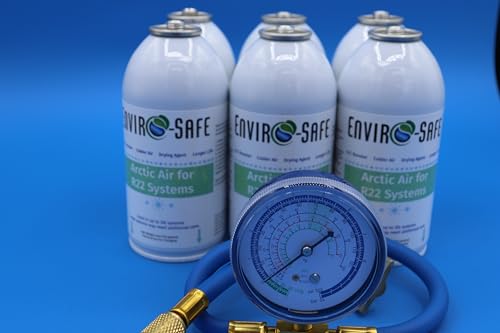
Arctic Air for R22 Systems, 6 Cans & Brass Charging Gauge, Envirosafe, White
Check price on Amazon
Arctic Air for R22 Systems, 6 Cans, Envirosafe, White
Check price on Amazon
ENVIRO-SAFE Arctic Air for R-22 Systems – AC Booster & Moisture Remover – Dual-Action Performance Enhancer for Colder Air & Extended System Life – 2 × 4 oz Cans
Check price on Amazon
Arctic Air for R22 Systems, 3 Cans, Envirosafe, White
Check price on Amazon
ENVIRO-SAFE Arctic Air for R-22 Systems – AC Booster & Moisture Remover – Dual-Action Performance Enhancer for Colder Air & Extended System Life – 3 × 4 oz Cans
Check price on Amazon
ENVIRO-SAFE Arctic Air for R22 Home Systems, Piercing Style Top, A/C Support + Moisture Remover, 2 Cans (Cans Only)
Check price on Amazon
ENVIRO-SAFE Arctic Air for R22 Home Systems, Piercing Style Top, A/C Support + Moisture Remover, 3 Cans (Cans Only)
Check price on Amazon
Refrigerator Freon Recharge Kit, AC Recharge Kit with BPV31 Piercing Valve | R134a/R-12/R-22 Refrigerant Charging Gauge Hose Set for Home Refrigerators, AC Refrigerant System
Check price on AmazonDisclaimer
Some of the content on this site uses AI assistance. Information is provided for educational purposes only. We are not responsible for any losses resulting from the use of this information. By using this site, you waive any right to bring legal claims against us arising from your use of the information provided. If you do not agree, please do not use this site. Read the full disclaimer.