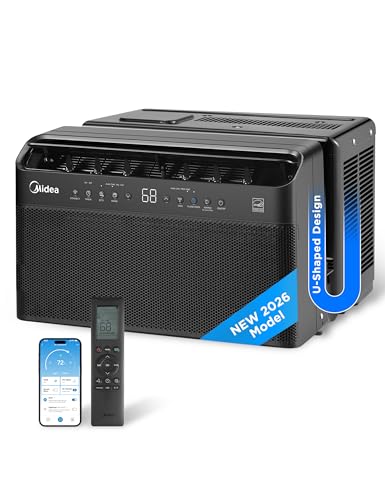
Small Window Air Conditioner Energy Star: The Complete Buyer's Guide
Everything you need to know about compact, Energy Star certified window air conditioners — from sizing and efficiency ratings to installation and long-term performance.
Start Your ResearchWhy this guide matters: If you are researching a small window air conditioner with Energy Star certification, you are likely looking for efficient cooling for a bedroom, home office, or studio. This guide covers sizing calculations, efficiency metrics, key features, installation considerations, and maintenance strategies so you can make an informed decision with confidence.
What Makes a Small Window AC "Energy Star" Certified?
Energy Star certification is a voluntary program that identifies products meeting strict energy efficiency criteria set by the U.S. Environmental Protection Agency. For window air conditioners, certification requires a unit to exceed minimum federal efficiency standards by a meaningful margin. In practical terms, an Energy Star certified small window AC uses less electricity to deliver the same cooling output compared to a non-certified model of similar capacity.
Energy efficiency for room air conditioners is measured primarily by the Combined Energy Efficiency Ratio (CEER), which replaced the older EER metric for this product category. A higher CEER indicates more cooling delivered per unit of electricity consumed. Energy Star units typically carry CEER values above the federal minimum, making them a solid choice for households that run their AC frequently during cooling season.
Understanding Sizing: BTU and Room Dimensions
Choosing the right cooling capacity is the single most important decision when selecting a small window unit. An undersized unit will run continuously without reaching the set temperature, while an oversized unit will cool too quickly and cycle on and off frequently, leading to poor humidity control and unnecessary wear.
As a general reference, small window air conditioners typically range from 5,000 to 8,000 BTU and are designed for rooms up to approximately 350 square feet. The table below provides a practical starting point, though factors like ceiling height, sun exposure, insulation quality, and occupancy will influence the final recommendation.
| Cooling Capacity | Typical Room Size | Best For |
|---|---|---|
| 5,000 – 6,000 BTU | Up to 150 sq ft | Bedrooms, small home offices, dorm rooms |
| 6,000 – 7,500 BTU | 150 – 250 sq ft | Studio apartments, guest rooms, small living areas |
| 8,000 BTU | 250 – 350 sq ft | Larger bedrooms, open-plan studio layouts |
For a more precise estimate, explore our detailed guidance on small air conditioners for small rooms and the room size guide for 5,000 BTU units.
Key Efficiency Metrics Explained
CEER Rating
The Combined Energy Efficiency Ratio is the primary efficiency metric for window ACs. Higher values indicate better efficiency. Energy Star models exceed the federal minimum threshold.
Energy Star Certification
Indicates the unit meets or exceeds EPA efficiency guidelines. Certified models are independently verified and typically qualify for utility rebate programs.
Inverter Technology
Some higher-tier small window units use inverter compressors that modulate speed rather than cycling on and off, improving efficiency and temperature stability.
Standby Power Draw
Modern Energy Star units are designed to draw minimal power when not actively cooling, reducing wasted electricity during idle periods.
Features That Matter in a Small Window AC
Beyond efficiency certification, several features directly affect comfort and usability in a compact form factor. The following are worth prioritizing during your research:
- Programmable or smart thermostat controls: Allow precise temperature scheduling and reduce runtime during unoccupied hours. See our guide to small air conditioners with thermostats.
- Remote control and Wi-Fi connectivity: Convenient for adjusting settings without reaching the unit. Explore small window ACs with remote control.
- Sleep mode and eco mode: Gradually adjusts temperature and fan speed to balance comfort and efficiency overnight.
- Washable filter access: Easy-access filters encourage regular cleaning, which preserves airflow and efficiency.
- Quiet operation: Especially important in bedrooms and home offices. Look for models with low decibel ratings.
- Compact dimensions: Critical for narrow window frames or limited wall space. Review our guide to 12-inch wide small window ACs for tight openings.
Window Fit and Installation Considerations
Small window air conditioners are designed to fit standard double-hung windows, but exact dimensions vary. Before selecting a model, measure the width and height of your window opening and compare it against the unit's minimum and maximum window width specifications. Most compact units fit openings between 23 and 36 inches wide, but narrow-profile models exist for tighter frames.
If your window is unusually narrow, explore options for a 14-inch wide small window AC or a 15-inch wide model. For vertical sliding windows, a specialized vertical window air conditioner may be required.
Installation itself is straightforward for most small units, but proper support is essential. Use the included mounting bracket or support brackets rated for the unit's weight, and ensure a slight downward tilt toward the exterior so condensate drains correctly. If you are not comfortable with the installation, consider hiring a professional — our guide on finding someone to install a window air conditioner can help.
Energy Star vs. Non-Certified: What to Expect
The difference between an Energy Star certified small window AC and a standard model is most noticeable in long-term electricity consumption. Certified units typically use a more efficient compressor, improved heat exchanger design, and better insulation around the chassis. Over a full cooling season, these improvements can translate into meaningful reductions in energy use, particularly in climates where the AC runs for several hours per day.
It is worth noting that efficiency gains are not uniform across all product tiers. Entry-level Energy Star models offer baseline certification, while mid-range and premium models often add inverter compressors, better fan designs, and more advanced controls that further improve real-world efficiency. When comparing options, focus on the CEER rating rather than marketing claims alone.
Maintenance for Long-Term Efficiency
Even the most efficient small window AC will lose performance if neglected. Regular maintenance preserves airflow, reduces strain on the compressor, and keeps energy consumption closer to the rated efficiency. Key tasks include:
- Cleaning or replacing the air filter every two to four weeks during heavy use.
- Checking and clearing the condensate drain path to prevent water backup.
- Inspecting the exterior grille and coils for debris, leaves, or pollen buildup.
- Sealing gaps around the installed unit to prevent cooled air from escaping.
- Having the unit professionally serviced periodically if it runs year after year.
For a broader maintenance routine, refer to our resources on single-room heating and air conditioning units.
Common Questions About Small Energy Star Window ACs
Is a small Energy Star window AC sufficient for a bedroom?
Yes, provided the capacity matches the room size. A 5,000 to 6,000 BTU Energy Star unit is generally appropriate for bedrooms up to roughly 150 square feet, assuming standard ceiling height and average insulation.
Does Energy Star certification guarantee lower electricity bills?
Certification indicates the unit meets efficiency thresholds, but actual consumption depends on usage patterns, room conditions, and maintenance. Certified units are more efficient than non-certified counterparts of similar capacity, all else being equal.
Can a small window AC be used in a room without a traditional window?
Window units require a compatible window opening. For rooms without suitable windows, alternative solutions like portable units or through-the-wall installations may be necessary. Explore options for a single-room AC unit without a window.
How long do small window air conditioners typically last?
With proper maintenance, a quality small window AC can provide several years of reliable service. Longevity depends on build quality, usage intensity, and regular filter cleaning.
Are there Energy Star small window ACs with heating functions?
Some models combine cooling with electric heat. These are useful in transitional seasons. See our guide to small heat and air conditioner window units.
Narrowing Down Your Options
When comparing small window air conditioners with Energy Star certification, organize your evaluation around four criteria: capacity match for your room, CEER rating, physical dimensions relative to your window, and the feature set that matters most for your daily use. Entry-level certified models cover the essentials, while mid-range and premium tiers add inverter compressors, quieter operation, and smarter controls.
If your priority is maximum efficiency in a compact frame, review our roundup of the smallest most efficient window air conditioner options. For spaces where cooling power matters more than compactness, consider a small but powerful window air conditioner.
Ready to Compare Energy Star Window ACs?
Explore our curated selection of small window air conditioners with Energy Star certification and find the right fit for your space.
View Recommended Models