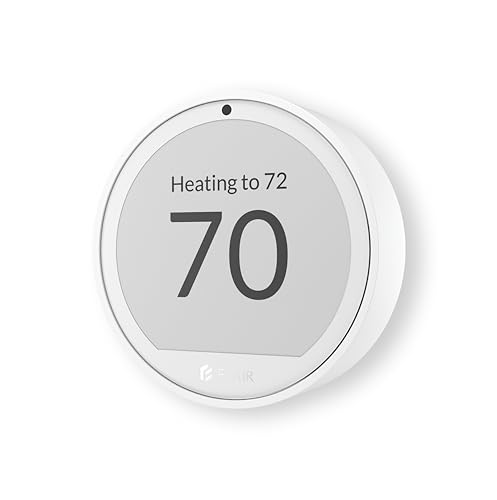
Smart Thermostat for Split Systems: The Complete Guide
Understand which smart thermostats work with ductless mini-splits and ducted split systems, how compatibility is determined, and what to check before you buy.
EXPLORE OPTIONSQuick context: "Split system" is an umbrella term. It can mean a ducted split system with a standard wall thermostat, or a ductless mini-split with a proprietary controller and IR remote. Smart thermostat compatibility depends almost entirely on which type you own. This guide separates the two clearly so you do not buy the wrong controller.
What "Split System" Means for Thermostat Compatibility
A split system has an outdoor condenser paired with an indoor unit. In a ducted split system, the indoor unit is an air handler connected to ductwork, and it is controlled by a conventional low-voltage wall thermostat. In a ductless mini-split, the indoor unit is a wall, ceiling, or floor-mounted head with its own controller and remote, and it usually does not use a standard thermostat at all.
This distinction matters because most mainstream smart thermostats are built for ducted systems. They expect standard wiring terminals such as R, Y, G, W, and C. A ductless head does not expose those terminals in the same way, so a standard smart thermostat will not control it. For a wider comparison of connected cooling approaches, see our guide to smart air conditioner control.
Smart Thermostat Options for Split Systems Compared
The table below separates the four practical approaches so you can match the controller to your system type.
| Approach | System Type | How It Connects | Best For | Tier |
|---|---|---|---|---|
| Mainstream smart thermostat | Ducted split system | Standard low-voltage wiring (R, Y, G, W, C) | Central ducted homes | Mid-range to premium |
| Mini-split-compatible thermostat | Ductless mini-split | Proprietary interface or manufacturer adapter | Ductless heads with native control support | Mid-range to high-end tier |
| IR smart controller | Ductless mini-split | Infrared commands mimicking the remote | Retrofit for units with an IR remote | Entry-level to mid-range |
| Manufacturer Wi-Fi module | Ductless mini-split | Plug-in module or built-in Wi-Fi | Newer mini-splits with native app support | Mid-range to premium |
Smart Thermostats for Ducted Split Systems
Ducted split systems are the simplest case. Because they use standard thermostat wiring, most mainstream smart thermostats are compatible, provided the wiring has the required terminals. These thermostats add scheduling, geofencing, remote access, usage reports, and voice assistant support. Many learn your patterns and adjust pre-cooling or setback automatically.
Installation is the main consideration. Some models require a C-wire for continuous power, while others include adapters or power-stealing designs. If your wiring is uncertain, our guides to the smart thermostat C-wire and smart thermostat without a C-wire explain the options. For system-specific advice, see smart thermostats for air conditioners, smart thermostats for heating and cooling, and the broader smart thermostat guide.
If your ducted system is paired with a heat pump, confirm the thermostat supports multi-stage heat pump control. A single-stage AC is the simplest match, while variable-capacity systems need thermostats that explicitly list compatibility with inverter-driven equipment.
Smart Thermostats for Ductless Mini-Split Systems
Mini-splits are the harder case. The indoor head typically has its own controller and communicates over a proprietary bus, so a generic smart thermostat cannot talk to it. There are three workable paths.
Mini-split-compatible smart thermostats are purpose-built for ductless heads. They connect through a manufacturer-approved interface and provide scheduling, remote access, and sometimes room sensors. These are the cleanest option when available for your model, but compatibility lists are narrow. Our guide to smart thermostats for mini-splits covers the current options in more detail.
IR smart controllers sit in the room and send infrared commands that mimic your existing remote. They work with many mini-splits that have a remote, and they add app and voice control without touching the unit's wiring. The limitation is one-way communication: the controller cannot always confirm the unit's actual state, and line-of-sight placement matters.
Manufacturer Wi-Fi modules are often the best fit for newer mini-splits. They plug into the indoor head or connect over built-in Wi-Fi and expose the unit through the manufacturer's app. Feature depth varies, but integration is usually the most reliable. For a single-room install, a single-zone mini-split paired with a native module is a clean combination. If you are still choosing the hardware, smallest mini-split options are worth reviewing for compact rooms.
Compatibility Checklist Before You Buy
Before choosing any smart thermostat for a split system, confirm these points:
- System type: Ducted split or ductless mini-split? This determines which category of thermostat can work.
- Wiring: Ducted systems need standard terminals plus a C-wire or adapter. Mini-splits usually need a proprietary interface or IR control.
- Compatibility list: Check the manufacturer's model list, not just the general product description.
- Stages and heat pump support: Multi-stage and heat pump systems need thermostats that explicitly support them.
- App longevity: Prefer manufacturers with a track record of app updates and clear documentation.
- Zoning: If you have multiple heads or zones, check whether the thermostat supports zone coordination or works alongside HVAC zoning systems.
For homes with multiple rooms and uneven temperatures, adding smart vents and room sensors can extend control beyond a single thermostat reading. These work best as part of a coordinated system rather than as standalone fixes.
Common Mistakes to Avoid
The most common error is buying a standard smart thermostat for a ductless mini-split. It will not control the head, and the wiring does not match. A close second is assuming every mini-split supports a third-party thermostat; most do not unless a specific interface is documented. On ducted systems, skipping the C-wire check leads to intermittent power issues or a thermostat that will not boot.
Placement matters too. An IR controller blocked by furniture will miss commands, and a thermostat mounted near a heat source will read the wrong temperature. The safer pattern is to match the controller to the system type, verify the compatibility list, and start with one zone before expanding.
Frequently Asked Questions
Can I use a standard smart thermostat with a mini-split?
Usually no. Most standard smart thermostats are designed for central HVAC wiring and do not work directly with ductless mini-splits. You need a mini-split-compatible thermostat, an IR smart controller, or the manufacturer's Wi-Fi module.
Does a smart thermostat for a split system need a C-wire?
Ducted split systems often need a C-wire or adapter for mainstream smart thermostats. Mini-split controllers and IR-based controllers generally do not use a C-wire.
What is the difference between a mini-split thermostat and a central AC thermostat?
A mini-split thermostat is designed for ductless heads and often uses proprietary communication. A central AC thermostat uses standard low-voltage terminals to control an air handler and condenser.
Can I control a ducted split system with a smart thermostat?
Yes, in most cases. Ducted split systems use standard thermostat wiring, so mainstream smart thermostats are compatible as long as wiring requirements are met.
Final Thoughts
Choosing a smart thermostat for a split system comes down to identifying the system type first. Ducted split systems are straightforward: pick a mainstream smart thermostat and verify wiring and C-wire requirements. Ductless mini-splits need a purpose-built controller, an IR smart controller, or the manufacturer's Wi-Fi module. Once that match is right, scheduling, remote access, and voice control become reliable everyday features rather than novelty add-ons. For the broader picture of connected cooling, see smart heating and air conditioning and the wider smart HVAC technology landscape.