Smart Thermostat Mini Split: Complete Compatibility and Buyer's Guide
Everything you need to know about pairing a smart thermostat with a ductless mini split system — compatibility, wiring, and the features that matter most.
Start Your ResearchWhy this guide matters: If you are researching a smart thermostat for a mini split system, you have likely discovered that ductless systems work differently from traditional central HVAC. This guide explains the compatibility landscape, wiring considerations, and feature priorities so you can select a solution that integrates cleanly with your mini split and delivers the control and efficiency you expect.
Why Mini Split Systems Need Special Thermostat Consideration
Mini split systems, also called ductless systems, use an outdoor compressor unit connected to one or more indoor air handlers. Unlike central HVAC systems that rely on a single wall-mounted thermostat to control the entire home, mini splits typically use proprietary handheld remotes or wall-mounted controllers supplied by the manufacturer. These controllers communicate over the manufacturer's own protocol rather than the standard 24-volt wiring used by central systems.
This difference is the central challenge for anyone wanting to add a smart thermostat. Most mainstream smart thermostats — such as those designed for central AC and furnaces — rely on low-voltage wiring and standard HVAC signals. They are not directly compatible with the proprietary control interfaces used by many mini split brands. Understanding this distinction before you buy is essential.
Your Options for Smart Control of a Mini Split
Manufacturer Smart Modules
Many mini split brands offer optional Wi-Fi modules or smart adapters that plug into the indoor unit and enable app-based control. This is often the most reliable route.
Third-Party IR Controllers
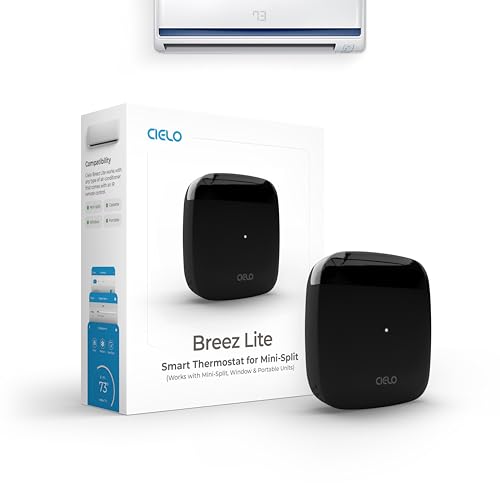
Devices that emit infrared signals mimicking the manufacturer's remote. These can add app and voice control but may lack full feature parity.
Universal Mini Split Thermostats
Purpose-built thermostats designed to interface with specific mini split brands. Compatibility varies widely and requires careful model verification.
Smart Home Hubs
Some hubs and integrations can bridge mini split control into broader smart home platforms. Support depends on the specific mini split model.
Compatibility: What to Check Before Buying
Before committing to any smart control solution for a mini split, verify the following:
- Mini split brand and model: Confirm the manufacturer offers a compatible smart module or that third-party solutions explicitly support your model.
- Control interface type: Determine whether your indoor unit uses an IR remote, a wired controller, or a proprietary protocol.
- Wiring requirements: Some solutions require low-voltage wiring or a dedicated port on the indoor unit. Verify the connection method.
- Feature support: Not all smart solutions expose every mini split function. Verify that fan speed, mode switching, and scheduling are supported.
- Multi-zone setups: If you have multiple indoor heads, check whether the smart solution supports each zone independently.
If your system is a single-zone ductless setup, our guide to the single-zone mini split may provide additional context. If you are still comparing system types, our overview of the smallest mini split options is a useful companion read.
Comparing Smart Control Tiers for Mini Splits
Smart control solutions for mini splits vary widely in capability. The table below summarizes the broad tiers you will encounter.
| Tier | Typical Capabilities | Best For |
|---|---|---|
| Entry-level | Basic app control, on/off, temperature adjustment, simple scheduling | Users wanting remote control without advanced automation |
| Mid-range | Voice assistant integration, geofencing, usage reporting, multi-zone support | Households that want automation and voice control |
| Premium / high-end tier | Full smart home integration, advanced scheduling, occupancy awareness, detailed analytics | Smart home enthusiasts with complex or multi-zone setups |
Manufacturer-supplied smart modules often sit at the entry-level or mid-range tier, while purpose-built third-party solutions and hub-based integrations can reach the premium tier depending on your ecosystem.
Wiring and Installation Considerations
Installation complexity varies significantly by solution type. Manufacturer smart modules typically plug into a designated port on the indoor unit and require minimal technical skill. Third-party IR controllers usually need only power and line-of-sight placement. Universal mini split thermostats may require low-voltage wiring and a more involved installation.
If the solution requires wiring that is not part of your existing mini split installation, a professional HVAC technician is the safest choice. The C-wire requirement common to traditional smart thermostats typically does not apply directly to mini splits, but some universal solutions may use a similar continuous-power connection. If you are adapting a traditional smart thermostat to a system that lacks a C-wire, our C-wire-free thermostat guide explains the alternatives.
For broader thermostat education, our smart thermostat guide and simple AC thermostat overview provide useful background.
Features That Matter Most for Mini Split Control
- Mode switching: Verify support for cooling, heating, fan-only, dry, and auto modes as your mini split allows.
- Fan speed control: The ability to adjust fan speed from the app is important for comfort and efficiency.
- Vane and louver control: Some solutions can adjust airflow direction, which matters for ductless systems.
- Scheduling and geofencing: Automation is a primary reason to add smart control. Confirm the app supports flexible schedules.
- Voice assistant integration: Support for Alexa, Google Assistant, or Siri adds convenience.
- Multi-zone management: If you have more than one indoor head, verify independent control for each zone.
- Usage reporting: Runtime and consumption data helps refine schedules and identify inefficiencies.
Integrating Mini Split Control into a Smart Home
Smart control for mini splits fits naturally into broader smart home ecosystems when the right module or bridge is chosen. Many manufacturer apps support voice assistants directly, and some third-party solutions integrate with platforms like SmartThings or Home Assistant. If you already run a smart home, prioritize solutions that integrate natively with your existing platform rather than adding a separate app.
Related resources include our overview of smart air conditioners, the guide to smart AC control, and the broader smart HVAC technology explainer.
Maintenance and Long-Term Reliability
Smart control modules and thermostats require minimal maintenance, but a few habits help ensure reliability:
- Keep the manufacturer app and module firmware updated.
- Verify Wi-Fi signal strength at the indoor unit location; weak signal can cause unreliable control.
- Revisit schedules seasonally to match current routines.
- If using an IR controller, confirm the emitter remains aligned with the indoor unit's receiver.
- Keep a record of your mini split model and the smart module model for future reference and support.
If your system includes both heating and cooling, our guide to smart heating and air conditioning covers broader considerations for year-round control.
Common Questions About Smart Thermostats for Mini Splits
Can I use a standard smart thermostat with a mini split?
Usually not directly. Most standard smart thermostats rely on 24-volt wiring and standard HVAC signals, while mini splits use proprietary control protocols. Purpose-built solutions, manufacturer smart modules, or IR-based controllers are the typical paths.
Does my mini split manufacturer offer a smart module?
Many major brands do, often as an optional accessory. Check your indoor unit's model documentation or the manufacturer's accessory catalog. These modules are typically the most reliable way to add app and voice control.
Will a smart thermostat work with a multi-zone mini split?
Support depends on the solution. Some manufacturer modules and third-party integrations support multi-zone control, allowing independent scheduling and adjustment for each indoor head. Verify zone support before purchasing.
Do I need a C-wire for a mini split smart thermostat?
The C-wire concept applies mainly to traditional central HVAC smart thermostats. Mini split solutions use different interfaces, though some universal controllers may still require a continuous power connection. See our C-wire guide for background.
Can I control my mini split with voice commands?
Yes, if the smart module or controller supports Alexa, Google Assistant, or Siri. This is one of the most common reasons to add smart control to a mini split.
Narrowing Down Your Options
When comparing smart thermostat options for a mini split, organize your evaluation around four criteria: compatibility with your specific mini split model, the level of control the solution offers, integration with your smart home ecosystem, and installation complexity. Manufacturer modules prioritize reliability; third-party solutions often offer more advanced automation but require careful compatibility verification.
For additional context on adjacent topics, explore our resources on smart thermostats for split systems, smart thermostat overview, and smart thermostat HVAC guide.
Ready to Compare Smart Controls for Your Mini Split?
Explore our curated selection of smart thermostats and control modules compatible with ductless mini split systems.
View Recommended Models