Smart Air Conditioner Control: The Complete Guide
Understand how smart AC control works, compare Wi-Fi ACs, smart thermostats, IR controllers, and smart vents, and build a cooling system you can run from anywhere.
EXPLORE OPTIONSWhy this guide matters: Smart air conditioner control is not a single product but a set of approaches. Some homeowners buy an AC with built-in Wi-Fi, others retrofit an existing unit with a controller, and others combine a smart thermostat with vents and sensors. Understanding the trade-offs helps you choose a setup that fits your system, your home layout, and how you actually use cooling.
What Smart Air Conditioner Control Actually Means
Smart air conditioner control refers to any method that lets you operate, schedule, or automate a cooling system beyond the basic remote or wall dial. In practice, it covers four broad categories: air conditioners with built-in Wi-Fi, retrofit smart AC controllers that communicate with an existing remote-controlled unit, smart thermostats that manage central or ducted systems, and supporting devices such as smart vents and temperature sensors.
The benefits are practical. Scheduling cooling around occupancy reduces wasted runtime, remote access lets you cool a room before you arrive, and voice or app control simplifies daily adjustments. For a broader look at connected cooling hardware, see our guide to smart air conditioners and the wider landscape of smart HVAC technology.
The Main Smart AC Control Options Compared
Each approach solves a different problem. The table below summarizes how they differ in installation effort, compatibility, and best use case.
| Approach | How It Works | Best For | Tier |
|---|---|---|---|
| Wi-Fi AC with built-in app | The air conditioner ships with native Wi-Fi and app support | New purchases where you want the simplest setup | Mid-range to premium |
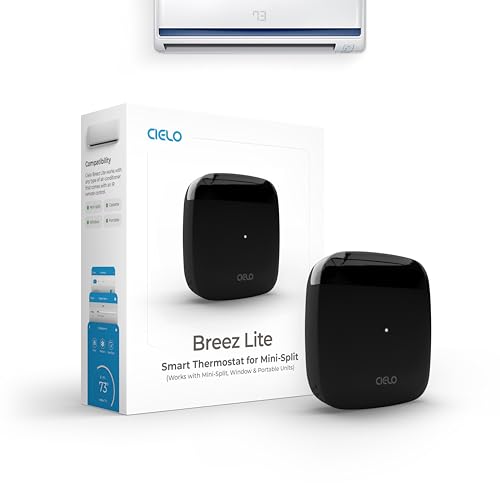
| IR smart AC controller | A hub emits infrared commands that mimic your existing remote | Retrofitting window, portable, and mini-split units | Entry-level to mid-range |
| Smart thermostat | Replaces or augments the wall thermostat for central systems | Central AC and heat pump systems | Mid-range to premium |
| Smart plug with app control | Cuts or restores power to a unit with mechanical controls | Basic on/off automation for simple units | Entry-level |
| Smart vents and sensors | Directs airflow and reports room conditions to the control system | Multi-room comfort tuning | Mid-range to high-end tier |
Wi-Fi Air Conditioners With Native Smart Control
A Wi-Fi air conditioner is the most straightforward path to smart control because the connectivity is designed into the unit. You pair the AC with the manufacturer app, connect it to your home network, and control cooling, fan speed, and modes from a phone. Many models also support voice assistants and scheduling.
Native Wi-Fi tends to offer the deepest feature integration: firmware updates, energy reports, and tighter coordination between the app and the unit's operating logic. The trade-off is that you are committing to the manufacturer's app ecosystem. If app support lags or the company changes its platform, some features can degrade. For buyers starting fresh, a Wi-Fi model is often the cleanest route, especially for rooms where a single unit handles the whole space.
Small rooms are a common target for this approach. If you are cooling a bedroom or home office, our guides to small air conditioners for small rooms and small air conditioners for bedrooms cover sizing and placement alongside connectivity considerations.
Retrofit Smart AC Controllers: Making an Existing Unit Smart
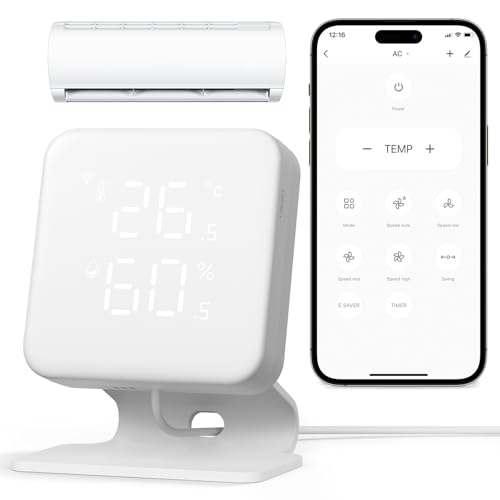
If your current air conditioner uses an infrared remote, a retrofit smart AC controller can add app and voice control without replacing the unit. These controllers sit in the room, learn or match your remote's IR codes, and send the same commands your remote would. Most support schedules, timers, and integration with voice assistants.
The appeal is obvious for renters and for anyone who already owns a reliable window or portable unit. IR control has limits, though: it is one-way communication, so the controller cannot always confirm the unit's actual state, and line-of-sight placement matters. Units with mechanical dials rather than remotes are not compatible with IR controllers at all.
For remote-controlled window units, pairing a controller with a model that already has a remote control gives you the best retrofit experience. The same logic applies to compact units in tight spaces, where a small air conditioner with a thermostat can make scheduling more predictable.
Smart Thermostats for Central and Ducted Systems
Smart thermostats are the right tool when you have central air conditioning, a heat pump, or a ducted system with a conventional wall thermostat. They replace the thermostat, connect to Wi-Fi, and add scheduling, geofencing, remote access, and usage reporting. Many learn your patterns and adjust pre-cooling or setback automatically.
Installation is the main consideration. Some models need a C-wire for continuous power, while others include adapters or power-stealing designs. If your wiring is uncertain, our guides to the smart thermostat C-wire and smart thermostat without a C-wire explain the options. For system-specific advice, see smart thermostats for air conditioners, smart thermostats for heating and cooling, and the broader smart thermostat guide.
Ductless systems need a different approach. Standard thermostats are not designed for mini-splits, so look at smart thermostats for mini-splits and smart thermostats for split systems. A single-zone mini-split can also be paired with an IR controller if the unit has a remote.
Smart Vents, Sensors, and Room-Level Control
Smart vents and wireless temperature sensors extend control beyond a single thermostat reading. Sensors report conditions in individual rooms, and smart vents can open or close to redirect airflow. In homes with uneven temperatures, this room-level data is often more valuable than a fancier thermostat alone.
These devices work best as part of a coordinated system. A smart home AC thermostat can use sensor data to prioritize rooms, while smart vents handle delivery. Keep expectations realistic: vents cannot fix duct design problems, and closing too many vents can raise static pressure. They are a tuning tool, not a substitute for proper sizing.
Voice Assistants and Automation Scenes
Most smart AC control platforms integrate with major voice assistants, which turns cooling into part of a broader home routine. Common automations include cooling a room when a sensor crosses a temperature threshold, turning the AC off when everyone leaves, or pre-cooling before a scheduled arrival.
The most reliable automations combine a trigger you can trust with a simple action. Geofencing works well for whole-home systems, while room sensors suit single-room units. For a wider view of connected heating and cooling, see smart heating and air conditioning and smart air conditioner control.
Compatibility Checklist Before You Buy
Before choosing any smart control device, confirm these points:
- Control type: Does your AC use an IR remote, a wall thermostat, or mechanical dials? This determines which category of controller can work.
- Protocol: Wi-Fi is simplest for most homes. Check whether the device needs a hub or supports only specific ecosystems.
- Power: Smart thermostats may need a C-wire. IR controllers and smart plugs usually plug into a standard outlet.
- App longevity: Prefer manufacturers with a track record of app updates and clear compatibility lists.
- System type: Central systems, heat pumps, mini-splits, window units, and portable units each have different best-fit controllers.
For central systems, also review the electrical side: a soft start air conditioner accessory can reduce startup current and make smart scheduling gentler on the system.
Common Mistakes to Avoid
Smart control adds convenience, but a few missteps undermine the results. Placing an IR controller where furniture blocks the line of sight to the unit causes missed commands. Relying on a smart plug for a unit with digital controls can cut power mid-cycle and reset settings. Closing too many smart vents can strain the blower. And choosing a thermostat without checking wiring compatibility often leads to a return or an electrician visit.
The safer pattern is to match the controller to the unit's native control method, verify power requirements, and start with one room before expanding. If you are also considering a simple non-connected upgrade, a simple AC thermostat can improve basic temperature regulation without any app dependency.
Frequently Asked Questions
Can I make my existing air conditioner smart?
Yes, in most cases. If your unit has an IR remote, a retrofit smart AC controller can add app and voice control. If you have a central system with a wall thermostat, a smart thermostat is the better route. Units with only mechanical dials are limited to basic smart plug control.
Do smart AC controllers work with mini-split systems?
Many do, especially when the mini-split has an IR remote. Dedicated smart thermostats also exist for mini-splits with native control interfaces. Always check the controller's compatibility list for your specific model.
What is the difference between a smart thermostat and a smart AC controller?
A smart thermostat manages central HVAC systems through wall wiring. A smart AC controller adds app control to units that use an IR remote, such as window, portable, and many ductless units.
Does smart AC control require a C-wire?
Only some smart thermostats require a C-wire. IR controllers and smart plugs generally do not. If your thermostat wiring lacks a C-wire, adapters and power-stealing designs are available.
Final Thoughts
Smart air conditioner control is best understood as a layered decision: start with the control method your unit already uses, choose the matching controller category, and then add sensors or vents only if you have a specific comfort problem to solve. A Wi-Fi AC is simplest for new purchases, a retrofit IR controller is the practical choice for existing remote-controlled units, and a smart thermostat is the right foundation for central systems. With those pieces in place, scheduling, remote access, and voice control become reliable everyday features rather than novelty add-ons.