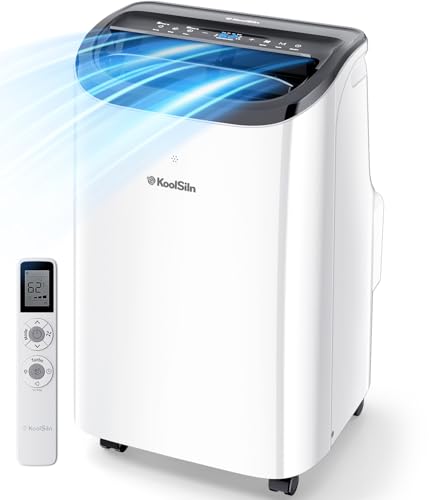
10000 BTU Portable Air Conditioner: Complete Buyer's Guide
Everything you need to know about 10,000 BTU portable AC units — room coverage, hose configurations, energy use, installation, and the features that actually matter before you buy.
START READINGWhat Is a 10000 BTU Portable Air Conditioner?
A 10000 BTU portable air conditioner is a freestanding, wheel-mounted cooling unit that sits inside the room and exhausts hot air through a flexible hose routed to a window or wall vent. Unlike a window unit, it does not need permanent installation, and unlike a mini-split, it does not require professional refrigerant work. You roll it in, connect the hose, plug it in, and it cools.
The 10,000 BTU figure describes nominal cooling capacity. In practical terms, it sits in the middle of the portable AC range: stronger than compact 5,000–8,000 BTU models meant for bedrooms, and lighter and easier to handle than 12,000–14,000 BTU units designed for open-plan living areas. This balance is why 10000 BTU portable ACs are among the most commonly recommended sizes for apartments, home offices, and medium bedrooms.
It is worth understanding that portable AC capacity is not directly comparable to central air or mini-split capacity. Because the entire unit — compressor, condenser, and evaporator — is inside the conditioned space, some heat is inevitably re-released into the room. That is why a 10,000 BTU portable unit performs more like a slightly smaller window unit in real-world conditions. If you are comparing formats, the related guide on 10000 BTU air conditioner room size breaks down capacity expectations across unit types.
Room Size and Cooling Coverage
The baseline recommendation for a 10000 BTU portable air conditioner is a room of 250 to 400 square feet. That covers a primary bedroom, a spacious home office, a small studio apartment, or a combined living-dining area in a compact home.
Square footage alone, however, is an incomplete measure. Several variables shift the effective coverage up or down:
- Ceiling height: Rooms with vaulted or high ceilings have more air volume to cool and may need a larger unit.
- Sun exposure: West- and south-facing rooms with large, unshaded windows gain significant solar heat and often need to be treated as one size larger.
- Insulation quality: Older homes with single-pane windows and poor wall insulation lose cooling faster than modern, well-sealed construction.
- Occupancy and appliances: Each person adds heat load, and kitchens, home gyms, and rooms with multiple computers or servers run hotter.
- Open floor plans: A 10,000 BTU unit cannot effectively cool an open-plan space that shares air with a large adjoining area — it will be overwhelmed.
A useful rule of thumb is to treat the 250–400 square foot range as a starting point and adjust one tier up if two or more of the factors above apply. For a more detailed breakdown of sizing logic, see the guide on 10,000 BTU air conditioner room size and the dedicated page on 10000 BTU cooling area.
| Room Type | Typical Size | Suitability of 10000 BTU Portable |
|---|---|---|
| Small bedroom | Under 150 sq ft | Oversized but effective; cools quickly and cycles less |
| Standard bedroom | 150–250 sq ft | Strong fit with reserve capacity for hot days |
| Master bedroom / home office | 250–400 sq ft | Ideal range; the primary design target |
| Studio apartment | 300–450 sq ft | Good fit if the layout is open and the space is well insulated |
| Large living room / open plan | Over 450 sq ft | Underpowered; consider 12,000–14,000 BTU |
Single-Hose vs Dual-Hose Design
This is the single most consequential design difference in the portable AC category, and it directly affects how well a 10000 BTU unit performs.
Single-Hose Portable AC
A single-hose unit uses one duct to exhaust hot air from the condenser. Because it pushes air out of the room, it creates negative pressure — outside air is pulled in through gaps around doors and windows to replace it. In hot weather, that infiltrating air is warm and humid, which works against the cooling effort. Single-hose units are simpler, lighter, and generally sit at the entry-level and lower mid-range positions in the market.
Dual-Hose Portable AC
A dual-hose unit uses two ducts: one draws outside air in to cool the condenser, and the other exhausts heated air back out. This balanced airflow means the unit does not depressurize the room, so warm outside air is not continuously drawn in through cracks. The result is more stable cooling and better efficiency in practice. Dual-hose 10000 BTU portable air conditioners are typically mid-range to high-end tier products and are the preferred configuration for anyone cooling a room for extended periods. For a closer look at this configuration, see the guide on 10000 BTU dual hose portable air conditioner.
Features That Matter on a 10000 BTU Portable AC
Marketing pages list dozens of features. In daily use, a handful genuinely change the experience:
Dehumidification Mode
Portable ACs remove moisture as a byproduct of cooling. A dedicated dehumidify mode runs the unit without full cooling, which is useful in humid shoulder seasons. If humidity is your main complaint rather than heat, a model with a strong dehumidifier function is worth prioritizing — see 10,000 BTU portable air conditioner with dehumidifier.
Remote Control and Programmability
A remote is close to essential on a portable unit, because the control panel is often low and hard to reach. Look for a remote with a display and, ideally, a 24-hour timer. Some models add app or Wi-Fi control, which lets you start cooling before you arrive home — covered in more detail under 10000 BTU portable air conditioner with remote.
Fan Speeds and Sleep Mode
Two or three fan speeds let you balance cooling against noise. A sleep mode gradually raises the set temperature and lowers fan speed overnight, which is noticeably quieter and more comfortable than running full blast in a bedroom.
Auto-Evaporation and Drain Options
Better units evaporate most condensate and only need manual draining in high humidity or dehumidify mode. A continuous drain outlet — where you attach a hose — is a major convenience if the unit will run unattended for long periods.
Window Kit Quality
The included window kit is an afterthought on many listings but matters in practice. A kit with adjustable panels and proper sealing reduces the amount of hot air leaking back in around the exhaust hose. A poor seal can erase much of the benefit of choosing a 10,000 BTU unit over an 8,000 BTU one.
Wheels and Handle
Portable ACs in this class typically weigh between 60 and 80 pounds. Sturdy casters and a molded handle make the difference between moving the unit easily between rooms and struggling with it.
Installation and Window Setup
Installation of a 10000 BTU portable air conditioner is a homeowner-level task with no refrigerant handling and no permanent modification to the building. The general process:
- Choose a window that can be partially opened and is reasonably close to where the unit will sit — most exhaust hoses are 5 to 7 feet long.
- Assemble the window kit panels and fit them into the window opening, closing the sash against the kit.
- Connect the exhaust hose to the unit and to the window kit outlet.
- Seal any gaps with the included foam or weatherstripping.
- Position the unit on a level surface with at least 12 to 18 inches of clearance around the air intake.
- Plug in, set the mode and temperature, and confirm hot air is discharging outside.
Two practical constraints come up frequently. First, casement and sliding windows may not accept the standard kit without an adapter — check compatibility before ordering. Second, long or sharply bent exhaust hoses reduce efficiency and can cause the unit to overheat; keep the hose as short and straight as the layout allows. For a broader comparison of installation effort across formats, see the HVAC installation overview.
Placement Tips
- Do not block the intake grille with furniture, curtains, or bedding.
- Keep the unit out of direct sunlight if possible; a unit in a sunlit corner works harder.
- Avoid extension cords where feasible — if one is necessary, use a heavy-gauge cord rated for the unit's current draw.
- For rooms that need cooling in more than one zone, consider a space-saving air conditioner arrangement or a second smaller unit rather than trying to force air through doorways.
Energy Use and Electrical Requirements
Most 10000 BTU portable air conditioners run on 115V household power and draw roughly 8 to 10 amps during cooling, which keeps them within the capacity of a standard 15-amp circuit — provided the circuit is not already loaded with other high-draw appliances.
Efficiency is usually expressed through the unit's EER or CEER rating. Higher numbers mean more cooling per unit of electricity. Within the 10,000 BTU class, dual-hose designs and inverter-driven compressors generally deliver better real-world efficiency than single-hose, fixed-speed units, because they waste less energy fighting negative pressure and can modulate compressor output instead of cycling on and off. If efficiency is a priority, the pages on 10000 BTU air conditioner ENERGY STAR and 10000 BTU ENERGY STAR air conditioner explain what certification actually verifies.
For context on how voltage affects options across the category, the comparison of 110V vs 240V air conditioner is a useful reference. Inverter technology, which is common in higher-tier portable units, is explained in the broader discussion of inverter AC vs non-inverter systems.
Maintenance and Drainage
A portable AC needs less maintenance than a central system, but skipping the basics shortens its life and degrades cooling.
Filter Cleaning
Most units have a washable mesh filter behind the front intake grille. Rinse or vacuum it every two to four weeks during heavy use. A clogged filter restricts airflow, forces the compressor to work harder, and can cause the evaporator coil to ice over.
Drainage
In cooling mode, many units evaporate condensate using the heat of the condenser. In humid weather or in dehumidify mode, water accumulates faster than it can evaporate. When the internal tank fills, most units shut off automatically until drained. Options:
- Manual drain: Remove a plug at the bottom and let water flow into a pan or bucket.
- Continuous drain: Attach a garden hose to the drain outlet and route it to a floor drain, condensate pump, or outside.
Seasonal Care
Before storing the unit for the off-season, drain the tank completely, clean and dry the filter, wipe down the exterior, and cover the unit to keep dust out of the coils. A periodic professional cleaning — described in the guide to HVAC cleaning and service — is worthwhile if the unit runs continuously through the summer.
Common Issues
If the unit runs but airflow is weak, the filter or intake is usually the cause. If it runs but does not cool, check that the exhaust hose is connected and discharging outside and that the room is not above the unit's rated capacity. For symptoms shared with other AC formats, the troubleshooting note on my air conditioner is running but not blowing air is a useful cross-reference.
Portable vs Window vs Mini-Split
A 10000 BTU portable AC competes directly with window units and ductless mini-splits of similar capacity. Each format has a distinct trade-off profile.
| Consideration | Portable AC | Window AC | Mini-Split |
|---|---|---|---|
| Installation | No tools, no permanent change | Requires window bracket and lifting | Professional installation |
| Portability | Moves between rooms | Fixed once installed | Fixed; indoor head is permanent |
| Efficiency | Lower; dual-hose improves it | Higher than portable | Highest of the three |
| Noise | Noticeable, especially entry-level | Moderate | Quiet indoors |
| Renter-friendly | Yes | Usually yes, with landlord approval | Rarely |
| Best for | Flexible cooling, no permanent install | Single room, long-term use | Whole-home or multi-zone comfort |
If the room will be cooled every summer for years and a window is available, a window unit in the same capacity class generally outperforms a portable unit on efficiency. If the window is unsuitable, the unit must move between rooms, or the space is rented, a portable 10000 BTU unit is the practical choice. For a comparable fixed solution, see the guide on 10000 BTU window air conditioner; for a ductless long-term option, see single zone ductless mini split air conditioning system.
One more option worth knowing: if the room lacks a suitable window entirely, through-the-wall formats exist, and the trade-offs are covered under 10000 BTU air conditioner through the wall.
Market Tiers and How to Choose
Within the 10000 BTU portable category, products group into recognizable tiers. Using tier descriptors rather than any specific figures makes it easier to compare models on the things that actually differ.
Entry-Level Tier
Single-hose design, mechanical or basic digital controls, two fan speeds, and a simple window kit. These units cool effectively in a closed, well-sealed bedroom and are a reasonable choice for occasional use or a secondary room. Expect more noise and less refined sealing around the window kit.
Mid-Range Tier
This is where most dual-hose models sit. Typical additions: a remote control, three fan speeds, sleep mode, a 24-hour timer, auto-evaporation with a continuous drain option, and a better-fitting window kit. For a room used daily through the summer, this is the balanced choice — the configuration improvements over entry-level are meaningful and directly affect cooling performance.
High-End / Top-Tier
Higher-end models add inverter compressors for smoother modulation and quieter operation, app or Wi-Fi connectivity, more precise temperature control, and occasionally heating functions for year-round use. If the unit will serve as the primary cooling source for a main living space, the top-tier refinements are a worthwhile long-term investment. Models that combine cooling and heating are covered under 10000 BTU portable air conditioner and heater.
If you are still comparing formats, the relative simplicity of portable units versus fixed systems is also discussed in the context of HVAC installation requirements, and the lifecycle question of when a unit is worth servicing versus replacing is covered in the HVAC cleaning and service guide.
Frequently Asked Questions
What size room does a 10000 BTU portable air conditioner cool?
Typically 250 to 400 square feet. Rooms with high ceilings, heavy sun exposure, poor insulation, or high occupancy should be treated as one size larger. Rooms well under 250 square feet are cooled comfortably, with the unit cycling more often.
Is a dual-hose 10000 BTU portable air conditioner better than a single-hose model?
In most cases, yes. A dual-hose design draws outside air for the condenser and exhausts hot air separately, so it does not create negative pressure in the room. That means less warm outside air is pulled in through gaps, and cooling is more consistent. Single-hose models are simpler and usually sit at the entry tier.
Can a 10000 BTU portable air conditioner run on a standard household outlet?
Most 10000 BTU portable units operate on 115V and draw roughly 8 to 10 amps, which fits a standard 15-amp circuit as long as it is not shared with other high-draw appliances. Always confirm the manufacturer's electrical specification before use.
Does a 10000 BTU portable air conditioner need to be drained?
In cooling mode, most units evaporate a large portion of the condensate. In humid conditions or in dehumidifier mode, the internal tank can fill and the unit will shut off until drained. Many models offer a continuous drain outlet for a hose, which is the most convenient long-term setup.
How noisy is a 10000 BTU portable air conditioner?
Noise levels typically fall around 50 to 56 decibels at the highest fan setting. Mid-range and top-tier models commonly include sleep modes and slower fan speeds that bring the level down noticeably, while entry-level units tend to run louder.
Can I use a 10000 BTU portable AC in a room without a window?
The exhaust hose must vent somewhere. Without a suitable window, you would need a wall vent, a sliding-door kit, or a through-the-wall installation. If no venting path exists, a portable unit is not the right format for that room.
Final Verdict
A 10000 BTU portable air conditioner is the most versatile solution for medium rooms where permanent installation is not possible or not desired. It is the right size for a primary bedroom, home office, or compact apartment, and it can be moved between spaces as needs change.
The single decision that most affects satisfaction is hose configuration: a dual-hose unit performs more consistently in real rooms than a single-hose unit of the same nominal capacity. After that, look for a remote, multiple fan speeds, a sleep mode, and a continuous drain option. Choose the tier based on how many hours per summer the unit will run, not on the size of the room.
If you have read this far, you have the information needed to compare models on substance rather than marketing language. Review the recommended models below, check the specifications against your room's actual conditions, and select with confidence.
Recommended 10000 BTU Portable Air Conditioners
⚠️ AFFILIATE DISCLOSURE: This website contains affiliate links. As an Amazon Associate, we earn from qualifying purchases. If you make a purchase through these links, we may receive a small commission at no additional cost to you. Read our full affiliate policy.

10000 BTU Portable Air Conditioners, Air Conditioner for Room Cools Up to 450 Sq.Ft with 24H Timer, Remote Control, Dehumidifier, 3-IN-1 AC Unit with Window Kit for Bedroom, Indoor Rooms, Home Office
Check price on Amazon
SereneLife Portable Air Conditioner 10000 BTU With WIFI | 3-in-1 Cooling, Fan and Dehumidifier | 24-H Timer up to 450 sq ft Coverage | AC Unit for Bedroom, Home & Office | Window Kit & Remote
Check price on Amazon
BLACK+DECKER Portable Air Conditioner, 10,000 BTU, BPACT10WT, White | 5,500 BTU SACC for Rooms up to 450 Sq. Ft., 3-in-1 Portable AC, Fan and Dehum with Follow Me Remote Control
Check price on Amazon
Tehanld Portable Air Conditioner 10000 BTU for Rooms up to 450 Sq. Ft. | 4-in-1: Cool, Fan, Dehumidify, Sleep Mode & 24H Timer, Under 45dB Quiet Operation, 61°F–90°F Temperature Range
Check price on Amazon
10,000BTU Energy Saving Portable Air Conditioners for Rooms up to 550 Sq Ft | Self-Evaporating Portable AC Unit with Remote Control&24H Timer, Cool/Dry/Fan/Sleep, LED Display&Installation Kits for Home
Check price on Amazon
Midea 10,000 BTU ASHRAE Portable Air Conditioner, Cools up to 300 Sq. Ft. | 7,100 BTU SACC Portable AC, Smart APP & Remote Control, with Dehumidifier & Fan mode, Window Kit, Easy-to-use and Install
Check price on Amazon
Temprium 10,000 BTU Portable Air Conditioner with Wifi Enabled | Cools up to 450 Sq.ft, 3-in-1 Quiet Portable AC with APP/Voice/Remote Control, 24H Timer, Lower Noise, Self-Evaporating
Check price on Amazon