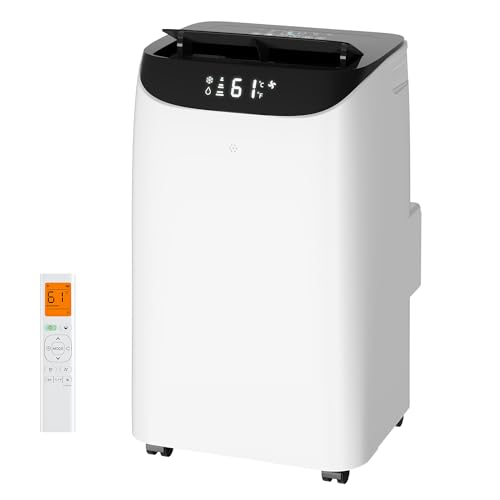
12,000 BTU Air Conditioner Room Size: What You Need to Know
Find out exactly how much square footage a 12,000 BTU air conditioner can cool, how to match capacity to your room, and which unit type fits your space best.
JUMP TO SIZING GUIDEQuick answer: A 12,000 BTU air conditioner is typically sized for rooms between 450 and 550 square feet. That covers a large bedroom, a standard living room, an open-plan kitchen, or a small studio apartment. Real-world coverage shifts based on ceiling height, insulation, window area, and local climate.
What Room Size Does a 12,000 BTU Air Conditioner Cool?
A 12,000 BTU air conditioner sits in the mid-capacity range of the residential cooling market. It is the step above compact 8,000 to 10,000 BTU units and the step below whole-room 15,000 BTU and larger systems. Because of that middle position, it serves a wide range of living spaces but is not a one-size-fits-all answer.
The standard rule of thumb used by HVAC technicians is roughly 20 BTU per square foot for a room with an 8-foot ceiling, average insulation, and a moderate climate. Dividing 12,000 by 20 gives 600 square feet as a theoretical maximum. In practice, most manufacturers and installers recommend a safety margin, which brings the realistic coverage down to 450 to 550 square feet.
That range makes a 12,000 BTU unit a strong candidate for the following spaces:
- Large master bedrooms measuring around 15 x 30 feet
- Standard living rooms in single-family homes
- Open-plan kitchens that connect to a dining area
- Studio apartments with a single main living zone
- Home offices with multiple workstations and equipment
- Finished basements in mild to moderate climates
12,000 BTU Room Size Chart by Unit Type
Different air conditioner types deliver cooling differently, so the same 12,000 BTU rating does not always translate to identical room coverage. Window and portable units lose some efficiency through installation gaps, while mini splits and through-the-wall units tend to hold their rated capacity more consistently.
| Unit Type | Typical Coverage | Best For |
|---|---|---|
| 12,000 BTU Window AC | 400 – 500 sq ft | Bedrooms and living rooms with a suitable window |
| 12,000 BTU Portable AC | 350 – 450 sq ft | Rentals, rooms without window support, temporary setups |
| 12,000 BTU Mini Split | 450 – 550 sq ft | Permanent installations, quiet operation, zoned cooling |
| 12,000 BTU Through-the-Wall | 400 – 500 sq ft | Wall-sleeve replacements and rooms without windows |
If you are specifically comparing window options, the 12,000 BTU 115V window air conditioner guide covers electrical requirements and installation details. For portable setups, the 12,000 BTU portable air conditioner room size breakdown explains how single-hose and dual-hose designs affect coverage.
How to Calculate the Right BTU for Your Room
Square footage is the starting point, not the final answer. To dial in whether 12,000 BTU is correct for your specific room, run through these adjustment factors.
Step 1: Measure the Room
Multiply the length by the width to get square feet. For L-shaped or irregular rooms, split the space into rectangles, calculate each one, and add the results together.
Step 2: Adjust for Ceiling Height
The 20 BTU per square foot rule assumes an 8-foot ceiling. For every foot above 8 feet, add roughly 10 percent to the BTU requirement. A 10-foot ceiling in a 500 square foot room pushes the need closer to 13,000 BTU, which means 12,000 BTU may run continuously on hot days.
Step 3: Account for Sun Exposure and Windows
South-facing and west-facing rooms absorb more solar heat. Large windows, skylights, and glass doors all raise the cooling load. Rooms with heavy sun exposure may need a unit rated 10 to 20 percent higher than the base calculation.
Step 4: Factor in Occupancy and Appliances
Each additional person adds roughly 600 BTU of heat load. Kitchens with ovens and stoves, home offices with multiple computers, and rooms with servers or gaming rigs all generate heat that the air conditioner must remove.
Step 5: Check Insulation and Climate
Well-insulated homes in moderate climates can lean toward the lower end of the coverage range. Older homes with single-pane windows, poor attic insulation, or a hot climate should lean toward the upper end or step up to a 15,000 BTU unit.
For a more detailed walkthrough, the how to size an air conditioner guide explains load calculation in depth, and the BTU calculator by room size offers a quick reference for other capacities.
Is a 12,000 BTU Air Conditioner Too Big or Too Small?
Sizing mistakes are common, and both directions cause problems. An oversized unit cools the air quickly but shuts off before it removes enough humidity, leaving the room feeling clammy. It also cycles on and off more often, which shortens compressor life. An undersized unit runs constantly, struggles to reach the set temperature, and drives up energy use without delivering comfort.
As a general check:
- Under 400 square feet: 12,000 BTU is likely oversized. Consider 8,000 to 10,000 BTU instead.
- 400 to 550 square feet: 12,000 BTU is well matched for most standard rooms.
- Over 550 square feet: 12,000 BTU may be undersized. Look at 15,000 BTU or consider a zoned mini split setup.
If you are comparing capacity tiers across the lineup, the 10,000 BTU air conditioner room size guide helps you see where the smaller tier lands, and the 14,000 BTU portable air conditioner room size page covers the next step up.
Inverter vs Non-Inverter: Does It Change Room Coverage?
Compressor technology affects how well a 12,000 BTU unit holds its rated capacity. A non-inverter unit runs at full power until the thermostat is satisfied, then shuts off completely. An inverter unit modulates compressor speed to maintain the target temperature with smaller, steadier adjustments.
In practice, an inverter 12,000 BTU unit often feels more consistent in rooms near the top of the coverage range because it can run at partial capacity for longer periods. That improves humidity control and reduces temperature swings. The inverter AC vs non-inverter comparison covers the trade-offs in detail, and the variable speed air conditioner guide explains how modulation works at the component level.
For window installations specifically, the 12,000 BTU inverter window air conditioner page covers models that combine the convenience of a window mount with inverter efficiency.
Placement Tips for a 12,000 BTU Unit
Even a correctly sized unit underperforms if it is installed in the wrong spot. A few placement principles apply across window, portable, and mini split configurations.
- Avoid direct sunlight on the unit. Shade the outdoor side of a window unit or the condenser of a mini split to reduce workload.
- Keep airflow paths clear. Do not block the supply grille with curtains, furniture, or shelving.
- Level the unit. Window and portable units need to sit level so condensate drains properly.
- Seal the installation gap. Window kits and portable exhaust hoses leak cool air if the gap is not sealed with foam or weatherstripping.
- Position the thermostat away from heat sources. Lamps, TVs, and direct sun can trick the sensor into short cycling.
For rooms that cannot support a window mount, the space-saving air conditioner guide covers floor-standing and wall-mounted alternatives, and the U-shaped window air conditioner page explains a design that lets the window close fully around the unit.
Maintenance to Keep 12,000 BTU Performance Consistent
A 12,000 BTU unit that has lost efficiency through neglect will behave like a smaller unit. Regular maintenance preserves rated capacity and keeps the unit within its intended coverage range.
- Clean or replace the filter every 2 to 4 weeks during peak cooling season.
- Clean the evaporator and condenser coils at least once per season, more often in dusty environments.
- Check the condensate drain for clogs that can cause water backups and shutdowns.
- Inspect the seal around window and portable installations for gaps that let hot air in.
- Schedule professional service every one to two years for refrigerant checks and electrical inspection.
The HVAC cleaning and service guide covers the full maintenance checklist, and the HVAC installation page explains what a proper installation should include so the unit starts at full capacity.
Common Room Size Mistakes to Avoid
Three mistakes show up again and again when buyers size a 12,000 BTU air conditioner.
Mistake 1: Using only square footage. A 500 square foot room with a 12-foot ceiling and a wall of west-facing windows needs more cooling than a 500 square foot room with an 8-foot ceiling and a shaded north wall. Treat the square footage chart as a starting point and adjust upward for heat gain factors.
Mistake 2: Assuming all unit types cover the same area. A 12,000 BTU portable unit typically covers less area than a 12,000 BTU mini split because of exhaust losses and single-room airflow limitations. Match the unit type to the installation constraints of the room before committing to a capacity.
Mistake 3: Ignoring the electrical setup. A 12,000 BTU unit draws more current than smaller units. Check whether the room has a dedicated circuit and the correct outlet type before ordering. The 110V vs 240V air conditioner guide explains how voltage affects installation and breaker requirements.
Frequently Asked Questions
What size room does a 12,000 BTU air conditioner cool?
A 12,000 BTU air conditioner is generally designed for rooms between 450 and 550 square feet. This makes it suitable for large bedrooms, living rooms, open-plan kitchens, and small studio apartments under standard ceiling heights.
Is 12,000 BTU too big for a 300 square foot room?
Yes, a 12,000 BTU unit is oversized for a 300 square foot room. Oversized units cool quickly but cycle on and off frequently, which reduces dehumidification and puts extra wear on the compressor. A 7,000 to 8,000 BTU unit is a better match for that space.
How many square feet does a 12,000 BTU mini split cover?
A 12,000 BTU mini split typically covers 450 to 550 square feet in a well-insulated home with standard 8-foot ceilings. In warmer climates or rooms with large windows and poor insulation, the effective coverage may drop closer to 400 square feet.
Does a 12,000 BTU air conditioner need a special electrical outlet?
Most 12,000 BTU window and portable units run on 115V and can use a standard household outlet, though some models require a dedicated circuit. Larger 12,000 BTU mini splits and through-the-wall units often use 230V and require a dedicated breaker installed by a licensed electrician.
What SEER rating should I look for in a 12,000 BTU air conditioner?
For window and portable units, look for an EER or CEER of 11 or higher. For mini splits, a SEER2 rating of 15 or above is a solid baseline, while high-end tier models reach SEER2 ratings of 20 to 25 or more for greater efficiency over the long run.
Ready to Compare 12,000 BTU Units?
Review the recommended models below to find a unit that matches your room size, installation setup, and efficiency goals.
VIEW RECOMMENDED UNITS