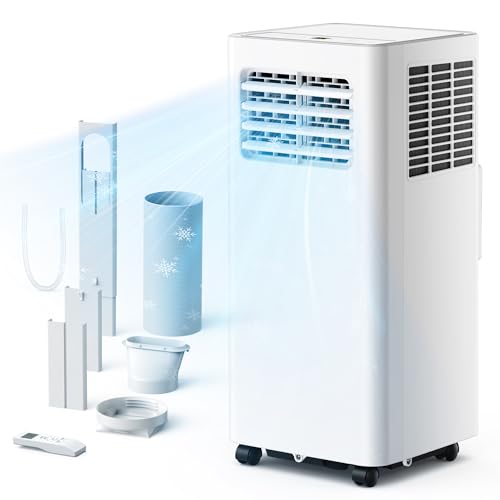
8000 BTU Portable Air Conditioner: The Complete Buying Guide
Everything you need to know before choosing an 8000 BTU portable air conditioner — cooling capacity, hose configurations, efficiency factors, and how to match the right model to your space.
EXPLORE RECOMMENDED MODELSWhat Does 8000 BTU Mean for a Portable Air Conditioner?
BTU, or British Thermal Unit, measures how much heat an air conditioner can remove from a room in one hour. An 8000 BTU portable air conditioner sits in the middle of the portable cooling range — more powerful than compact 5,000–6,000 BTU units, yet more portable and flexible than large 12,000 BTU and 14,000 BTU floor models.
This capacity class is widely considered the sweet spot for renters, apartment dwellers, and homeowners who need targeted cooling in a bedroom, living area, or home office without installing a permanent system. Because portable units roll on casters and require only a window or wall vent for exhaust, they offer a level of flexibility that window units and mini-splits cannot match.
If you are still comparing capacity classes, our breakdown of the 8000 BTU portable air conditioner room size provides additional context on how far this capacity can stretch in real-world conditions.
How 8000 BTU Compares to Other Portable Classes
| Capacity Class | Typical Cooling Area | Best For |
|---|---|---|
| 6,000 BTU portable | Up to ~250 sq ft | Small bedrooms, nurseries, dorm rooms |
| 8,000 BTU portable | 300–350 sq ft | Living rooms, primary bedrooms, home offices |
| 10,000–12,000 BTU portable | 400–500 sq ft | Open-plan apartments, larger living areas |
| 14,000 BTU portable | 500–700 sq ft | Large rooms, basement conversions, small studios |
These figures are guidelines. Ceiling height, insulation quality, window area, sun orientation, and the number of people or heat-producing devices in the room all shift the effective cooling area. A well-insulated 350 sq ft bedroom with north-facing windows may cool comfortably, while a 280 sq ft sunroom with glass on three sides might struggle.
Room Size and Cooling Coverage
The most common mistake buyers make is overestimating how much space an 8000 BTU portable unit can handle. Manufacturers often list optimistic coverage numbers based on ideal conditions. In practice, the effective cooling area is shaped by several variables:
- Ceiling height: Standard 8-foot ceilings are assumed. A 10-foot ceiling increases the cubic volume by 25%, reducing effective coverage.
- Insulation and window quality: Poorly sealed windows and doors let conditioned air escape and hot air infiltrate.
- Sun exposure: West- and south-facing rooms absorb significant solar heat in the afternoon.
- Occupancy and appliances: Each person adds roughly 400 BTU of heat load; electronics and kitchen appliances add more.
- Open floor plans: An open doorway to a hallway or adjacent room dilutes cooling effectiveness.
For a more precise capacity check, the 8000 BTU air conditioner room size guide walks through the math step by step. If your space is smaller — around 250 square feet — a 6000 BTU portable air conditioner room size analysis may point you toward a more appropriately sized unit.
Practical tip: Measure the actual length and width of the room, not the listed square footage on a floor plan. Alcoves, closets, and stairwells often inflate the advertised number.
Single Hose vs Dual Hose: Which Configuration Is Right?
This is the single most consequential design decision in the 8000 BTU portable AC category. Both configurations work, but they behave very differently in real rooms.
Single Hose Portable Air Conditioners
A single hose model pulls indoor air into the unit, uses it to cool the condenser coil, and exhausts that heated air outside. The cooling coil itself is cooled by refrigerant, and a separate stream of air is blown back into the room. The problem is the negative pressure: every cubic foot of air exhausted must be replaced, and that replacement air seeps in through gaps around doors and windows — often hot outdoor air.
Single hose units are simpler, lighter, and generally easier to move. They are well-suited to smaller rooms where the infiltration effect is limited and where simplicity matters more than maximum efficiency.
Dual Hose Portable Air Conditioners
A dual hose model uses one hose to draw outdoor air across the condenser and a second hose to exhaust the heated air back outside. Because intake and exhaust are balanced, the room's air pressure stays neutral, and the unit does not pull hot outdoor air through every gap in the envelope.
The trade-off is size, weight, and complexity. Dual hose units are bulkier and require two window or wall openings (or a specially designed window kit). For rooms with significant sun exposure or in hotter climates, the efficiency gain is usually noticeable. Our overview of the 8000 BTU dual hose portable air conditioner digs deeper into this configuration.
| Factor | Single Hose | Dual Hose |
|---|---|---|
| Cooling consistency | Moderate; affected by negative pressure | More stable; balanced air pressure |
| Efficiency in hot rooms | Lower | Higher |
| Weight and portability | Lighter, easier to move | Heavier, bulkier |
| Window kit complexity | Single opening | Two openings or split kit |
| Best for | Smaller rooms, milder climates | Larger rooms, sun-exposed spaces |
If your room is toward the upper end of the 8000 BTU coverage range or receives direct afternoon sun, a dual hose model is the more defensible choice. If portability and simplicity are priorities, a single hose unit remains practical.
Key Features to Evaluate Before Buying
Beyond BTU capacity and hose configuration, several features determine how usable an 8000 BTU portable AC will be in daily life.
Dehumidification Mode
Portable air conditioners remove moisture as a byproduct of cooling. Many 8000 BTU models offer a dedicated dehumidify mode that runs the compressor without the fan, pulling moisture from the air without over-cooling the room. This is valuable in humid climates and in basements. Our article on the 8000 BTU portable air conditioner with dehumidifier explains how this mode differs from full cooling operation.
Fan-Only and Sleep Modes
Fan-only mode circulates air without compressor operation, useful in shoulder seasons. Sleep mode typically reduces fan speed and may adjust temperature gradually through the night to maintain comfort while reducing noise.
Programmable Timer and Thermostat
A 24-hour timer lets you schedule startup and shutdown around your routine. Digital thermostats with remote sensing (where the remote measures temperature at your location rather than at the unit) improve comfort accuracy in larger rooms.
Drainage Options
Most units collect condensate in an internal tank that must be emptied manually. Continuous drain options — via a hose connection — let gravity drain moisture away, which is essential for unattended operation or high-humidity environments.
Noise Level
Portable ACs are inherently louder than window units because the compressor and fan sit inside the room. Look for published decibel ratings; mid-range and premium models often include sound-dampening insulation and variable-speed fans that reduce noise at lower cooling demands.
Air Filter Quality
Washable mesh filters are standard. Some models add activated carbon or HEPA-stage filtration. If allergy relief is a priority, check whether replacement filters are readily available.
Window Kit Compatibility
Most units ship with a sliding window kit. Verify that the kit fits your window type — double-hung, casement, and sliding windows each require different adapters. For unusual window configurations, a 6 inch wall vent for portable air conditioner installation may be a more permanent solution.
Efficiency and Operating Factors
Portable air conditioners are not rated with the same SEER2 metrics as central systems, but efficiency still matters. Several factors influence how much cooling you get per unit of electricity:
- Compressor type: Single-speed compressors cycle on and off. Variable-speed (inverter-driven) compressors modulate output and generally maintain temperature more evenly while using less energy at partial load.
- Hose insulation: Exhaust hoses radiate heat back into the room. Insulated or double-wall hoses reduce this loss.
- Window kit sealing: Gaps around the window panel let hot air in. Weatherstripping and foam seals improve performance noticeably.
- Placement: Keep the unit away from direct sunlight and ensure unobstructed airflow around intake and exhaust.
- Filter condition: A clogged filter restricts airflow and forces the compressor to work harder.
An 8000 BTU portable AC typically draws between 7 and 9 amps on a 115V circuit. Confirm that the circuit you plan to use can handle the load alongside other devices; a dedicated circuit is ideal.
Efficiency note: Dual hose configurations generally deliver more useful cooling per unit of electricity in hot, sun-exposed rooms because they avoid pulling conditioned air out of the space. In mild conditions, the difference is smaller.
Installation and Venting Essentials
Portable air conditioners are the easiest cooling appliances to install, but proper venting is non-negotiable. Here is the standard process:
- Choose the location. Place the unit near a window or wall vent, on a level surface, with at least 12–18 inches of clearance around air intakes.
- Assemble the window kit. Most kits use a sliding panel that fits into the window track. Seal gaps with the included foam or weatherstripping.
- Connect the exhaust hose. Attach the hose to the unit's exhaust port and route it to the window panel. Keep the hose as short and straight as possible — long, coiled hoses reduce efficiency.
- Seal the window opening. Close the window against the kit and lock it if possible. Any gap around the panel should be sealed.
- Power and test. Plug into a grounded outlet, run the unit in fan mode briefly, then switch to cooling and verify that warm air is exiting the hose outside.
If your window setup is unusual, a dedicated venting accessory can help. For example, a 6 inch exhaust hose for portable air conditioner replacement can restore performance if the original hose is damaged or too short. A 6 inch flexible ductwork section is another option when routing needs to be extended carefully.
Can You Vent Through a Wall?
Yes, with the right hardware. A wall vent installation is more permanent and often more efficient than a window kit because it eliminates window gaps. This approach is common in basements and rooms without operable windows. If you are considering this route, our guide to the 6 inch wall vent for portable air conditioner covers the components and considerations.
What About Sliding Doors?
Sliding glass doors can accommodate portable AC venting with a specialized kit, but sealing is more challenging than with a standard window. Expect to use additional weatherstripping and a locking bar to keep the door secure.
Market Tiers Explained
To help you compare models without relying on transient figures, we use a consistent tier framework that reflects relative market positioning, build quality, and feature depth.
Entry-Level Tier
Basic single-hose models with mechanical or simple digital controls, manual drain tanks, and standard window kits. Solid choice for occasional use in smaller rooms.
Mid-Range Tier
Improved controls, programmable timers, remote thermostats, quieter fans, and often dual-hose configurations. A balanced option for daily use in primary living spaces.
Premium Tier
Variable-speed compressors, advanced filtration, app or smart-home integration, continuous drain, and reinforced construction. Built for long-term, high-frequency operation.
In general, mid-range models offer the most sensible balance for most households: they add meaningful comfort features without the complexity of top-tier controls. Entry-level units remain appropriate for guest rooms and seasonal use, while premium models make sense when the unit will run daily through a long cooling season.
Who Should Choose an 8000 BTU Portable Air Conditioner?
This capacity class fits a specific set of use cases:
- Renters who cannot install permanent equipment or window units with brackets.
- Apartment dwellers with rooms between 300 and 350 square feet.
- Homeowners with rooms lacking ductwork, such as converted garages, attics, or additions.
- Remote workers who need targeted cooling in a home office without cooling the entire house.
- Households needing supplemental cooling during heat waves when the central system struggles.
If your room is significantly larger than 350 square feet, consider stepping up to a 8000 BTU unit comparison or a higher-capacity model. If you need cooling for a room closer to 150–250 square feet, a 7000 BTU air conditioner portable option may be more efficient.
When 8000 BTU Is Not the Right Choice
If you need whole-home cooling, a portable unit is the wrong tool. Central air conditioning or a ductless mini-split system is more appropriate. If you have a window that can safely hold a window unit, a window AC is generally more efficient and takes up less floor space. And if your room is heavily sun-exposed with large windows, a dual hose model or a higher-capacity unit will deliver better results.
Maintenance Essentials for Long-Term Performance
An 8000 BTU portable air conditioner will maintain performance for years with modest care. The essentials:
- Clean or replace the air filter every two to four weeks during heavy use. Most filters are washable with warm water and mild soap.
- Empty the condensate tank before it reaches the full line. Many units shut off automatically when full, but standing water can promote mold if left too long.
- Inspect and clean the exhaust hose. Dust accumulation inside the hose reduces airflow. Replace damaged hoses promptly.
- Check the window kit seal seasonally. Foam and weatherstripping degrade over time; re-seal as needed.
- Clean the exterior vents with a vacuum brush to remove dust and pet hair.
- Store properly in the off-season. Drain all water, clean the filter, coil the hose loosely, and cover the unit to prevent dust ingress.
If cooling performance drops noticeably despite clean filters and proper venting, the issue may be refrigerant-related or a failing compressor. In that case, professional service is advisable rather than DIY repair. Our guide to AC blowing warm air troubleshooting covers common symptoms and what they typically indicate.
Frequently Asked Questions
What size room does an 8000 BTU portable air conditioner cool?
Typically 300 to 350 square feet under standard conditions. Ceiling height, insulation, sun exposure, and occupancy can shift the effective area up or down. Rooms with heavy sun or poor insulation should be treated as smaller for capacity purposes.
What is the difference between a single hose and dual hose 8000 BTU portable AC?
A single hose unit exhausts indoor air outside, creating negative pressure that pulls warm outdoor air in through gaps. A dual hose unit uses separate intake and exhaust hoses, maintaining balanced pressure and delivering more consistent cooling in hot or sun-exposed rooms.
Can an 8000 BTU portable air conditioner cool a whole house?
No. It is designed for a single room or a defined open area up to roughly 350 square feet. Whole-home cooling requires central air conditioning or a multi-zone ductless system.
How many amps does an 8000 BTU portable air conditioner use?
Most models draw approximately 7 to 9 amps on a standard 115V circuit. Check the nameplate rating and ensure the circuit is not shared with high-draw appliances.
Does an 8000 BTU portable air conditioner need to be vented out a window?
Yes. Every portable AC must exhaust hot air outside through a hose, typically via a window kit or wall vent. Without proper exhaust, the unit cannot remove heat and will not cool effectively.
Is a dual hose 8000 BTU portable AC worth the extra bulk?
For rooms near the top of the coverage range or with significant sun exposure, yes — the balanced pressure and improved efficiency are noticeable. For smaller, shaded rooms, a single hose model is often sufficient and easier to move.