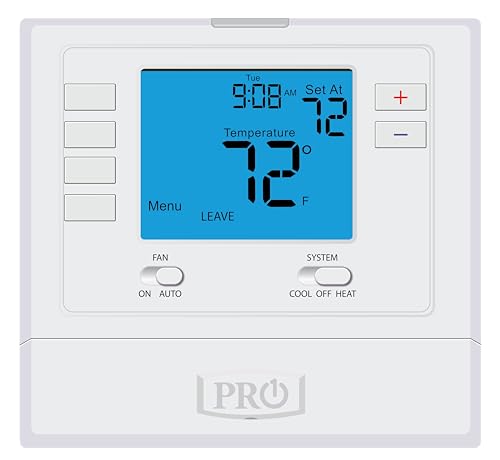
Pro AC Thermostat: Complete Guide to Professional Temperature Control
Understand how professional-grade thermostats improve comfort, efficiency, and reliability — from wiring and compatibility to smart features and placement.
Start LearningWhy this guide matters: A thermostat is the control center of your air conditioning system. Upgrading to a pro AC thermostat can deliver more precise temperature control, better scheduling, and smoother equipment operation — but only when it matches your system. This guide walks you through everything you need to know before choosing one.
What Is a Pro AC Thermostat?
A pro AC thermostat is a professional-grade temperature control device engineered for accurate sensing, dependable switching, and long service life. Unlike entry-level thermostats that focus on basic on/off control, professional-grade models typically support multi-stage equipment, advanced scheduling, and remote monitoring. They are commonly installed in residential HVAC systems, light commercial spaces, and retrofit projects where reliability matters.
The term “pro” refers to the product’s position in the market — it sits above starter-tier units in build quality, feature depth, and compatibility with modern HVAC equipment. A pro thermostat is designed to communicate cleanly with air handlers, compressors, and heat pumps, reducing short cycling and improving overall system stability.
Key Features of Professional-Grade AC Thermostats
Professional thermostats are distinguished by features that support precise control and long-term reliability. The following characteristics are common across most mid-tier and high-end tier models.
Multi-Stage Support
Controls single-stage, two-stage, and variable-speed equipment with proper staging logic, reducing abrupt temperature swings.
Precise Temperature Sensing
Higher-resolution sensors and tighter deadbands deliver steadier room temperatures compared to basic bimetal thermostats.
Advanced Scheduling
Seven-day or multi-period programming allows different comfort profiles for weekdays, weekends, and specific zones.
Remote Access
Wi-Fi and app-based control let you adjust settings, review runtime data, and receive alerts from anywhere.
Durable Construction
Reinforced housings, sealed relays, and high-grade terminals support long service intervals and stable performance.
System Diagnostics
Fault codes, filter reminders, and runtime logs help technicians and homeowners identify issues early.
Pro AC Thermostat Tiers Compared
Thermostats are commonly grouped by market position rather than by numerical ratings. The table below uses universal tier descriptors to help you compare relative capability without tying the comparison to any currency or region.
| Tier | Best For | Typical Capabilities | Control Style |
|---|---|---|---|
| Essential tier | Single-stage AC, basic homes | Manual or simple 5-2 day scheduling, basic LCD, limited compatibility | On/off switching |
| Balanced tier | Most residential systems | 7-day programming, multi-stage support, backlit display, filter reminders | Programmable staging |
| Premium tier | Heat pumps, two-stage AC | Wi-Fi, app control, humidity sensing, adaptive recovery, detailed diagnostics | Adaptive multi-stage |
| Top-tier | High-end and light commercial | Variable-speed support, zoning integration, remote sensors, advanced data logging | Proportional / modulating |
When comparing tiers, keep in mind that a balanced-tier thermostat often provides the strongest match for typical homes, while top-tier units are most beneficial when paired with variable-speed compressors or zoned systems. Choosing a tier above your equipment’s capability can deliver limited practical benefit.
Wiring and Compatibility Essentials
Before choosing a pro AC thermostat, confirm the wiring available at your current thermostat location and the communication requirements of your HVAC equipment. Most low-voltage residential systems use a standard terminal set, but the number of active terminals varies by system complexity.
Common Low-Voltage Terminals
- R / Rc / Rh — 24V power; Rh for heating, Rc for cooling
- C — common wire for continuous thermostat power
- G — indoor blower fan control
- Y / Y1 / Y2 — compressor stage 1 and stage 2
- W / W1 / W2 — heating stage 1 and stage 2
- O / B — reversing valve for heat pumps
- AUX / E — auxiliary or emergency heat
A missing C-wire is one of the most common obstacles when upgrading to a Wi-Fi or smart thermostat. Some professional-grade models include power-stealing circuitry or an adapter kit, but a dedicated C-wire remains the most reliable solution. If your system lacks a C-wire, review options such as a programmable thermostat without C-wire before committing to a specific model.
Compatibility note: Line-voltage thermostats (used with some electric baseboard heaters and certain PTAC systems) are not interchangeable with low-voltage thermostats. Always verify system voltage and control type before installation. For PTAC-specific controls, see the PTAC air conditioners overview.
Where to Place a Pro AC Thermostat
Placement directly affects how accurately a thermostat reads room temperature and how efficiently the system cycles. A poorly placed thermostat can cause short cycling, uneven comfort, and higher energy use — even on a premium-tier model.
Recommended Placement
- Interior wall, approximately five feet above the floor
- Central location in the conditioned space with good air circulation
- Away from direct sunlight, lamps, and other radiant heat sources
- At least four feet from supply registers and return grilles
- Not on exterior walls or near doors and windows
- Away from kitchens, bathrooms, and laundry areas with high humidity
If the existing thermostat location is compromised, consider a model with remote sensors. Remote sensor support allows the thermostat to average readings across multiple locations, which is especially useful in larger or multi-level homes. Related controls such as a remote AC thermostat can extend control to additional rooms.
Smart Features That Matter in Daily Use
Professional thermostats increasingly include connected features. The most useful ones in everyday operation are scheduling, geofencing, humidity control, and runtime diagnostics. These features help maintain comfort without constant manual adjustment.
- Adaptive recovery: Learns how long the system takes to reach target temperature and starts early so the setpoint is reached on schedule.
- Geofencing: Adjusts operation based on whether occupants are home or away.
- Humidity sensing: Enables better control of indoor moisture, especially during cooling season.
- Filter and maintenance reminders: Reduces the risk of restricted airflow and coil issues.
- Runtime and cycle logs: Helps identify short cycling or unusual equipment behavior.
For homes with programmable preferences, a programmable thermostat for heating and cooling offers a practical middle ground between basic and fully connected models. If your system includes a furnace, a programmable furnace thermostat may better match the equipment’s staging behavior.
Installation: DIY vs Professional
Replacing a thermostat with an identical wiring configuration is often a manageable DIY task. However, professional installation is recommended when new wire runs are required, when the system uses line voltage, or when the equipment includes multiple stages, heat pump reversing valves, or zoning controls.
DIY-Friendly Situations
- The existing thermostat uses low-voltage wiring with a clearly labeled terminal block
- The replacement model supports the same terminal set
- Power can be safely shut off at the air handler or furnace before work begins
Call a Professional When
- No C-wire is present and no adapter kit is available
- The system uses line voltage or proprietary communication
- You need to add a thermostat in a new location
- The equipment includes heat pump, multi-stage, or zoning controls
If you are also considering broader HVAC upgrades, related professional services such as professional duct cleaning can support airflow and overall system performance. For window units, professional help with professional window air conditioner installation can reduce installation-related issues.
Common Pro Thermostat Issues and Fixes
Most thermostat problems fall into a small set of categories: power, wiring, configuration, or sensor placement. The table below summarizes common symptoms and practical first steps.
| Symptom | Likely Cause | First Step |
|---|---|---|
| Blank display | No power at thermostat; tripped breaker; missing C-wire | Check breaker and confirm 24V at R and C terminals |
| Short cycling | Thermostat placed near a heat source or supply vent | Relocate sensor or adjust cycle settings |
| System does not cool | Miswired Y terminal, wrong configuration, or equipment fault | Verify wiring against the installation manual |
| Fan runs continuously | Fan set to ON instead of AUTO, or G-wire issue | Switch fan mode to AUTO and inspect G-wire |
| Temperature reading seems high or low | Sensor drift or placement near drafts | Compare with a separate thermometer and check placement |
If the air conditioner is running but not cooling effectively, the thermostat may not be the cause. Reviewing reasons why an air conditioner is not cooling can help distinguish control issues from refrigerant or airflow problems. For quick checks, see the quick fix for AC not blowing cold air.
Maintenance Tips for Long-Term Reliability
Professional-grade thermostats are designed for durability, but basic maintenance supports consistent performance and accurate readings.
- Replace batteries annually on models that use battery backup
- Gently clean the display and vents with a dry microfiber cloth
- Verify that the thermostat is level and firmly mounted
- Review filter reminders and replace filters on schedule
- Update firmware on connected models when prompted
- Inspect wiring connections during annual HVAC service
Pairing thermostat maintenance with broader HVAC service routines supports efficiency. Guides on programmable thermostats and pro HVAC thermostats provide additional context for long-term care and upgrade planning.
Frequently Asked Questions
What is a pro AC thermostat?
A pro AC thermostat is a professional-grade temperature control device designed for precise operation of air conditioning systems. It typically offers advanced scheduling, multi-stage support, remote access, and durable construction compared to entry-level models.
Does a pro AC thermostat require a C-wire?
Many professional-grade thermostats require a C-wire for continuous power. Some models include adapter kits or power-stealing technology, but a dedicated C-wire remains the most reliable option for consistent performance.
Can I install a pro AC thermostat myself?
Replacing a thermostat with matching wiring is often a straightforward DIY task. However, installing a new wire run, handling line-voltage systems, or configuring multi-stage HVAC equipment is best left to a qualified technician.
Where should a pro AC thermostat be placed?
Mount the thermostat on an interior wall roughly five feet above the floor, away from direct sunlight, supply vents, exterior doors, and heat-producing appliances. Proper placement ensures accurate temperature readings and efficient cycling.
How does a pro thermostat differ from a basic model?
A basic thermostat focuses on simple on/off control. A pro thermostat adds multi-stage support, more precise sensing, advanced scheduling, and often connectivity and diagnostics — making it better suited to modern HVAC systems.
Can a pro thermostat work with a heat pump?
Yes, many professional-grade thermostats support heat pumps, including reversing valve control and auxiliary heat. Always confirm compatibility with your specific equipment model before choosing a thermostat.
Final Takeaways
A pro AC thermostat is more than a control accessory — it is the interface that determines how accurately and efficiently your air conditioning system operates. Matching the thermostat’s tier to your equipment’s capability, verifying wiring and compatibility, and placing it correctly will deliver the most noticeable comfort improvements.
For homeowners planning broader upgrades, reviewing related topics such as pro air conditioner thermostat options and remote HVAC thermostat features can help align the thermostat choice with overall system goals. When in doubt, prioritize compatibility and proper installation over feature count.