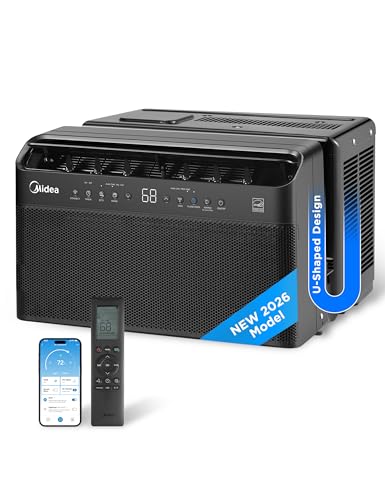
Side to Side Window Air Conditioner: The Complete Guide
Everything you need to know about horizontal window air conditioners designed for sliding and casement windows: how they work, how to size one correctly, installation essentials, efficiency features, and how to choose the right unit for your room.
Explore Recommended UnitsWhat Is a Side to Side Window Air Conditioner?
A side to side window air conditioner is a horizontal room air conditioner built for windows that open laterally, such as sliding windows and some casement windows. Instead of standing upright in a tall double-hung window opening, the unit sits in a wide, relatively short opening. The chassis, controls, and air discharge are arranged so the unit can rest level while the window sash slides shut against it.
These units are sometimes called horizontal window ACs, sliding window air conditioners, or side-sliding window ACs. They are a practical solution for homes, apartments, and rentals where the available window does not accept a conventional vertical window unit. The main appeal is straightforward: it lets you cool a room without modifying the window or installing a ductless system.
Compared with a standard vertical window unit, a side to side model typically has a lower profile and a different mounting strategy. Many models use a support bracket or a reinforced frame to keep the unit stable, and the window kit is designed to seal a horizontal opening. If you are exploring related formats, our overview of the small air conditioner for side sliding window covers compact options, while the slider casement window air conditioner at 5,000 BTU is a useful reference for the smallest end of the category.
How Side to Side Window AC Units Work
The cooling process is the same as any room air conditioner. A compressor circulates refrigerant through evaporator and condenser coils. Indoor air passes over the cold evaporator coil, giving up heat and humidity, and is then blown back into the room. Heat is rejected outdoors through the condenser coil and the rear of the unit.
What differs is the physical layout. In a horizontal window AC, the air path is often side-to-side rather than front-to-back, and the unit is wider than it is tall. That shape matches a lateral window opening. Many models also include a slide-out chassis so the main body can be serviced or removed while the outer frame stays mounted.
Because the unit sits in a side-opening window, correct leveling matters more than on a standard unit. A slight tilt toward the outdoors helps condensate drain away, but excessive tilt can stress the frame and create gaps. Follow the manufacturer's specified tilt and use a bracket when one is recommended. If your window setup is unusual, the guide on a sliding window portable air conditioner kit explains an alternative approach using a portable unit.
Which Windows Fit a Side to Side Window AC?
Not every window works with a horizontal unit. Before shopping, measure the opening carefully and confirm the window type.
Good candidates
- Single-hung or double-hung sliding windows: A horizontal sash that slides left or right creates a wide opening that suits a side to side unit when the frame is wide enough.
- Horizontal sliding windows: These are the classic fit for this category, provided the unit's width and height range match the opening.
- Some casement windows: Casement windows that crank outward can work with a purpose-built casement AC, but only if the unit is designed for that frame. Do not assume a standard horizontal unit fits.
Less suitable or unsuitable
- Narrow vertical windows: A tall, thin opening usually calls for a standard vertical window AC, not a horizontal model.
- Windows with obstructions: Crank handles, interior sills, storm windows, and screens can interfere with the unit and the window kit.
- Windows above ground floor without secure support: Safety and support requirements are stricter; an outdoor bracket is strongly advised.
If your opening is very small, look at the options in our small window air conditioner at 12 inches wide and small window air conditioner at 14 inches wide references. For very short openings, the 10 inch height unit guide is a helpful starting point. And if a window is not an option at all, our small AC unit that doesn't need a window overview covers alternatives.
Sizing a Side to Side Window AC
Correct sizing is the single biggest factor in comfort and efficiency. An undersized unit runs constantly and never fully dehumidifies. An oversized unit cools quickly but short-cycles, leaving the room clammy and wearing the compressor. The table below offers a practical starting range; adjust upward for high ceilings, strong sun, poor insulation, or many occupants, and downward for shaded, well-insulated rooms.
| Room Area (approx.) | Typical BTU Range | Best For |
|---|---|---|
| Up to 150 sq ft | 5,000 – 6,000 BTU | Bedrooms, home offices, small studios |
| 150 – 250 sq ft | 8,000 – 10,000 BTU | Living rooms, larger bedrooms, guest rooms |
| 250 – 400 sq ft | 12,000 – 14,000 BTU | Open-plan living areas, lofts, large rooms |
| 400 sq ft and above | 15,000 BTU and higher | Large open spaces; consider a ductless or central system |
Two more factors matter. First, measure width and height of the window opening, not just the glass. The unit must fit the frame with room for the window kit and any bracket. Second, check the electrical circuit. Most small and mid-range window units run on a standard 115V household circuit, while larger units may need a dedicated 230V circuit. Never share a circuit with other heavy appliances.
For a deeper sizing walkthrough, our how to size an air conditioner guide covers load factors in detail. If you are working from a specific room size, the room size for a 5,000 BTU air conditioner reference is a quick sanity check.
Efficiency Ratings and Features to Look For
Efficiency is where two units with similar capacity can differ dramatically in day-to-day operation. Focus on these indicators rather than headline wattage alone.
Efficiency ratings
- CEER (Combined Energy Efficiency Ratio): The current efficiency metric for room air conditioners. Higher is better. Compare CEER across models in the same capacity class.
- EER: Older models may list EER. It is still useful for comparison but CEER is the modern standard.
- ENERGY STAR listing: Indicates the model meets a recognized efficiency threshold. Our ENERGY STAR certified AC guide explains what the certification covers.
Features that improve real-world comfort
- Inverter or variable-speed operation: More common in mini-splits but increasingly seen in window units. It reduces on/off cycling and holds temperature more steadily.
- Programmable thermostat and timer: Lets you align cooling with your schedule. See our small air conditioner with thermostat notes for how these controls behave in compact units.
- Eco or energy-saver mode: Cycles the compressor and fan to trim consumption once the room reaches setpoint.
- Remote control and smart features: Helpful for hard-to-reach installations. Our smart air conditioner overview covers app and voice control options.
- Washable filter and self-clean functions: Simpler maintenance and more consistent airflow over time.
- Quiet operation: Look for decibel ratings and sleep mode if the unit is near a bed or desk.
Installation and Support Essentials
A horizontal window unit places different loads on the window frame than a vertical unit. The goal is stable, level support with a proper seal and a safe outdoor tilt for drainage.
Before installation
- Confirm the window opening width and height match the unit's published range.
- Check the weight of the unit and whether your window frame and sill can carry it. Older frames may need reinforcement.
- Verify the electrical outlet type, circuit rating, and cord length. Avoid extension cords.
- Review local rules for window-mounted units, especially in rentals, historic buildings, or upper-floor units.
Support and sealing
- Use the manufacturer's bracket or a compatible outdoor support bracket when specified. A bracket reduces vibration and prevents the unit from shifting.
- Level the unit side to side and set the recommended outdoor tilt for condensate drainage.
- Install the window kit and seal gaps with insulation foam or weatherstripping. Air leaks defeat the cooling effort and let humidity in.
- Secure the sash so it cannot be opened from outside. Safety and security matter as much as cooling performance.
If you prefer not to handle the installation yourself, our someone to install window air conditioner guide explains what to ask a professional. For unusual spaces, the space-saving window air conditioner overview covers compact mounting approaches, and the slim window air conditioning unit reference is useful for tight frames.
Installation Quick Checklist
- Measured opening and confirmed unit fits
- Checked circuit, outlet, and cord requirements
- Support bracket or platform ready
- Window kit and weather seal on hand
- Unit level with slight outdoor tilt
- Sash secured and gap-free
- Test run complete with no vibration or leaks
Buying Checklist for Side to Side Window ACs
Use this checklist to compare models on substance rather than marketing. The descriptors below use a consistent tier system: essential tier, balanced tier, premium tier, and top-tier.
| Consideration | What to Look For | Typical Tier |
|---|---|---|
| Window fit | Published width and height range that matches your opening | All tiers |
| Cooling capacity | BTU matched to room size and heat load | All tiers |
| Efficiency | Higher CEER, ENERGY STAR listing, eco mode | Balanced to top-tier |
| Controls | Programmable thermostat, timer, remote, smart features | Balanced to premium |
| Noise | Published decibel ratings, sleep mode, quiet fan settings | Premium to top-tier |
| Build and support | Durable construction, included bracket or reinforced frame, slide-out chassis | Mid-range and above |
| Maintenance | Washable filter, accessible coils, self-clean function | Balanced to premium |
An entry-level model can be a solid choice for a guest room used occasionally. A mid-range model usually adds better controls and sealing hardware, while a premium or top-tier model focuses on quieter operation, finer temperature control, and longer service life. The right tier depends on how often the room is used and how sensitive you are to noise and temperature swings.
If you are also weighing window versus portable options, the sliding window kit for portable air conditioner guide and the sliding glass door air conditioner kit overview explain how portable units handle lateral openings.
Frequently Asked Questions
What is a side to side window air conditioner?
It is a horizontal window AC built for sliding or side-opening windows. The unit sits in a wide, short opening rather than a tall double-hung window, and it uses a support bracket and window kit to stay level, secure, and properly sealed.
Can I install a regular window AC in a sliding window?
It is not recommended. A standard vertical unit is designed for a different opening shape and support pattern. Using one in a side-opening window often leads to poor sealing, vibration, and safety concerns. Choose a side to side or casement-specific unit instead.
What size side to side window AC do I need?
Start with room area: up to about 150 sq ft often suits 5,000–6,000 BTU, 150–250 sq ft often suits 8,000–10,000 BTU, and 250–400 sq ft often suits 12,000–14,000 BTU. Adjust for ceiling height, sun, insulation, and occupancy, and confirm the unit fits your window opening.
Are side to side window ACs energy efficient?
Efficiency varies by model. Compare CEER, look for an ENERGY STAR listing, and prioritize eco mode, programmable timers, and inverter or variable-speed operation where available. Correct sizing matters as much as the rating itself.
Do side to side window ACs need special support?
Yes. A level support bracket or platform, proper sealing, and secure fastening are important. Some units include a window kit; for others, an outdoor bracket is recommended. Always follow the manufacturer's installation instructions and local requirements.
How do I maintain a horizontal window AC?
Clean or replace the filter every few weeks during heavy use, keep the outdoor coil clear of debris, check the window seal seasonally, and inspect the bracket for stability. A brief pre-season check of the cord and outlet is also worthwhile.