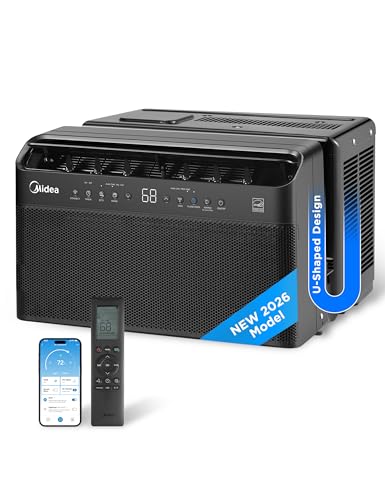
Slim Window Air Conditioning Unit
Everything you need to know about compact, narrow-profile window AC units — from measuring your window to choosing the right capacity and efficiency for your space.
EXPLORE KEY FEATURESWhy slim window units matter: Many modern homes and apartments have narrow window openings that standard window air conditioners simply cannot fit. A slim window air conditioning unit solves this by reducing the chassis width or height while preserving cooling capacity. This guide explains exactly what "slim" means in practice, how to measure your window correctly, and which trade-offs come with the compact form factor.
In This Guide
What Makes a Window AC Slim?
"Slim" in the window AC market refers to more than one dimension. Depending on the model, a slim unit may be narrow in width (side to side), short in height (top to bottom), or shallow in depth (how far it protrudes into the room). Understanding which dimension matters for your window is the first step.
Compact Side-to-Side Chassis
Designed for window openings that are narrower than the typical 15–16 inch minimum. Widths can drop to 12, 14, or 15 inches, making them viable for small casement or slider openings.
Best for: narrow double-hung windows and small side-sliding windows.
Low-Profile Vertical Clearance
Reduced height allows installation in windows with limited vertical opening — common in basements, dormers, and older homes with low sill-to-sash measurements.
Best for: basement windows and short sash openings.
Minimal Indoor Protrusion
Some slim units reduce how far the chassis extends into the room. This is useful for tight floor plans, hallways, and rooms where furniture sits directly below the window.
Best for: small bedrooms, home offices, and apartments.
Compromise on All Three Axes
Many modern slim models reduce width and depth slightly rather than excelling in a single dimension. This balanced approach fits more windows while keeping internal components serviceable.
Best for: general-purpose rooms with standard but tight openings.
If your window opening is genuinely non-standard, you may also want to review our guide on 12-inch wide window AC units or 14-inch wide models for exact fit references.
How to Measure Your Window for a Slim Unit
Buying a slim unit without measuring correctly is the most common source of returns. Follow these steps before comparing models.
- Measure the clear opening width. With the window sash raised, measure the narrowest point side to side. This is the hard limit your unit's chassis must fit through.
- Measure the clear opening height. From the sill to the bottom of the raised sash. The unit must sit on the sill and the sash must close above it, with the window frame kit installed.
- Measure the sill depth. The unit's outdoor portion extends past the window. You need enough exterior clearance and a secure support bracket.
- Check the window type. Double-hung windows accept most slim units. Casement and awning windows do not open vertically and require a different approach — see our side-sliding window AC guide.
- Verify the electrical outlet. Check the unit's amperage rating against your circuit. Our amps and breaker sizing guide explains how to do this safely.
Slim vs Standard Window AC Units
Slim units trade some internal space for a smaller footprint. The table below summarizes the practical differences.
| Aspect | Slim Window Unit | Standard Window Unit |
|---|---|---|
| Typical Width | 12–15 inches | 16–26 inches |
| Cooling Capacity Range | 5,000–12,000 BTU | 5,000–24,000 BTU |
| Efficiency Potential | Good, but fewer top-tier models | Broad range including top-tier |
| Noise Level | Often slightly higher at max output | Generally quieter at equivalent capacity |
| Feature Set | Essential to mid-range | Essential to premium |
| Best For | Narrow openings, compact rooms | Standard windows, larger rooms |
Slim units are not inherently lower quality — they simply prioritize fit. A well-specified mid-range slim model can match a standard unit in cooling performance and reliability within its capacity class. If capacity is your priority, see our guide to the most powerful compact window ACs.
Sizing and Capacity for Slim Units
Capacity selection for a slim unit follows the same principles as any window AC. The compact chassis does not change the physics of cooling load.
- Match BTU to room size. A 5,000–6,000 BTU unit suits rooms up to about 150 sq ft. A 10,000–12,000 BTU unit handles roughly 300–450 sq ft. Our 5,000 BTU room size guide provides a detailed reference.
- Adjust for ceiling height and sun. Higher ceilings, south-facing windows, and unshaded glass all add load. Do not downsize just to fit a slimmer model.
- Consider the room's purpose. Bedrooms and home offices tolerate a slightly smaller unit than kitchens or living rooms with frequent occupancy.
- Check the unit's airflow rating. Slim chassis sometimes use smaller fans. Confirm the CFM (cubic feet per minute) is appropriate for the BTU rating.
For a broader walkthrough of the calculation, read our guide on how to size an air conditioner. If your room is genuinely small, the small room AC guide covers the trade-offs in detail.
Efficiency and Features to Look For
Slim does not mean stripped-down. Many compact units now include features previously reserved for larger models.
- ENERGY STAR certification. Look for the label if you run the unit daily. See our guide to ENERGY STAR small window ACs for what the certification actually guarantees.
- Inverter compressor. Less common in slim window units but increasingly available. An inverter-driven compressor modulates speed for steadier temperatures and lower energy use over long runs.
- Programmable thermostat. A built-in timer or programmable thermostat reduces waste. Our guide to small ACs with thermostats explains what to look for.
- Remote control and smart features. Wi-Fi control is becoming available even in compact units. See smart air conditioner features for a broader overview.
- EER or CEER rating. The higher the rating, the more efficient the unit at peak load. This matters most in hot climates.
Installation and Support Considerations
Installation of a slim window unit is similar to a standard model, but the smaller footprint creates a few specific concerns.
- Use the manufacturer's support bracket. Slim units often protrude farther relative to their width. A proper exterior bracket prevents sagging and reduces vibration noise.
- Seal the window frame kit carefully. Gaps around the unit let hot air in and cool air out. Foam insulation strips included with most kits are essential, not optional.
- Check the sash lock. Many slim installations require the window to be secured above the unit. A sash lock or a wooden block prevents the window from being opened from outside.
- Plan for seasonal removal. If you remove the unit in winter, store it upright and cover the outdoor portion to prevent debris buildup.
- Consider professional installation if the window is unusually high, if the unit is heavy, or if the electrical circuit needs upgrading. Our guide on finding someone to install a window AC covers the options.
For space-saving alternatives when a window unit is not ideal, see our space-saving window AC guide and vertical window AC options.
Ready to Compare Slim Window Units?
Browse our curated selection of slim window air conditioning units below, filtered for compact chassis and narrow window compatibility.
View Recommended UnitsFrequently Asked Questions
What is the narrowest window AC unit available?
Chassis widths as low as 12 inches exist, though availability varies. Units in the 14–15 inch range are more common and typically offer better capacity and efficiency. Our 12-inch wide AC guide and 15-inch wide AC guide cover the specific trade-offs.
Does a slim unit cool as well as a standard unit?
Within the same BTU class, yes. Cooling capacity is determined by the compressor and coil, not by the chassis width. A slim 8,000 BTU unit removes the same heat as a standard 8,000 BTU unit. The main compromise is often noise level and the availability of premium features.
Can a slim unit fit a casement window?
Casement windows open outward on a hinge and do not accept standard window ACs. You need a specialized casement window kit or a different approach entirely. Our guide on slider and casement window AC options explains the alternatives.
How do I know if my window is too narrow for a standard unit?
Measure the clear opening width with the sash raised. If it is under 16 inches, you likely need a slim model. Standard units typically require 16 inches or more of clear width. Double-check the height requirement as well — some units need more vertical clearance than their width suggests.
Are slim units harder to maintain?
Not significantly. Filter cleaning is identical. Coil access can be slightly tighter on very compact models, but routine maintenance — filter washing, exterior coil rinsing, and seasonal storage — follows the same schedule as any window unit. Our AC maintenance guide covers the full checklist.
Can I install a slim unit myself?
Yes, if the window is standard double-hung and you can safely lift the unit. Most slim units in the 5,000–8,000 BTU range weigh under 50 pounds. Larger units and non-standard windows benefit from professional installation. See our guide on window AC installation help for when to call a pro.
For related reading, explore basement window AC options and slim units with remote control if convenience features matter to you.