Space Saving Window Air Conditioner
A complete guide to compact, low-profile, and slim window air conditioners — how space saving designs work, what window they require, and how to choose the right unit for a tight room.
Why this guide matters: If you are researching a space saving window air conditioner, you are likely dealing with a narrow room, limited window area, or a desire to keep the view open. This guide covers the main space saving designs, sizing, and the practical trade-offs so you can choose a unit that fits your room and your window.
What Is a Space Saving Window Air Conditioner?
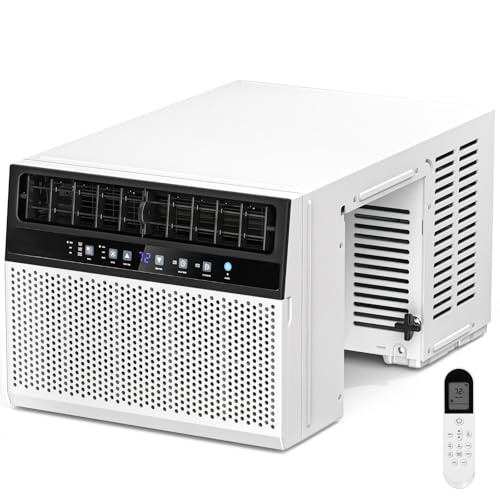
A space saving window air conditioner is a compact cooling unit designed to take up less room inside the window area and intrude less into the living space. The term covers several design approaches: low-profile cabinets with reduced height, slim chassis with reduced depth, narrow units for small window openings, and U-shaped or saddle designs that allow the window to close over the unit.
Standard window ACs are effective but can block a significant portion of the window and extend noticeably into the room. Space saving designs address those issues by reducing the physical footprint or changing the installation geometry. The goal is the same cooling performance with a smaller visible and functional footprint.
If you are still deciding between a window unit and another format, see the slim window air conditioning unit overview for comparison.
Types of Space Saving Window AC Designs
There are several distinct approaches to saving space with a window air conditioner. Understanding them helps you match the design to your room and window.
Low-Profile Cabinets
Some units reduce height rather than width or depth. This is useful when the window has limited vertical clearance or when you want to preserve more of the view. A lower cabinet may also fit under a partial window covering. If height is your constraint, a 10-inch height unit is a good starting point.
Slim and Narrow Chassis
Slim units reduce depth, which is helpful in rooms where floor space near the window is tight. Narrow units reduce width, which is useful for small window openings. For narrow openings, look at 12-inch wide options and 14-inch wide models.
U-Shaped and Saddle Designs
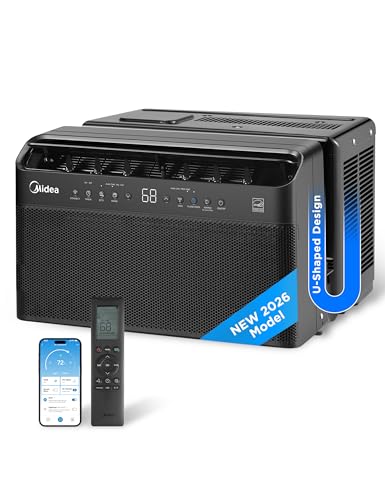
U-shaped and saddle designs straddle the window sill, with the compressor and condenser section outside and the evaporator section inside. The window closes over the middle, allowing the window to be opened and closed while the unit remains installed. These are among the most space saving designs because they do not block window operation.
Low Profile
Reduced height preserves the view and fits windows with limited vertical clearance.
Slim Chassis
Reduced depth keeps the unit from intruding into the room, which is useful in tight spaces.
Narrow Width
Designed for small window openings where a standard unit will not fit.
U-Shaped
Allows the window to close and open while the unit is installed, preserving window function.
Sizing a Space Saving Window AC
Space saving does not change the cooling rules. The unit still needs to match the room's cooling load. An undersized unit runs continuously and may never reach the set temperature, while an oversized unit short-cycles and leaves the room clammy.
| Room Size | Recommended BTU | Typical Space Saving Fit | Market Tier |
|---|---|---|---|
| Up to 150 sq ft | 5,000 – 6,000 BTU | Compact and narrow units for small windows | Entry-level |
| 150 – 250 sq ft | 8,000 – 10,000 BTU | Slim and low-profile units for bedrooms and offices | Mid-range |
| 250 – 400 sq ft | 12,000 – 14,000 BTU | U-shaped and larger compact units for living areas | Top-tier |
For a focused breakdown on small rooms, see room size for a 5,000 BTU air conditioner and small air conditioners for small rooms. If the room is a bedroom, small air conditioners for bedrooms covers quiet and low-profile considerations.
Space tip: U-shaped designs save the most functional space because they allow the window to close. Low-profile and slim designs save visual and physical space but still block the window opening. Decide which kind of space matters more to you before shopping.
Window Fit and Installation
Space saving designs have specific installation requirements. Measure carefully before choosing a unit.
If installation is not something you want to handle yourself, see someone to install a window air conditioner for guidance. For vertical window configurations, explore the small window air conditioner for vertical window and small vertical air conditioner window unit options.
Features That Complement a Space Saving Design
Because space saving units are often used in smaller or more constrained rooms, certain features become more valuable.
Digital Thermostat
Precise control in a small room reduces temperature swings. See small air conditioner with thermostat.
Remote Control
Useful when the unit is installed high or in a tight position. See remote-control models.
Energy Efficiency
High CEER ratings reduce running energy use. See ENERGY STAR small window units.
Quiet Operation
Important in bedrooms and small offices where the unit is close to occupants.
Space Saving Window AC vs Alternatives
A space saving window unit is not the only way to cool a tight room. Understanding the alternatives helps you confirm you are choosing the right category.
| Option | Space Impact | Best For | Trade-Off |
|---|---|---|---|
| Space saving window AC | Low to moderate; U-shaped designs preserve window function | Rooms with a compatible window and limited floor space | Requires window installation; capacity range varies |
| Portable AC | Moderate; takes floor space but no window footprint | Renters or rooms without a compatible window | Less efficient; requires venting; bulkier footprint |
| Mini-split | Low indoor footprint; wall-mounted | Long-term installations where quiet operation and efficiency matter | Professional installation and higher upfront investment |
| Through-the-wall AC | Permanent wall installation | Rooms where window space must remain fully available | Requires wall modification; less flexible placement |
If a window installation is not possible, a small AC unit that doesn't need a window or small air conditioner that doesn't need a window may be a better fit. For a compact free-standing option, see single room free standing air conditioner.
Maintenance for Compact Units
Compact units have less internal space, so maintenance matters. A clogged filter or dirty coil quickly reduces performance in a small chassis.
For broader maintenance guidance, the small air conditioning system overview covers compact system care.
Frequently Asked Questions
A space saving window air conditioner uses a compact chassis, low-profile cabinet, or slim design that occupies less window area and intrudes less into the room. Some models use a U-shaped or saddle design that lets you open and close the window even when the unit is installed.
Yes, when sized correctly for the room. A space saving window AC with the appropriate BTU rating cools just as effectively as a standard unit of the same capacity. The main trade-off is usually a narrower selection of capacities in the most compact designs.
Some space saving designs, such as U-shaped or saddle-style units, allow the window to open and close while the AC remains installed. Traditional window units block the window opening. If window access is important to you, choose a U-shaped or similar design.
Requirements vary by model. Most compact window ACs need a window opening at least 21 to 23 inches wide and 12 to 14 inches high. Slim models may require narrower openings, while U-shaped units need a specific window height and sill depth. Always check the manufacturer's specifications.
Not necessarily. Noise depends on the fan and compressor design, not on physical size. Some compact units are quieter than standard models, but others are louder because the internal components are packed into a smaller chassis. Check the decibel rating if quiet operation matters.
Making Your Final Choice
The right space saving window air conditioner depends on which kind of space you are trying to preserve. If you want to keep the window functional, a U-shaped or saddle design is the strongest choice. If you want to keep the room feeling open, a slim or low-profile chassis helps. If your window is very narrow, prioritize a narrow model and confirm the minimum opening width.
For related formats, review small room air conditioner window, 15-inch wide options, and 20-inch wide models. If you want the absolute smallest footprint available, the smallest window air conditioner you can buy guide covers the most compact options on the market.