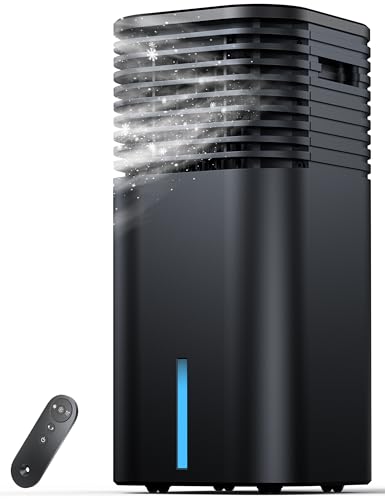
Small Portable Air Conditioner Without Hose
Understand hose-free cooling options, how they work, where they perform best, and how to choose the right unit for your room.
COMPARE HOSE-FREE OPTIONSWhat "without hose" really means: A true compressor-based portable air conditioner always needs a way to exhaust heat, which usually means a hose. Units marketed as hose-free are typically evaporative coolers or personal air coolers. They cool through water evaporation and airflow, not a refrigeration cycle. This guide explains what they can and cannot do, so you can decide whether a hose-free unit fits your space or whether a vented option is the better choice.
How Hose-Free Portable Coolers Work
Hose-free portable coolers rely on evaporation rather than a compressor. A fan pulls warm, dry air through a wet cooling pad or water-saturated medium. As water evaporates, it absorbs heat from the air, and the fan pushes the cooled air into the room. This is the same principle used by whole-house evaporative coolers, scaled down for personal spaces.
Because there is no compressor and no exhaust hose, these units are simple to place and easy to move. The trade-off is that they raise indoor humidity and lose effectiveness in already humid air. That is why a hose-free cooler is a strong fit for dry climates and a poor fit for muggy coastal summers.
If you are comparing this category against vented options, our overview of the small evaporative air cooler explains how evaporative cooling differs from refrigerated air conditioning. For rooms where humidity is high, a compressor-based unit such as a small portable air conditioner for a small room is a more effective cooling solution.
Types of Hose-Free Portable Coolers
The hose-free category includes several distinct products. They share the same core principle but differ in size, airflow, and intended use.
| Cooler Type | Tier | Best For | Key Strengths |
|---|---|---|---|
| Personal Air Cooler | Entry-level | Desks, nightstands, and personal spaces | Compact, USB-powered options, very low power draw |
| Small Evaporative Cooler | Essential tier | Small rooms in dry climates | Larger water tank, stronger airflow, oscillating louvers |
| Tower Evaporative Cooler | Mid-range | Living areas and open-plan spaces | Tall airflow path, wider coverage, remote control |
| Hybrid Evaporative Cooler | Balanced tier | Mixed climates and versatile use | Fan-only mode, cooling mode, and sometimes heating |
| Battery-Operated Personal Cooler | Starter tier | Camping, patios, and off-grid use | Portable, rechargeable, no outlet needed |
Personal Air Coolers
Personal air coolers are the smallest hose-free option. They sit on a desk or nightstand and direct a narrow stream of cooled air toward one person. Many models use USB power, which makes them easy to place anywhere. They are a solid choice for the tier when you want localized comfort rather than whole-room cooling.
Small Evaporative Coolers
A small evaporative cooler has a larger water tank and a more powerful fan than a personal cooler. It can cool a small room in a dry climate, especially when placed near an open window so humid exhaust air can escape. Look for oscillating louvers and multiple fan speeds if you want more even airflow.
Tower and Hybrid Evaporative Coolers
Tower models push air through a taller path, which helps with wider coverage. Hybrid models add a fan-only mode and sometimes a heating element, making them versatile across seasons. These are competitive within their class for households that want one unit to handle multiple comfort needs.
Battery-Operated and Off-Grid Coolers
Rechargeable personal coolers are designed for camping, patios, and power-limited spaces. They run for a limited time per charge and cool a very small area. If portability is your priority, a small portable battery-operated air conditioner overview can help you compare runtime and coverage. For camping specifically, a smallest portable air conditioner for camping roundup is a useful reference.
What Hose-Free Units Can and Cannot Do
Setting realistic expectations is the key to a satisfying purchase. Hose-free coolers are excellent at what they are designed for, but they are not a replacement for a compressor-based air conditioner in every situation.
Great in Dry Climates
Evaporative cooling is most effective when the air is dry. Low humidity allows more evaporation and a stronger cooling effect.
Limited in Humid Air
In humid climates, evaporation slows down and the cooler may feel like a fan. Compressor-based units perform better in muggy conditions.
Localized Cooling
Most small hose-free coolers cool a personal area rather than an entire room. Position them close to where you sit or sleep.
Needs Airflow
Open a window or door so humid air can escape. Sealed rooms reduce effectiveness and can make the space feel clammy.
Simple Installation
No window kit, no hose, no bracket. Hose-free coolers are the easiest category to set up and move between rooms.
Low Power Draw
Evaporative coolers use far less power than compressor-based air conditioners, which makes them efficient in the long run for personal cooling.
When a Vented Unit Is the Better Choice
If you live in a humid climate, need to cool an entire room rather than a personal space, or want a unit that removes humidity, a compressor-based air conditioner is the right tool. A small portable air conditioner for one room vents heat through a hose and removes moisture as it cools.
If a window is available, a small room air conditioner window unit offers strong cooling with simple installation. If there is no usable window at all, a small AC unit that doesn't need a window guide covers the alternatives, and a small air conditioner that doesn't need a window comparison can help you narrow the field further.
Sizing a Hose-Free Cooler for Your Space
Hose-free coolers are rated by airflow rather than BTU. A personal cooler is designed for a desk or nightstand, while a small evaporative cooler can handle a small room in dry conditions. As a rule of thumb, match the cooler's airflow rating to the space you want to cool, and remember that the effective cooling area shrinks as humidity rises.
If you are cooling a compact bedroom, the small air conditioners for bedrooms guide gives useful context on what different room sizes require. For very compact rooms, the small air conditioners for small rooms overview is a practical starting point.
Features Worth Looking For
- Adjustable fan speeds so you can balance airflow and noise.
- A water tank large enough for several hours of continuous use.
- Oscillating louvers for wider airflow coverage.
- Ice compartment or cooling pack support for extra chilled air.
- Quiet fan operation if the unit will be used in a bedroom.
- Easy-to-fill tank and removable cooling pad for cleaning.
- Timer or auto-off to avoid running unattended for long periods.
Placement and Use Tips
- Place the cooler near an open window or door so humid air can escape.
- Position it a few feet away so the airflow reaches you without feeling drafty.
- Keep it on a level, stable surface to prevent water spills.
- Refill the tank regularly and clean the cooling pad to avoid odors.
- Avoid using it in a sealed room with high humidity.
- Direct airflow toward occupants rather than toward the ceiling or walls.
Common Mistakes to Avoid
- Expecting a hose-free cooler to cool a whole room in a humid climate.
- Using it in a sealed room without ventilation.
- Forgetting to refill the water tank, which turns the unit into a plain fan.
- Neglecting to clean the cooling pad, which can develop odors.
- Placing the unit too far from the person it is meant to cool.
- Assuming "portable air conditioner" always means a compressor-based unit.
Matching the Cooler Tier to Your Needs
Entry-Level and Starter Tier Coolers
Personal and battery-operated coolers are a solid choice for the tier when you need localized comfort at a desk, on a patio, or while camping. They are simple, compact, and easy to move.
Essential and Mid-Range Tier Coolers
Small and tower evaporative coolers are competitive within their class for dry-climate room cooling. They offer larger tanks, stronger airflow, and more control over direction and speed.
Balanced and Hybrid Tier Coolers
Hybrid models are feature-rich for their class because they combine fan-only and cooling modes, and sometimes heating. They suit households that want one unit to handle multiple comfort needs across seasons.
Ready to Compare Hose-Free Coolers?
Browse the recommended small portable air conditioners without a hose below and find the right match for your climate and space.
VIEW RECOMMENDED COOLERSFrequently Asked Questions
What is a small portable air conditioner without a hose?
A small portable air conditioner without a hose typically refers to an evaporative cooler or a personal air cooler. These units cool the air through water evaporation or a cooling pad rather than a compressor and exhaust hose. They do not need window venting but work best in dry climates with good airflow.
Do hose-free portable air conditioners really cool a room?
Evaporative coolers lower air temperature through water evaporation and work well in dry, low-humidity climates. They cool personal spaces effectively but are not a substitute for a compressor-based air conditioner in humid conditions. Personal air coolers provide localized comfort rather than whole-room cooling.
Where should I place a hose-free portable air cooler?
Place the unit near an open window or door so humid air can escape, and position it a few feet away from you so the airflow reaches your space. Keep it on a level surface, refill the water tank regularly, and avoid using it in a sealed room with high humidity.
Can I use a hose-free portable cooler in a bedroom?
Yes, but choose a unit with a quiet fan and a small footprint. Evaporative coolers add humidity, so they work best in dry climates and in bedrooms with some airflow. For humid climates, a compressor-based unit such as a small window AC or mini-split is a better fit.