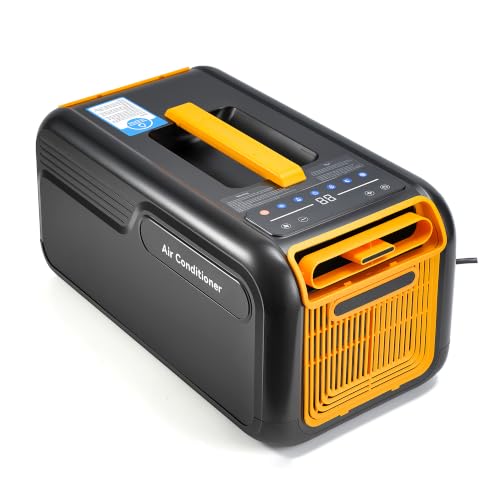
Low Power Consumption Portable Air Conditioner: The Complete Buying Guide
Portable air conditioners bring cooling to rooms that cannot support a window unit or ductwork. But not all portable ACs are equal when it comes to electricity draw. This guide explains what low power consumption really means, how to compare models fairly, and how to pick a portable AC that keeps cooling effective while keeping energy use modest.
Research-stage guide · Independent · Efficiency-focusedWhat "Low Power Consumption" Means for a Portable AC
A portable air conditioner's power consumption is the amount of electrical energy it draws while running. It is usually expressed in watts. For portable units, the running draw typically falls somewhere between 500 and 1,400 watts depending on cooling capacity, compressor design, and fan speed. A model described as low power consumption generally sits in the lower portion of that range while still delivering adequate cooling for the room it is rated for.
It is important to separate two ideas that are often confused: low wattage and high efficiency. A unit can draw few watts simply because it is small and weak. A genuinely efficient portable AC delivers more cooling per watt consumed. The better question is not "how few watts does it draw?" but "how much cooling does it deliver for each watt?" This distinction is central to choosing well, and it is why efficiency ratings matter more than raw wattage alone.
Portable air conditioners are a practical option for rooms without window support or ductwork. If your situation rules out a window unit entirely, our guide on cooling a room without a window covers the alternatives in detail. If you are comparing portable units against wall-mounted options, the broader category of low wattage air conditioners puts portable, window, and mini-split models side by side.
How Portable AC Power Draw Is Measured
Manufacturers report power consumption in several ways, and understanding the labels prevents misleading comparisons.
- Rated watts: The nominal running draw under standard test conditions. This is the number most commonly listed on the spec sheet and is the most useful starting point for comparison.
- Amperage: Current draw at a given voltage. In the United States, most portable ACs run on 115V household circuits, so a 900-watt unit draws roughly 7.8 amps. Amperage matters because it determines whether your circuit can carry the load safely.
- EER (Energy Efficiency Ratio): Cooling output in BTU divided by watts consumed. A higher EER means more cooling per watt. This is the single most useful efficiency figure for a portable AC.
- CEER (Combined Energy Efficiency Ratio): A newer rating that factors in standby and part-load operation, giving a more realistic picture than EER alone.
Be cautious with marketing phrases like "energy saving" that appear without a supporting EER or CEER figure. Without a measured efficiency ratio, a claim of low power consumption is not verifiable. The same caution applies to portable units advertised with vague efficiency language; comparing the rated wattage against the BTU output is the fastest way to see through the marketing.
The Core Formula
EER = Cooling BTU ÷ Watts consumed. Two portable ACs with the same BTU rating but different wattage will have different EER values. The one with the higher EER is the more efficient choice, even if its wattage number looks larger on paper.
Single-Hose vs Dual-Hose: The Biggest Efficiency Decision
The hose configuration is the most consequential design choice for portable AC efficiency, and it is frequently overlooked by buyers focused only on wattage.
A single-hose portable AC pulls air from the room, uses part of it to cool the condenser, and exhausts that air outside. This creates negative pressure in the room. Air that was already cooled is pushed outdoors, and warm outside air is drawn back in through gaps around doors and windows. The compressor then has to work harder to compensate. The net effect is that a single-hose unit often consumes more energy in practice than its rated wattage suggests.
A dual-hose portable AC uses one hose to draw outside air in for condenser cooling and a second hose to exhaust it. Because the condenser air loop is separate from the room air, the unit does not depressurize the room and does not pull in warm replacement air. Dual-hose models are consistently more efficient within the same tier and are the better starting point for anyone prioritizing low power consumption.
If you are specifically comparing dual-hose options, our roundup of the most efficient dual-hose portable air conditioners breaks down the design differences that matter. Hose length and routing also affect performance; a very long run can reduce efficiency, so it is worth understanding how a long exhaust hose affects portable AC operation before you buy.
| Design | Room Pressure Effect | Typical Efficiency | Best For |
|---|---|---|---|
| Single-hose | Creates negative pressure; draws in warm outside air | Lower in practice than rated | Occasional use, smallest rooms, entry-level tier |
| Dual-hose | Neutral; condenser loop isolated from room air | Higher and more consistent | Daily use, efficiency-focused buyers, mid-range and premium tiers |
| Dual-hose with inverter compressor | Neutral; smooth modulation of cooling output | Highest available in portable format | Extended cooling sessions, top-tier efficiency goals |
Inverter vs Fixed-Speed Compressors in Portable ACs
Compressor technology is the second major factor in power consumption. Fixed-speed compressors operate in a simple on-off cycle: the unit runs at full power until the room reaches the set temperature, then shuts off, then restarts when the room warms again. Each restart draws a surge of current, and the repeated cycling is less efficient than continuous modulation.
Inverter compressors vary their speed continuously. Instead of cycling fully on and off, they ramp up when the room is warm and slow down to a steady low output once the target temperature is reached. This produces three practical benefits for power consumption:
- Startup current surges are largely eliminated, smoothing the load on the circuit.
- Total energy use over a long cooling session is lower because the compressor is not repeatedly restarting.
- Room temperature stays more stable, so the unit is not fighting sudden warm-air spikes.
Inverter portable ACs usually sit in the mid-range to top-tier of the market. They are a worthwhile investment for anyone who runs a portable unit for several hours a day. For a broader look at how inverter technology changes operating behavior across product categories, our comparison of inverter vs non-inverter air conditioners explains the mechanics in depth. If you are weighing whether the technology is a long-term fit, the case for an air conditioner as a long-term investment applies directly to inverter portable units.
Watts, BTU, and Real Cooling Output
A portable AC's cooling capacity is rated in BTU per hour. The power it consumes to produce that cooling is rated in watts. The ratio between the two is what determines whether a unit is genuinely efficient. A 10,000 BTU portable AC drawing 900 watts has an EER of about 11.1. A 10,000 BTU unit drawing 1,200 watts has an EER of about 8.3. The first unit is meaningfully more efficient, even though both are sold as 10,000 BTU machines.
Matching capacity to room size is equally important. An oversized portable AC cools too quickly, cycles frequently, and leaves the room humid — a pattern that wastes energy and feels uncomfortable. An undersized unit runs continuously without reaching the set point, which is also inefficient. The right capacity depends on room area, ceiling height, sun exposure, occupancy, and whether the room is a kitchen or a bedroom.
For room-by-room capacity guidance, our portable air conditioner guide and the small room air conditioner efficiency guide cover the sizing logic. If your portable unit is being considered alongside a window option, the most efficient window air conditioner comparison is a useful cross-reference, since window units often deliver better efficiency for the same cooling output.
Quick Sanity Check
Before buying, divide the stated BTU by the stated watts. If the result is below roughly 8, the unit is on the inefficient side for its class. Above 10 is strong for a portable unit. This single calculation filters out most weak options faster than reading marketing copy.
Portable AC Efficiency Tiers
Rather than ranking models by price — which shifts constantly and is not a reliable proxy for efficiency — it is more useful to think in terms of market tiers. The tiers below describe where a portable AC sits relative to the category, based on design and efficiency features rather than any specific figure.
Entry-Level Tier
Single-hose, fixed-speed compressors. Adequate for occasional cooling in small rooms. Efficiency is the weakest in the category, and real-world performance often falls short of the rated figures due to negative pressure. A solid choice only when cooling needs are light and intermittent.
Mid-Range Tier
Dual-hose designs with fixed-speed or basic inverter compressors. This is where most efficiency-conscious buyers should start. Dual-hose construction removes the negative-pressure penalty, and the better models in this tier include programmable timers and multi-speed fans that reduce waste.
High-End Tier
Dual-hose with full inverter compressors, variable fan speeds, and smart controls. These units maintain stable temperatures with minimal cycling and are the most efficient option for daily, extended use. Well-specified for the category and a worthwhile investment for heavy users.
Top-Tier / Premium
The highest-efficiency portable units available, combining inverter compressors, dual-hose isolation, advanced filtration, and precise thermostat control. Feature-rich for their class and designed for buyers who prioritize long-term energy performance over any other factor.
Within each tier, look for the model with the highest EER or CEER and the most flexible fan and timer controls. A mid-range dual-hose unit will almost always outperform an entry-level single-hose unit on real power consumption, even if the entry-level model's wattage number looks lower on the spec sheet.
Setup and Usage Tips That Lower Power Draw
The most efficient portable AC can be undermined by poor setup. These adjustments preserve efficiency and reduce the load on the compressor:
- Seal the window kit completely. Gaps around the exhaust panel let warm air back in, forcing the unit to run longer. Use foam or weatherstripping to close any remaining space.
- Keep the exhaust hose short and straight. Bends and long runs restrict airflow and reduce cooling efficiency. Route the hose as directly outdoors as possible.
- Shade the room during peak sun. Closing blinds or curtains on sun-facing windows reduces the cooling load substantially, letting the portable AC reach its set point faster.
- Use the timer and smart scheduling. Running the unit only when the room is occupied avoids wasted cooling. Many mid-range and high-end units support scheduled operation.
- Clean the filter regularly. A clogged filter restricts airflow and forces the compressor to work harder. Rinsing or vacuuming the filter every few weeks preserves efficiency.
- Check the condenser coils. Dust buildup on the coils reduces heat exchange efficiency. Periodic cleaning keeps power draw near the rated figure.
- Do not oversize the unit for the room. An oversized portable AC short-cycles and dehumidifies poorly. Match capacity to room area for stable, efficient operation.
For installation specifics, our guide on installing a portable AC in a casement window and the walkthrough for crank-out window installation cover the sealing details that most affect efficiency. Routine upkeep also matters over time; the general guidance in our maintenance for HVAC systems section applies to portable units as well.
Pre-Purchase Checklist for a Low Power Portable AC
Before committing to a model, run through this checklist. It is designed to catch the mismatches that lead to disappointing efficiency after purchase.
Verify Before You Buy
- Confirm the unit is a dual-hose design, or a single-hose unit used only occasionally in a small room.
- Check whether the compressor is inverter-driven. If daily use is planned, an inverter model is the better fit.
- Calculate the EER (BTU ÷ watts) and compare it against other models in the same capacity class.
- Match the BTU rating to the room area, ceiling height, and sun exposure. Do not oversize.
- Confirm the unit's amperage is compatible with the circuit you will use, and that the outlet is not shared with other high-draw appliances.
- Check for a programmable timer, multiple fan speeds, and a thermostat with precise set-point control.
- Read the window kit specifications to confirm it fits your window type, and plan to seal any gaps.
- Look for washable filters and accessible condenser coils, since maintenance directly affects long-term power draw.
If your home has a central system that is underperforming in one room, a portable AC may not be the only answer. Our resources on residential HVAC and HVAC service providers cover how to evaluate whether a targeted fix or a portable supplement is the better path. The same applies if you are deciding between a portable unit and a more permanent solution covered in the mini-split AC system overview.
Frequently Asked Questions
How many watts does a low power consumption portable AC use?
Most low power consumption portable air conditioners draw between 500 and 900 watts during normal cooling operation. Dual-hose inverter models tend to sit at the lower end of that range, while single-hose fixed-speed units sit at the higher end. The exact figure depends on cooling capacity, compressor type, and ambient conditions.
Is a dual-hose portable AC more efficient than a single-hose unit?
Yes, in most real-world installations. A dual-hose design separates intake and exhaust air, which prevents the unit from pulling cooled indoor air out of the room to cool its own condenser. Single-hose models create negative pressure that draws warm outside air back in through gaps, forcing the compressor to work harder. Dual-hose models are consistently more efficient within the same tier.
Does an inverter compressor reduce portable AC power consumption?
An inverter compressor modulates its speed instead of cycling fully on and off. This smooths out power draw and avoids the high startup surge that fixed-speed compressors produce. Over longer cooling sessions, inverter portable ACs typically consume less total energy and maintain a more stable room temperature.
Can I run a low wattage portable AC on a standard household circuit?
Most low wattage portable ACs draw under 900 watts, which is well within the capacity of a standard 15-amp, 120-volt household circuit. However, the circuit should not be shared with other high-draw appliances. Check the unit's rated amperage and confirm that the outlet and breaker can handle the continuous load.
What is the most efficient way to set up a portable air conditioner?
Seal the window kit thoroughly, keep the exhaust hose as short and straight as possible, shade the room from direct sun during peak hours, and use the unit's timer or smart scheduling to avoid running it in an empty room. Keeping the filter clean and the condenser coils free of dust also preserves efficiency over time.
Ready to Compare Efficient Portable AC Options?
You now know how to read wattage against BTU, why dual-hose designs outperform single-hose units, and how inverter compressors change the efficiency equation. Use the checklist above, then explore the recommended models below to find a portable AC that matches your room and your energy priorities.
View Recommended Portable ACs