Portable Air Conditioner Intake and Exhaust: Complete Guide
Understanding how air moves through a portable air conditioner is the key to getting the most out of it. This guide explains intake and exhaust airflow, compares single-hose and dual-hose designs, and shows how to set up venting correctly so your unit cools efficiently.
START LEARNINGQuick reality check: Portable air conditioners are unlike window or central systems because they sit inside the room and must move heat out through a hose. Every portable AC has an intake path that brings air into the unit and an exhaust path that discharges heat outside. Understanding this airflow is essential for choosing the right model, avoiding negative pressure, and keeping the unit cool and efficient. If you are still deciding on the category, our portable air conditioner overview is a good starting point.
How Air Moves Through a Portable Air Conditioner
A portable air conditioner cools a room through a simple but important process. Warm room air is pulled across an evaporator coil, where refrigerant absorbs heat. The cooled air is blown back into the room. That absorbed heat, along with heat from the compressor, must be rejected somewhere. In a portable AC, this heat is discharged outdoors through an exhaust hose.
This creates two distinct air paths:
- Intake path: air that enters the unit to be cooled or, in dual-hose designs, air used to cool the condenser.
- Exhaust path: heated air that leaves the unit and is routed outside through a window or wall vent kit.
How these paths are separated determines whether the unit is single-hose or dual-hose, and that distinction has a significant effect on efficiency.
Single-Hose vs Dual-Hose: What's the Difference?
The two designs differ in how they manage intake for the condenser side. Both cool the room, but they behave differently in terms of pressure and efficiency.
| Feature | Single-Hose Portable AC | Dual-Hose Portable AC |
|---|---|---|
| Number of hoses | One (exhaust only) | Two (one intake, one exhaust) |
| Condenser cooling air source | Room air | Outdoor air |
| Effect on room pressure | Creates slight negative pressure | Balanced pressure |
| Net cooling efficiency | Lower | Higher |
| Weight and complexity | Lighter and simpler | Heavier with more setup |
| Best for | Small rooms, occasional use | Larger rooms, longer runtime |
For a deeper look at each design, see portable air conditioner single hose.
Single-Hose Design: Simplicity With a Trade-Off
In a single-hose portable AC, the unit draws room air into the evaporator and blows cooled air back into the room. The same air supply also cools the condenser, and then that air is exhausted outside through the hose. Because the unit is pulling air out of the room, the room becomes slightly negatively pressurized. The result is that warm outside air is drawn in through gaps, doors, and windows to replace what was exhausted.
This does not make single-hose units ineffective — they are still popular because they are lighter and simpler to set up — but they do lose some net cooling capacity compared to dual-hose designs. This is why a single-hose unit typically performs better in a small, well-sealed room.
Dual-Hose Design: Better Efficiency
Dual-hose portable ACs use one hose to pull outdoor air in to cool the condenser, and a second hose to discharge that heated air outside. The room air used for cooling is separated from the air used for condenser cooling, so the unit does not depressurize the room. This design generally delivers better net cooling and avoids pulling in warm outside air through gaps.
Dual-hose units are more common in larger and higher-capacity portable models, and they are often the better choice when the unit will run for many hours per day. Setup is slightly more involved because two hoses must be routed to the window kit. Our related guide to portable air conditioner intake and exhaust explains how to manage both hoses correctly.
Exhaust Hose: Setup and Best Practices
The exhaust hose is the part of the system most often set up incorrectly, and it has a direct effect on performance. Follow these practices:
- Keep the hose as short and straight as possible. Bends and kinks restrict airflow and reduce cooling.
- Do not exceed the manufacturer's maximum length. Longer runs reduce capacity and may strain the blower.
- Use an insulated sleeve if the hose runs through a warm room, since an uninsulated hose radiates heat back into the space. See portable air conditioner insulated exhaust hose.
- Seal the window kit to prevent warm outside air from leaking around the vent panel.
- Route the hose downward slightly toward the outside so condensate cannot drain back into the unit.
Intake Considerations
The intake side of a portable AC is often overlooked, but it matters for both cooling and unit longevity.
Indoor Air Intake (Single-Hose)
The unit draws air from the room through grilles on its cabinet. Keep these grilles clean and unobstructed. Filters on the intake side should be cleaned or replaced on a regular schedule, especially in dusty environments.
Outdoor Air Intake (Dual-Hose)
The intake hose must draw outside air. Make sure the intake end is positioned so it is not pulling exhaust air from the exhaust hose. Route the two hoses so they do not cross or run against each other, which would cause heat to cycle back into the unit.
Clearance Around the Unit
Manufacturers specify minimum clearances around the intake and exhaust. Blocking these areas with furniture or curtains reduces airflow, reduces cooling, and can cause the compressor to overheat.
Window and Wall Venting Options
The exhaust must reach the outdoors. How you vent depends on the window or wall type.
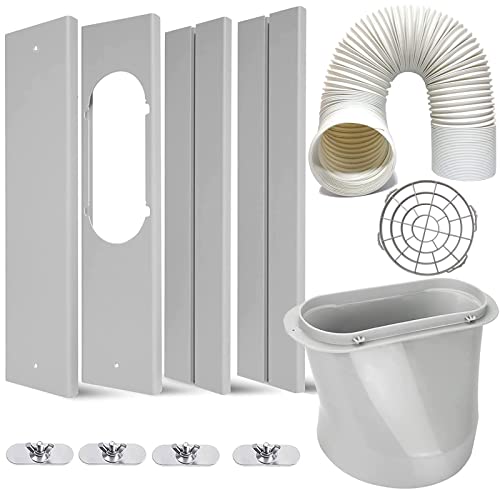
- Standard double-hung windows: most kits include a slider panel that fits vertically.
- Sliding windows: horizontal slider panels are available. See portable air conditioner sliding window kit.
- Casement and crank-out windows: special kits are required because the window opens on a hinge rather than sliding. See portable air conditioner window kit for crank window.
- Wall venting: some units support permanent wall venting, which is more efficient and requires less setup each season.
If your room does not have a standard window, our guide to portable air conditioner without window vent discusses alternatives, and portable air conditioner for casement windows covers the most common non-standard window scenario.
Common Intake and Exhaust Problems
Unit is not cooling well
Often caused by a kinked or overlong exhaust hose, blocked intake grilles, or a window kit that does not seal well. Check these three areas before assuming the unit is failing. See portable air conditioner not cooling enough for a fuller diagnostic sequence.
Exhaust hose is very hot
This is normal because the hose carries hot air. Use an insulated sleeve to reduce heat radiation. If the hose is unusually hot or the unit struggles to cool, check that the outdoor vent is not blocked.
Warm air blowing back into the room
Usually caused by an exhaust hose that has disconnected or a window kit that has opened. Reconnect the hose firmly and reseal the kit. Occasionally, the exhaust and intake hoses on a dual-hose unit have been crossed; verify each hose is connected to the correct port.
Unit shuts off unexpectedly
Portable units have thermal overload protection. If the intake or exhaust is blocked, or the hose is too long or crushed, the unit may shut off to protect the compressor. Restore proper airflow and let the unit cool down before restarting.
Choosing the Right Design for Your Room
The right intake and exhaust configuration depends on the room and how the unit will be used.
- Small, well-sealed rooms: a single-hose model is usually sufficient and easier to set up.
- Larger or frequently used rooms: a dual-hose model provides better efficiency and fewer pressure effects.
- Rooms with limited window space: consider a single-hose unit with a compact window kit, or explore portable air conditioners no venting required (note that true no-vent cooling is not possible for compressor-based units).
- Long operating hours: favor dual-hose and inverter designs for efficiency and durability. See portable air conditioner with inverter technology.
For small room guidance, see portable air conditioners for small rooms.
Frequently Asked Questions
What is the intake and exhaust on a portable air conditioner?
The intake and exhaust describe how air moves through a portable air conditioner. The intake brings air into the unit, and the exhaust discharges hot air out of the room through a hose and window or wall kit. In a single-hose design, the unit draws room air in, cools part of it, and exhausts the heated air outside. In a dual-hose design, the unit uses a separate intake hose to draw outside air for cooling the condenser, which is then exhausted back outside.
Is a dual-hose portable AC better than a single-hose model?
Dual-hose portable ACs are generally more efficient because they avoid using already-cooled room air to cool the condenser. Single-hose units pull air out of the room, creating negative pressure that can draw warm outside air in through gaps. Dual-hose models separate intake and exhaust, which improves net cooling. However, dual-hose units are typically heavier and may be more expensive than comparable single-hose models.
Can I extend the exhaust hose on a portable air conditioner?
Most manufacturers specify a maximum exhaust hose length, often around five to nine feet. Extending the hose beyond the manufacturer's limit can reduce cooling performance and strain the unit. If a longer run is unavoidable, use insulated hose sections and keep the run as straight as possible. Never modify the hose in a way that voids the warranty.
Why is my portable AC exhaust hose getting hot?
The exhaust hose carries hot air from the condenser to the outside, so it naturally gets warm. An insulated hose sleeve reduces heat radiating back into the room. If the hose is very hot or the unit is not cooling well, check that the hose is not kinked, crushed, or excessively long, and confirm that the outdoor vent is unobstructed.
Does a portable air conditioner need fresh air intake from outside?
No. Most single-hose portable ACs use room air for the evaporator side and only exhaust hot air outside. Dual-hose models use outside air for the condenser side. Portable ACs are not designed to bring in fresh outdoor air for ventilation; their intake is for the cooling process, not for indoor air quality.
Final Thoughts
Portable air conditioner intake and exhaust is the single most important factor in how well these units perform in a real room. Single-hose models are simpler but slightly less efficient; dual-hose models cost more and weigh more, but they deliver better net cooling. Regardless of design, correct setup is essential: short, straight hoses, a well-sealed window kit, and clear intake grilles make the difference between a unit that cools effectively and one that struggles. For more guidance, explore our related articles on portable air conditioner models and portable air conditioner without a window vent.