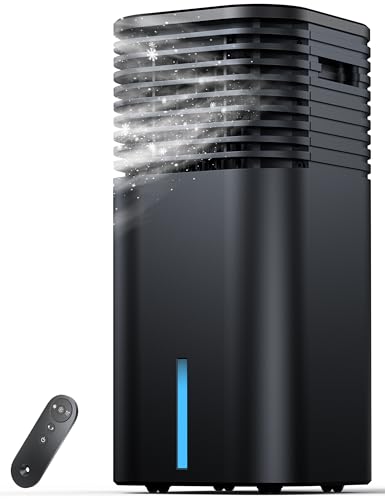
Portable Air Conditioners for Small Rooms: The Complete Guide
Small rooms present a specific cooling challenge: the space heats quickly, the unit sits close to the occupant, and every inefficiency is noticeable. This guide explains how to size a portable air conditioner for a small room, where to place it, how to vent it properly, and which features matter most when floor space is limited and noise is a real consideration.
Why Small Rooms Need a Different Approach
A small room has a low cooling load in absolute terms, which means a modest portable air conditioner can reach the set temperature quickly. That is the good news. The challenge is that everything about the unit becomes more noticeable in a compact space: the noise, the floor footprint, the exhaust hose, and the way cooled air is distributed.
Placement matters more than in a large room. A unit that is tucked into a corner cannot circulate air effectively, and one that blows directly onto the occupant creates a cold draft that feels uncomfortable. The exhaust hose also occupies usable space, and in a small room it is more likely to cross a walkway or block a window.
Oversizing is a common mistake. A unit that is too large for the room cools it quickly, then cycles the compressor on and off, which removes humidity less effectively and increases wear. In a small room, correct sizing produces smoother and more comfortable results than raw capacity.
BTU Sizing for Small Rooms
The starting guideline is 20 BTU per square foot of floor area, adjusted for ceiling height, sun exposure, occupancy, and heat-producing appliances. For small rooms, the range that matters most is between 5,000 and 10,000 BTU.
| Room Area | Typical BTU Range | Common Room Types |
|---|---|---|
| Up to 100 sq ft | 5,000 - 6,000 BTU | Dorm room, small office, nursery |
| 100 - 150 sq ft | 6,000 - 8,000 BTU | Bedroom, study |
| 150 - 250 sq ft | 8,000 - 10,000 BTU | Studio apartment, guest room |
Adjust upward by roughly 10 percent for a room with large south- or west-facing windows, for rooms with more than two regular occupants, and for kitchens where cooking heat is present. Adjust downward for heavily shaded rooms, basements, and rooms that are already partially cooled by a central system.
For focused guidance on the smallest spaces, see portable AC for a very small room and the article on portable AC for a small window, which matters if the only venting opening is narrow.
Best Portable AC Types for Small Spaces
Single hose portable AC
A single hose unit is the most common configuration for small rooms. It is compact, simple to install with one window panel, and typically lighter than dual hose models. The trade-off is that it creates a slight negative pressure in the room, which is manageable if gaps are sealed. The guide to single hose portable air conditioners explains the mechanics in detail.
Dual hose portable AC
A dual hose unit maintains room pressure better and can be more efficient in hot, poorly sealed spaces. It takes up more floor space and requires a larger window kit, which can be a constraint in a small room. For a compact bedroom, the added bulk may not be worth the efficiency gain; for a small but very hot room with a leaky window, dual hose can be the better performer.
Compact and slimline units
Some manufacturers offer slimline portable units designed for narrow spaces. These are worth considering when floor space is the binding constraint. The guide to portable AC on wheels covers how caster design affects maneuverability in tight rooms.
Combination units
If the same small room needs heating in cooler months or moisture control in humid conditions, a 3-in-1 unit can replace two or three separate appliances. The article on portable AC with heater and dehumidifier explains the trade-offs of the combination format.
Placement and Airflow in a Small Room
Placement determines whether a small room feels comfortable or unevenly cooled. The goal is to keep the exhaust hose short, allow airflow around the unit, and direct cooled air into the occupied area without blowing directly on the occupant.
Placement guidelines
- Position the unit near the window used for exhaust, ideally with the hose running straight out.
- Leave at least 12 to 20 inches of clearance behind the unit for the rear intake.
- Aim the front grille across the room or at a wall, not directly at a bed or desk.
- Keep curtains and furniture away from the intake and exhaust.
- Place the unit on a level surface; casters can drift on uneven floors.
- If possible, place the unit so the hose does not cross a walkway.
In a bedroom, placing the unit near the foot of the bed rather than beside the head reduces noise exposure. In a home office, placing it behind and to the side of the desk keeps the airflow moving without blowing papers. The guide to portable air conditioning unit for bedroom covers bedroom-specific placement in more detail.
Venting Options for Small Windows
Small rooms often have small windows, and the window style determines which kit works. The most common styles are sliding windows, casement windows, crank-out windows, and narrow single-hung windows. Each requires a specific adapter or panel configuration.
Window kits by style
- Sliding windows: covered in the sliding window kit overview.
- Casement windows: see the casement window guide and the casement window kit article.
- Crank-out windows: covered in the crank-out window guide and the crank-out window kit overview.
- Side-opening windows: see the side-opening window guide.
- Narrow openings: covered in the small window guide.
If the room has no suitable window at all, the options narrow considerably. The guides to portable AC for a room with no window and portable AC without a window vent explain the limited alternatives, including sliding door kits and wall vents.
Efficiency in Tight Spaces
In a small room, efficiency gains come from reducing the cooling load and improving the way the unit operates. Small changes produce noticeable results because the room reaches its set point quickly.
Steps that improve efficiency
- Seal gaps around doors and windows with weatherstripping or a draft stopper.
- Keep the exhaust hose short, straight, and free of kinks.
- Use an exhaust hose insulation sleeve to reduce heat radiated back into the room.
- Shade windows during the hottest hours with blinds or curtains.
- Close the door to the room so cooling is not lost to adjacent spaces.
- Turn off heat-producing appliances when the unit is running.
- Use a timer or schedule to run the unit before the room heats up, rather than after.
For readers comparing efficiency across form factors, the analysis of the most energy efficient room air conditioner options provides useful context. Readers interested in smoother compressor operation should review portable AC with inverter technology, which modulates speed instead of cycling on and off.
The explanation of portable AC intake and exhaust helps readers understand why some designs perform better in small, sealed rooms.
Noise Considerations for Small Rooms
In a small room, the unit is physically close to the occupant, so noise is more noticeable than in a large living area. The compressor and the fan contribute different types of noise: the compressor produces a low hum, while the fan produces broadband air noise that rises with fan speed.
Reducing perceived noise
- Choose a model with a low-speed quiet mode if the room is a bedroom or office.
- Place the unit as far from the bed or desk as the layout allows.
- Run the fan on low or auto once the room reaches the set temperature.
- Place the unit on a mat to reduce vibration transmitted to the floor.
- Avoid placing the unit against a wall that shares a surface with a headboard.
Decibel ratings are useful for comparison, but perceived noise also depends on tone. A unit with a slightly higher rating but a smoother sound profile may be less disruptive than a louder, harsher unit. Reading reviews that mention bedroom use is often more informative than the rating alone.
Drainage and Maintenance in Small Rooms
Moisture removal is part of the cooling process. Many portable units include a self-evaporating system that disposes of condensate through the exhaust stream in moderate humidity. In humid conditions, the tank may fill and require manual emptying or a gravity drain hose.
In a small room, drainage planning matters because the unit may sit in a tight spot. Position the unit so the drain plug is accessible, and route the drain hose to a bucket or floor drain without crossing a walkway. The guides to portable AC with no drain required and self-evaporating system explain the options in detail.
Routine maintenance
- Clean or replace the air filter every two to four weeks during heavy use.
- Empty the condensate tank before it reaches the shutoff level.
- Inspect the exhaust hose for kinks, cracks, or detached connectors.
- Vacuum the rear intake grille to remove dust buildup.
- Store the unit upright and covered during the off-season.
Common problems
- Not cooling enough: check filter condition, hose sealing, and room size against capacity. See portable AC not cooling enough.
- Compressor not running: the troubleshooting steps in my AC compressor is not running apply to portable units as well.
- Unit runs but air is not cold: the diagnostics in my AC is off but still blowing air and my AC is turning on but not blowing air help isolate fan versus compressor issues.
- General cooling failure: the broader checklist in my AC isn't blowing cold air covers refrigerant, airflow, and thermostat causes.
Best Use Cases for Small-Room Portable ACs
Where these units perform well
- Bedrooms: a correctly sized unit cools a bedroom quickly and can run on a schedule overnight. See the bedroom unit guide.
- Home offices: direct cooling for a workspace occupied for defined hours.
- Dorm rooms and studios: compact units fit tight layouts and require only a single window panel.
- Rentals: no permanent installation and no landlord approval needed for a window panel. See the guide to portable air conditioning units for rent.
- Guest rooms and nurseries: supplemental cooling for rooms that are not connected to central air.
Where a different solution makes more sense
- Whole-home cooling: a portable unit cools one room, not a house. Central air or a multi-zone mini-split is the appropriate class of solution.
- Rooms without any venting path: see portable AC for a room with no window for the limited options.
- Off-grid use: compressor-based units need reliable power; see off-grid cooling for the alternative approaches.
- Very large rooms: a portable unit struggles beyond a certain area. The guide to portable AC for a 500 sq ft room explains the practical limits.
For commercial spaces, the portable AC for commercial use overview explains how duty cycle and operating hours affect the choice of configuration.
Buying Checklist for Small-Room Portable ACs
Use this checklist to compare models on the factors that matter most when floor space is limited.
| Factor | What to Look For | Why It Matters |
|---|---|---|
| Capacity | BTU rating matched to room area | Prevents short cycling and uneven cooling |
| Footprint | Width, depth, and height of the unit | Determines whether it fits the available floor space |
| Window kit | Panel type compatible with your window style | Keeps installation straightforward |
| Hose length | Long enough to reach the window without kinks | Affects placement flexibility |
| Noise | Decibel rating and low-speed quiet mode | Critical for bedrooms and home offices |
| Drainage | Self-evaporating system or gravity drain option | Reduces manual maintenance in humid conditions |
| Controls | Timer, remote, and optional Wi-Fi | Improves scheduling and convenience |
| Build tier | Entry-level, mid-range, or premium construction | Signals expected durability and feature depth |
Readers who want remote scheduling should review the options for portable AC with Wi-Fi control. Those who prefer a cooling-only unit can compare against the portable air conditioner without dehumidifier category.
Ready to Choose a Small-Room Portable AC?
You now understand how to size a portable air conditioner for a small room, where to place it, how to vent it through the available window, and which features matter most when space and noise are constrained. Compare the recommended models below and select a unit that fits your room and layout.
Compare Recommended ModelsFrequently Asked Questions
What size portable air conditioner do I need for a small room?
A common guideline is 20 BTU per square foot. A room up to 150 square feet typically needs around 5,000 to 6,000 BTU, and a room between 150 and 250 square feet usually needs around 8,000 to 10,000 BTU. Adjust upward for sun exposure, occupancy, and heat-producing appliances.
Where should I place a portable air conditioner in a small room?
Place the unit near the window or venting opening so the exhaust hose is as short and straight as possible. Leave clearance behind and around the unit for airflow, keep it away from curtains and furniture, and aim the front grille so cooled air circulates into the occupied area rather than against a wall.
Is a single hose or dual hose portable AC better for a small room?
Single hose units are more compact and simpler to install, which suits small rooms well. Dual hose units maintain room pressure better and can be more efficient in hot climates. For a small, well-sealed bedroom, a single hose model is often the practical choice; for a hot, poorly sealed space, dual hose may perform better.
Will a portable air conditioner cool a small room effectively?
Yes, if the unit is correctly sized and the room is reasonably sealed. Portable air conditioners are well suited to small rooms because the cooling load is modest and the unit can reach the set point quickly. Sealing gaps, insulating the exhaust hose, and closing doors improves performance noticeably.
How loud is a portable AC in a small room?
Noise levels vary by model and fan speed. In a small room, the unit is physically close to the occupant, so noise is more noticeable than in a large space. Look for a model with a low-speed quiet mode if the room is a bedroom or home office, and place the unit away from the head of the bed or the desk.
Do portable air conditioners need to be drained in a small room?
Many models include a self-evaporating system that disposes of condensate through the exhaust stream in moderate humidity. In humid conditions the tank may fill and require manual emptying, or a gravity drain hose can be connected. In a small room, plan a drain location that does not obstruct foot traffic.