What Indoor Humidity Should Be
Understand the ideal indoor humidity range for comfort, health, and energy efficiency — and learn how your air conditioner helps you get there
SEE THE IDEAL RANGEQuick answer: For most homes, indoor relative humidity should stay between 30% and 50%. In summer, aim for 40%–50%. In winter, 30%–40% is usually best. Keeping moisture in this band protects your health, your home, and the efficiency of your cooling system.
Indoor humidity is one of the most overlooked parts of home comfort. Most people focus on temperature, but the amount of moisture in the air decides whether a room feels refreshing or sticky, whether windows fog up, and whether mold has a chance to settle in. This guide explains what indoor humidity should be, how to measure it, and how to correct it using your air conditioner, ventilation, and dedicated moisture-control equipment.
If you are still learning how your cooling system manages moisture, start with a general overview of what air conditioning is and how the cooling process also dehumidifies the air inside your home.
The Ideal Indoor Humidity Range at a Glance
Relative humidity (RH) is the percentage of moisture the air currently holds compared to the maximum it could hold at that temperature. The table below summarizes recommended targets for common situations. Use it as a reference, then adjust slightly based on how your home feels and any health considerations in your household.
| Situation | Recommended RH | Why It Matters |
|---|---|---|
| General healthy home | 30% – 50% | Supports comfort, limits mold and dust mites, and reduces respiratory irritation. |
| Summer / cooling season | 40% – 50% | Balances comfort with the natural dehumidification from running the AC. |
| Winter / heating season | 30% – 40% | Prevents window condensation and keeps the air from becoming uncomfortably dry. |
| Bedroom / sleeping areas | 30% – 50% | Promotes restful sleep and reduces allergen activity near bedding. |
| Basement | 30% – 50% (never above 55%) | Basements are prone to dampness; staying in range discourages mold growth. |
| Home with allergy or asthma concerns | 30% – 45% | Lower end of the range helps limit dust mites and mold spores. |
How Your Air Conditioner Affects Indoor Humidity
An air conditioner does more than cool the air — it also removes moisture. As warm air passes over the cold evaporator coil, water vapor condenses on the coil and drains away. This is why a properly running AC naturally brings indoor humidity down during the cooling season.
However, the AC only controls humidity effectively when it runs long enough to complete that condensation cycle. A system that is oversized for the home cools the air too quickly and shuts off before enough moisture is removed. The result is a room that feels cold and clammy at the same time. If that sounds familiar, review the differences between non-inverter and inverter AC systems, since inverter models can modulate their output and run longer at lower capacity, which often improves dehumidification.
For a broader explanation of the cooling cycle and the components involved, the guide on what a central air conditioner is walks through how the indoor and outdoor units work together to cool and dry the air.
Signs Your AC Is Managing Humidity Well
- The home feels comfortable at a slightly higher thermostat setting.
- Windows and mirrors do not fog up during normal cooling.
- There is no persistent musty or damp smell in rooms.
- Floors and furniture do not feel sticky or clammy.
- Condensate drains steadily from the indoor unit or drain line.
Signs Your AC Is Not Managing Humidity Well
- The house feels cold but still humid or sticky.
- Frequent short on-off cycles (short cycling).
- Moisture on supply vents or condensation on ducts.
- Mold spots appearing on walls, ceilings, or around vents.
- Clammy air in specific rooms even when the thermostat is satisfied.
If the system is not cooling at all, the problem may be unrelated to humidity. See the guide on why central air is not cooling before assuming moisture control is the only issue.
What Happens When Humidity Is Too High or Too Low
Staying inside the 30%–50% band is not just about comfort. Both extremes create problems that affect your home and your health. The cards below summarize the most common consequences.
Above 60% (Too High)
Mold and mildew growth, dust mites, musty odors, condensation on windows, warped wood, and a sticky feeling even at cool temperatures.
50% – 60% (Borderline)
Manageable for many homes but risky in basements and humid climates. Monitor closely and improve ventilation where possible.
30% – 50% (Ideal)
Comfortable, healthy, and efficient. This is the target range for most homes in both summer and winter.
Below 30% (Too Low)
Dry skin, irritated eyes and throat, static electricity, cracked wood, and increased susceptibility to colds and sinus irritation.
If your home stays above 60% for extended periods, read what to do about high humidity in the house. It covers ventilation, dehumidification, and source control in detail. For a room-level problem, what to do if my room is too humid offers practical fixes before you consider larger equipment.
On the other end of the scale, persistent dryness usually calls for a humidifier. The guide on whole-house humidifier systems explains how central humidification integrates with your existing HVAC setup.
Seasonal Adjustments: Summer vs Winter
The ideal indoor humidity changes slightly with the seasons. In summer, the air outside is warm and carries more moisture, so your AC does most of the dehumidifying. In winter, cold outdoor air holds very little moisture, and heating that air lowers its relative humidity further — which is why homes often feel dry in cold weather.
For summer-specific guidance, see what humidity should my house be in summer. For winter targets and window-condensation prevention, read what should indoor humidity be in the winter.
Room-by-Room Humidity Considerations
Not every room needs the same treatment. Kitchens and bathrooms generate moisture quickly, while bedrooms and living areas benefit from a stable mid-range. Basements are the most vulnerable space in most homes.
Bedrooms
Aim for 30%–50%. Stable humidity supports better sleep and reduces dust mite activity around bedding. If the air feels dry, see what to use for dry air in bedroom.
Living Areas
Keep within the 30%–50% band. These rooms usually have the most occupants and electronics, so comfort matters. Cross-check with the ideal humidity for your home.
Basements
Target 30%–50% and never exceed 55%. Basements are prone to dampness; consult what should your basement humidity be for targeted advice.
Bathrooms & Kitchens
Use exhaust fans to remove moisture at the source. These rooms can briefly exceed the ideal range, but moisture should clear quickly.
How to Measure Indoor Humidity Accurately
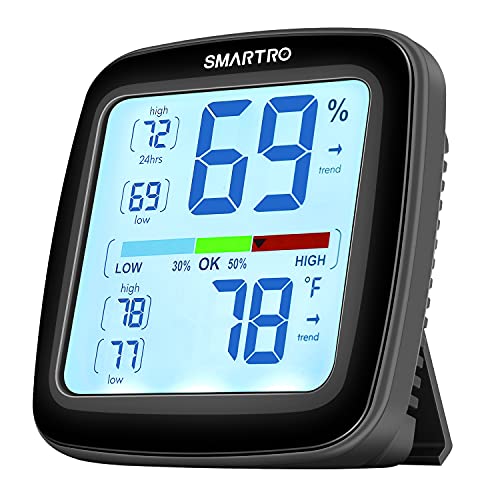
You cannot manage what you cannot measure. A dedicated hygrometer or a smart thermostat with humidity sensing gives you real numbers instead of guesswork.
- Portable hygrometer: An entry-level device that shows temperature and relative humidity in a single room.
- Smart thermostat: Mid-range and high-end tier thermostats often report indoor humidity and can trigger dehumidification or ventilation. See Wi-Fi HVAC thermostats for options.
- Whole-house monitoring: Some modern HVAC systems log humidity trends over time, which helps identify seasonal patterns.
Measure in several rooms, not just one. Humidity can vary significantly between floors, especially in multi-story homes and finished basements. The article on typical humidity in a house explains how readings vary across a home and what ranges are normal.
How to Correct Indoor Humidity
Once you know your numbers, choose the right solution. Mild deviations can often be corrected with simple habits; persistent problems usually require dedicated equipment.
| Problem | Solution Tier | Best For |
|---|---|---|
| Slightly high humidity in one room | Essential tier | Better ventilation, exhaust fans, and reduced moisture sources. |
| Persistent high humidity across the home | Balanced tier | A whole-house dehumidifier integrated with the HVAC system. |
| Dry air in winter | Balanced tier | A whole-house humidifier or a room-level humidifier for targeted areas. |
| Poor air exchange and stale rooms | High-end tier | A whole-house ventilation system to bring in fresh, filtered air. |
| Humidity problems with no ductwork | Mid-range | Ductless options, such as a whole-house ductless heating and cooling system, paired with a dehumidifier. |
If the AC itself is the weak link, consider whether a system upgrade is warranted. The guide on whole-house air conditioning systems covers sizing, efficiency, and integration with humidity control. Efficiency ratings matter too: a higher SEER rating often correlates with better moisture removal, and what SEER rating should I buy helps you match the rating to your climate.
For air quality in general, a whole-house air purifier complements humidity control by filtering allergens that thrive in damp or dry conditions.
When to Call an HVAC Professional
DIY adjustments go a long way, but some humidity issues point to deeper HVAC problems. Call a qualified technician if you notice any of the following:
- Persistent humidity above 60% despite ventilation and dehumidification efforts.
- The AC short-cycles frequently or never reaches the thermostat setpoint.
- Water pooling near the indoor unit, or ice forming on the evaporator coil.
- Musty odors coming from vents, which may indicate mold growth inside ductwork.
- Humidity spikes after a recent installation or system change.
The article on when to call an HVAC technician explains the symptoms that should not be ignored. Regular maintenance also helps: when to replace your AC filter covers the simple habit that keeps airflow — and moisture removal — working as designed.
Frequently Asked Questions
What indoor humidity should be for a healthy home?
Most health organizations and HVAC professionals recommend 30%–50% relative humidity. This range supports comfort, discourages mold and dust mites, and reduces respiratory irritation.
Should indoor humidity be different in summer and winter?
Yes. In summer, target 40%–50% because the AC is actively removing moisture. In winter, 30%–40% is better — it keeps the air comfortable while reducing condensation on cold windows.
How does an air conditioner affect indoor humidity?
As air passes over the cold evaporator coil, moisture condenses and drains away. A properly sized AC running long enough cycles will keep humidity in range. An oversized unit may cool too quickly and leave excess moisture behind.
What humidity level is too high indoors?
Above 60% relative humidity is generally considered too high. It encourages mold growth, dust mites, and musty odors. Persistent high humidity usually requires a whole-house dehumidifier or improved ventilation.
What humidity level is too low indoors?
Below 30% relative humidity is generally considered too low. It can cause dry skin, irritated eyes, static electricity, and cracking wood. A whole-house humidifier can restore comfortable moisture levels.
Can I control humidity with a portable air conditioner?
Portable AC units do remove some moisture, but their dehumidification capacity is limited. For a single room, a portable unit may be sufficient. For whole-home control, a central system or dedicated dehumidifier is more effective. See what is a good portable air conditioner for guidance on choosing a unit.
Why does my house feel humid even when the AC is running?
Common causes include an oversized AC that short-cycles, a clogged filter restricting airflow, a refrigerant issue, or excessive moisture sources. Check the filter first, then review what to do about humidity in the house before calling a technician.
What is a good humidity level for a house in general?
For most homes, 30%–50% is the target. Within that band, 40%–50% is comfortable in summer and 30%–40% is comfortable in winter. The article on what's a good humidity level for a house expands on these targets.
Ready to Bring Your Home Into the Ideal Humidity Range?
Compare air conditioners and moisture-control equipment that are well specified for their tier. Browse our recommended units below and choose the option that fits your home, climate, and comfort goals.
Explore Recommended Units