
Portable Air Conditioner for 800 Square Feet: The Complete Buying Guide
Everything you need to size, select, and use a portable air conditioner that reliably cools an 800 square foot room, living area, or open-plan space.
See Recommended ModelsWhy 800 Square Feet Needs Special Attention
An 800 square foot space sits in an awkward middle zone. It is larger than most single rooms, so a typical bedroom-sized portable unit will struggle, yet it is usually smaller and more contained than a whole-home cooling scenario. That makes choosing the correct capacity and unit design far more important than for a small bedroom.
In practice, 800 square feet often corresponds to a studio apartment, a large living room combined with an open kitchen, a finished basement, a garage conversion, or a spacious master suite. Each of these spaces has different heat loads. A sun-drenched living room with west-facing windows behaves very differently from a shaded basement, even at the same square footage.
Portable air conditioners are a practical fit for these situations because they require no permanent installation and can be moved between areas. However, they also have real limitations, especially around venting and airflow distribution. Understanding those limitations up front helps you avoid the most common mistake: buying an underpowered unit and expecting it to cool a large space effectively.
BTU Sizing for 800 Square Feet
BTU (British Thermal Unit) is the standard measure of cooling capacity. As a rough starting guideline, many sizing charts use about 20 BTU per square foot for standard ceiling heights and moderate climates. That points to roughly 16,000 BTU for 800 square feet, though real-world conditions shift this number in both directions.
Manufacturers often rate portable units for 800 square feet at around 14,000 BTU and upward, assuming favorable conditions. If your space has high ceilings, large windows, poor insulation, or intense afternoon sun, you should plan for the higher end of the range or beyond. Conversely, a well-insulated, shaded room with a moderate climate may perform acceptably with a slightly lower-rated unit.
| Room Condition | Suggested Capacity Range | Notes |
|---|---|---|
| Shaded, well-insulated, standard ceiling | ~14,000 BTU | Favorable conditions; lower end of the range is workable |
| Average room, moderate sun, standard ceiling | ~15,000–16,000 BTU | Typical starting point for 800 square feet |
| High ceilings, large windows, strong sun | ~18,000 BTU or higher | Consider dual-hose and higher airflow |
| Kitchen-adjacent open plan or many occupants | ~18,000 BTU or higher | Appliances and people add heat load |
Other factors that push you toward a higher capacity include the number of people regularly in the room, heat-producing appliances, and whether the space is a top-floor room with a hot roof above. If you are cooling a divided floor plan rather than an open area, consider whether a single high-capacity unit can realistically push cool air into adjacent rooms, or whether two smaller units might distribute comfort more evenly.
For a deeper walkthrough of the sizing formula, see our guide on how to size an air conditioner. If you are comparing this room size with adjacent ones, the guidance for a 700 square foot portable AC setup and a 1000 square foot portable AC setup can help you calibrate expectations.
Dual-Hose vs Single-Hose: The Decision That Shapes Performance
Portable air conditioners come in two main venting configurations. Single-hose units pull air from the room, use it to cool the condenser, and exhaust hot air out through one hose. This creates negative pressure inside the room, which draws warm outside air back in through gaps and cracks, reducing overall efficiency.
Dual-hose units use one hose to draw outdoor air in for the condenser and a second hose to exhaust hot air out. This balanced approach reduces negative pressure and re-infiltration, making dual-hose models generally more effective for larger spaces like 800 square feet. The trade-off is that dual-hose units are typically bulkier and require a wider window or wall vent setup.
Dual-Hose Advantages
- Better cooling performance in large rooms
- Less negative pressure and warm-air re-entry
- More consistent temperature across an open area
- Usually stronger airflow for the same nominal capacity
Single-Hose Considerations
- Simpler setup and often lighter
- Can struggle to maintain comfort in very large spaces
- Negative pressure pulls in warm outdoor air
- Better suited to smaller, enclosed rooms
If you are cooling 800 square feet and want the most reliable performance, dual-hose is the safer choice. If you already own a single-hose unit or prefer a simpler setup, you can improve results by sealing the room as tightly as possible and using the unit in a more contained zone. For readers comparing related configurations, our guides on a non-window vented portable air conditioner and a portable AC that doesn't need to be vented clarify which venting options actually exist and which claims to be cautious about.
Key Features That Matter for an 800 Sq Ft Space
Beyond capacity and hose design, several features directly affect comfort and usability in a larger room. Prioritize the ones that match how you actually use the space rather than chasing every available feature.
Airflow and Fan Speeds
Higher airflow (measured in cubic feet per minute, or CFM) helps cool air travel farther across an open floor plan. Multiple fan speeds let you run the unit at a lower, quieter setting once the room reaches a comfortable temperature. For 800 square feet, look for units with strong maximum airflow and at least three fan speeds.
Dehumidification
Portable air conditioners remove moisture as a byproduct of cooling. In humid climates, a higher dehumidification rate improves comfort and helps prevent a clammy feeling. Many units also offer a dedicated dehumidify mode that runs the fan and compressor without full cooling. If humidity is a major concern, see our guide to a portable air conditioner dehumidifier setup.
Drainage Options
Condensate has to go somewhere. Most portable units collect water in an internal tank that must be emptied, while some support continuous drainage via a hose. For long cooling sessions in a large room, continuous drainage reduces interruptions. You can learn more about portable AC that doesn't need to be drained and portable AC you don't have to drain to understand which designs minimize manual emptying.
Noise Level
High-capacity units are generally louder than small ones because they move more air. If the 800 square foot space is a living room or home office, check decibel ratings and read owner feedback about real-world noise. A unit that cools well but is too loud to tolerate will not get used consistently.
Smart Controls and Scheduling
Wi-Fi control and programmable timers are useful in a large space because you can start cooling before you arrive or schedule it around peak heat. These features are more common in mid-range and high-end tier models. They are convenience features, not core performance features, so weigh them accordingly.
Placement and Venting Tips for Large Rooms
Even a correctly sized portable air conditioner will underperform if it is poorly placed or vented. A few practical adjustments make a noticeable difference in an 800 square foot space.
- Position near the heat source: Place the unit where the largest heat gain occurs, typically near sun-exposed windows or an open kitchen area, so it can intercept heat before it spreads.
- Keep the exhaust hose short and straight: Long, kinked, or looping hoses reduce exhaust efficiency. Use the shortest practical route to the window.
- Seal the window kit: Gaps around the window panel let hot air back in. Use the included foam seals and consider additional weather stripping.
- Avoid corners and tight alcoves: The unit needs clearance around the intake and exhaust. Blocked airflow reduces capacity and can cause overheating.
- Insulate the exhaust hose if needed: In very hot spaces, an exhaust hose insulation sleeve reduces heat radiating back into the room.
- Use a fan to extend reach: A box fan or tower fan positioned to push cooled air toward the far side of the room helps in open layouts.
If the room has unusual windows, our guides on a portable AC window kit for casement windows and a portable air conditioner for a casement window explain compatible venting solutions. For rooms without any windows, a portable air conditioner for a room without windows guide covers the realistic alternatives.
Tier Comparison: What to Expect at Each Level
Portable air conditioners in the 800 square foot class fall into recognizable tiers. The descriptors below reflect relative market position and typical feature sets, not any specific numeric figure.
| Tier | Best For | Typical Characteristics |
|---|---|---|
| Essential tier | Occasional use, shaded rooms, basic cooling needs | Single-hose design, manual controls or simple digital panel, basic window kit, entry-level noise isolation |
| Balanced tier | Regular use in average 800 sq ft living spaces | Stronger airflow, multiple fan speeds, remote control, timer, improved drainage options, moderate noise |
| Top-tier | Open-plan areas, hot climates, daily use | Dual-hose design, high airflow, Wi-Fi or smart controls, quiet operation mode, continuous drainage support, robust window kit |
| Professional-grade | Demanding layouts, commercial-adjacent use | Heavy-duty construction, high-capacity airflow, reinforced components, advanced scheduling and monitoring features |
For most households cooling 800 square feet, the balanced tier is the sensible starting point, with the top tier worth considering when the room is open-plan, sun-exposed, or used for many hours each day. The essential tier can work in favorable conditions but leaves less margin for error.
Recommended Portable Air Conditioners for 800 Sq Ft
The selection below focuses on models and configurations suited to the capacity and airflow demands of an 800 square foot space. Use the comparison as a starting point, then confirm dimensions, window kit compatibility, and venting requirements for your specific room.
Related Reading on This Topic
- Portable AC unit for room: how to match capacity to space
- Portable air conditioner for an apartment
- Portable air conditioner for bedroom comfort
- Portable air con units for home use
- Portable air conditioner 16000 BTU overview
- Portable air conditioner and heater combination
- ENERGY STAR certified portable air conditioner
- Are portable air conditioners any good? Honest assessment
Top Portable Air Conditioners for 800 Square Feet
⚠️ AFFILIATE DISCLOSURE: This website contains affiliate links. As an Amazon Associate, we earn from qualifying purchases. If you make a purchase through these links, we may receive a small commission at no additional cost to you. Read our full affiliate policy.

Humhold Inverter 16000BTU Portable Air Conditioners with Remote, Free Stand Cooling Portable AC Unit for Room up to 800 sq.ft, with Dehumidifier & Fan, Dual Hose, Quiet Sleep Mode(42dB), Windows Kit
Check price on Amazon
SereneLife Portable AC Unit 8000 BTU | Compact Room Air Conditioner with Dehumidifier & Fan | Energy Efficient 800W Low-Power Motor | Rolling Wheels, Remote, 24-Hour Timer | Window Mount Kit
Check price on Amazon
SereneLife Portable Air Conditioner & Dehumidifier - 8,000 BTU Wi-Fi Enabled Indoor AC, Pulls 1.1 liters Moisture Per Hour for Fast Cools Up to 300 Sq Ft - SLPAC805W
Check price on Amazon
14,000 BTU Portable Air Conditioner Cools Up to 700 Sq.Ft, 3-IN-1 Energy Efficient Portable AC Unit with Remote Control & Installation Kits for Large Room, Office, Temporary Space
Check price on Amazon
10,000BTU Energy Saving Portable Air Conditioners for Rooms up to 550 Sq Ft | Self-Evaporating Portable AC Unit with Remote Control&24H Timer, Cool/Dry/Fan/Sleep, LED Display&Installation Kits for Home
Check price on Amazon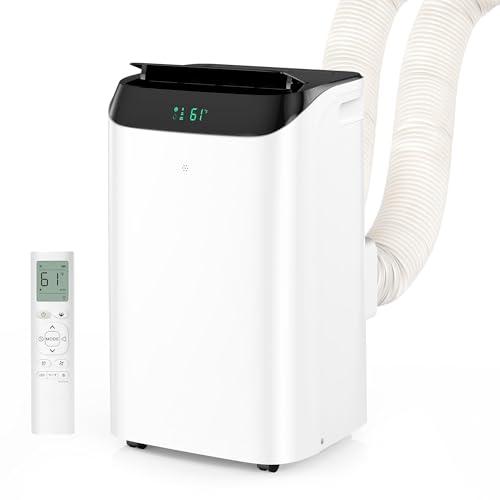
16000 BTU Dual Hose Inverter Portable Air Conditioners, Cooling, Fan, Dehumidification, Sleep Mode for Large Rooms up to 800 Sq.Ft, AC Unit with Remote Control, 24H Timer, Installation Kits Included
Check price on AmazonFrequently Asked Questions
What BTU portable air conditioner do I need for 800 square feet?
For an 800 square foot space under standard conditions, aim for roughly 14,000 to 16,000 BTU. Increase the target for high ceilings, strong sun exposure, many occupants, or hot climates. Decrease only if the room is well-insulated and shaded. A dual-hose design at the higher end of this range generally performs most reliably in open areas.
Can one portable air conditioner cool 800 square feet?
Yes, a single high-capacity portable air conditioner can cool an open 800 square foot area when it is correctly sized and properly vented. Open floor plans cool more evenly than divided rooms. If the space is split into multiple enclosed rooms, you may get more consistent comfort from two smaller units or a different cooling approach entirely.
Is a dual-hose portable AC better for a large room?
In most large-room situations, yes. Dual-hose units avoid the negative pressure problem that causes single-hose models to pull warm outdoor air back inside. That makes them more effective at maintaining a stable temperature across a bigger space, even though they are usually bulkier and require a slightly more involved window setup.
How many BTU per square foot for a portable AC?
A common starting guideline is about 20 BTU per square foot for standard ceilings and moderate climates, which points to roughly 16,000 BTU for 800 square feet. Many manufacturers rate units for this size starting around 14,000 BTU assuming favorable conditions. Treat the formula as a baseline and adjust for sun, insulation, ceiling height, and occupancy.
Will a portable AC cool a room with high ceilings?
It can, but high ceilings increase the air volume that needs cooling, so you should size upward. Cool air naturally settles low, which helps at head height, but the unit still has to remove heat from a larger volume. Using a ceiling fan on low speed helps mix the air and reduces stratification.
Do I need to drain a portable AC often in a large room?
It depends on humidity and how long the unit runs. In humid conditions and long cooling sessions, the internal tank can fill quickly. Units that support continuous drainage via a hose avoid frequent emptying. Our guides on portable AC that doesn't need to be drained and portable AC you don't have to drain explain the options in more detail.
Final takeaway: Cooling 800 square feet with a portable air conditioner is achievable when capacity, hose configuration, and placement are handled correctly. Start with a dual-hose unit in the roughly 14,000–16,000 BTU range for average conditions, size upward for demanding rooms, and seal the venting setup carefully. If you are still comparing approaches, our overview of portable AC units and the guide to portable air conditioners for rooms without windows cover adjacent scenarios that often come up in the same research process.