
Portable Air Conditioner Windowless: What Actually Works
Rooms without windows still need cool air. This guide explains how windowless portable ACs work, which venting methods are realistic, how to size a unit for enclosed spaces, and which models suit different room types—so you can buy with confidence.
Quick reality check: A portable air conditioner must remove heat somewhere. "Windowless" does not mean "no exhaust"—it means the unit offers alternative venting routes or uses evaporative technology. Understanding this distinction is the single most important step before you buy. Everything below builds on that principle.
What "Windowless" Really Means for Portable ACs
The term portable air conditioner windowless is used loosely in the market, and that ambiguity causes most buyer mistakes. There are two genuinely different product categories hiding under the same label:
Evaporative (Ventless) Coolers
These units cool air by passing it through water-saturated pads. They exhaust nothing outside, so they truly need no window. The trade-off: they only perform well in dry climates and they raise indoor humidity. In a muggy room, they can feel worse than no cooling at all.
Compressor Units With Alternative Venting
These are real refrigerated portable ACs that still produce hot exhaust air. They are sold for windowless rooms because the kit supports venting through a door gap, wall sleeve, drop ceiling, or existing duct—rather than a window. They cool effectively but require a venting plan.
If you are researching a portable air conditioner with no window required setup, decide first which of these two paths fits your climate and your room. For dry, low-humidity spaces, evaporative cooling can be a legitimate fit. For humid climates or year-round comfort, you want a compressor-based unit paired with a realistic vent route.
Realistic Venting Options for Rooms Without Windows
If you choose a compressor-based unit, the exhaust has to go somewhere. Here are the practical routes, ranked by how commonly they are used in residential settings:
| Venting Method | Best For | Key Consideration |
|---|---|---|
| Door gap seal kit | Interior rooms adjacent to a hallway or exterior door | Works with sliding or hinged doors; must seal the gap tightly to stop hot air re-entering |
| Wall sleeve / dryer vent | Permanent setups in basements, offices, server closets | Requires cutting a wall opening; check local building rules before installing |
| Existing HVAC return duct | Homes with central ductwork but a problematic room | Only viable if the duct can handle the extra load; consult an HVAC technician |
| Drop-ceiling plenum | Commercial spaces and offices | Common in office buildings; confirm the plenum is approved for exhaust routing |
| Casement / crank-out window adapter | Rooms that do have a non-standard window | Not truly windowless, but solves the "wrong window type" problem—see our casement window solutions |
For a deeper walkthrough of the hardware side, our guide on portable AC options without outside venting covers the trade-offs of each route in more detail. If your room is genuinely sealed on all sides, the door-gap approach is usually the most practical starting point.
Matching the Unit to Your Enclosed Space
Windowless rooms tend to trap heat because there is no cross-ventilation. That changes the sizing math slightly—you should size toward the upper end of the BTU range for the square footage, not the lower end.
| Room Type | Typical Size | Suggested Capacity | Recommended Tier |
|---|---|---|---|
| Small bedroom / studio nook | Up to 150 sq ft | 5,000–6,000 BTU | Entry-Level |
| Home office / small basement room | 150–250 sq ft | 8,000–10,000 BTU | Mid-Range |
| Living area / larger enclosed room | 250–400 sq ft | 12,000–14,000 BTU | Premium |
| Server closet / equipment room | Under 100 sq ft but high heat load | 10,000–14,000 BTU (heat-load driven) | Commercial-Grade |
Two room types deserve special attention. A portable AC for a room without windows in a residential home usually pairs best with a door-gap kit and a mid-range compressor unit. An office without windows often has higher occupancy and electronics heat, so step up one tier in capacity and prioritize a unit with a condensate pump. For tight quarters, our very small room guide narrows the field further.
Features That Matter Most in Windowless Setups
Because windowless rooms have limited airflow, certain features carry more weight than they would in a normal room with a window.
Condensate Management
Without a window to route a drain hose, water removal becomes a chore. Look for a self-evaporating system or a built-in condensate pump. Our comparison of self-evaporating portable ACs explains how much moisture these systems actually handle in practice.
Noise Level
Enclosed rooms amplify compressor noise. If the unit sits near a desk or bed, prioritize models rated for quieter operation. The portable AC buying checklist includes a noise benchmark you can compare against.
Air Filtration
With less fresh-air exchange, indoor air quality matters more. A unit with a washable filter and optional HEPA layer helps. Our roundup of portable ACs with air purifiers covers models that combine both functions.
Humidity Control
If your climate is humid, you want dehumidification capability rather than evaporative cooling. The portable AC and dehumidifier guide explains how to tell whether a unit is a true dehumidifier or just a marketing label.
Strengths of Windowless-Ready Units
- Flexible venting kits fit doors and wall sleeves
- No permanent window installation required
- Portable—move between rooms as needed
- Condensate pumps reduce manual draining
Trade-Offs to Accept
- Compressor units still need an exhaust route
- Evaporative models add humidity
- Door-gap venting can let some heat back in
- Enclosed rooms amplify noise
Ready to see the shortlist? Our recommended windowless portable air conditioners are listed below, grouped by tier so you can compare features before deciding.
View Recommended ModelsSizing and Installation for Enclosed Rooms
BTU sizing follows the same rule as any room, with one adjustment: assume a higher heat load. A 200 sq ft windowless bedroom with a gaming PC and a closed door behaves more like a 250 sq ft room. When in doubt, choose the higher capacity within the tier.
Installation steps for a door-gap vent setup:
- Measure the door gap and order a seal kit sized to that opening.
- Attach the exhaust hose to the unit and route it through the seal panel.
- Seal the panel edges completely—any leak undermines cooling performance.
- Position the unit so the exhaust hose has the shortest, straightest run possible.
- Run the unit in fan-only mode briefly to confirm airflow before engaging cooling.
If the exhaust run exceeds roughly 8 feet or contains multiple bends, cooling efficiency drops noticeably. For permanent installs, a wall sleeve with a weatherproof exterior flap delivers better results. Our guide on insulated exhaust hoses explains how to reduce heat loss along the run.
If your unit seems to run but does not cool, the venting route is the first thing to check. Our troubleshooting article on a portable AC running but not cooling walks through the diagnostic order.
Recommended Windowless Portable Air Conditioners
The models below are grouped by market tier rather than by specification list, so you can see where each unit sits relative to the others. Choose based on room size, venting route, and which features matter for your space.
Recommended Windowless Portable Air Conditioners
⚠️ AFFILIATE DISCLOSURE: This website contains affiliate links. As an Amazon Associate, we earn from qualifying purchases. If you make a purchase through these links, we may receive a small commission at no additional cost to you. Read our full affiliate policy.

24" Windowless Portable Air Conditioner, 15H Timer & 120°Oscillation, 3-IN-1 Portable AC Unit w/Remote, 2Gal Tank, 3 Modes & 3 Speeds, Ultra-Quiet Ventless Swamp Cooler for RoomHomeOffice, Matte Black
Check price on Amazon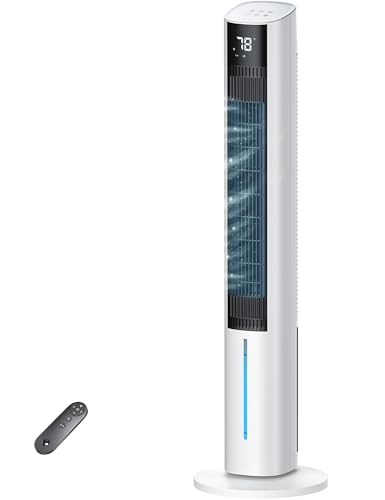
Windowless Portable Air Conditioners, 45.1" Evaporative Cooler for Room No window, 12H Timer & 60° Swing, 1.06Gal Water Tank & 4 Ice Packs, Quiet Portable ac Unit with Remote for Bedroom white
Check price on Amazon
Windowless Portable Air Conditioner, 26.4" Small Evaporative Air Cooler for Room No Window, 3-Speed Settings, 4 Modes, 7H Timer, Remote Control, 4 Ice Packs, Quiet AC Unit for Bedroom, Black
Check price on Amazon
Windowless Portable Air Conditioners, 37.2’’ Evaporative Air Cooler w/Remote, Cooling Tower Fan, 2.5L Water Tank & Ice Packs, 12H Auto-off, 70° Oscillating, Ultra-Quiet Standing Fan For HomeOffice
Check price on Amazon
Windowless Portable Air Conditioner, 24.3" Small Evaporative Air Cooler for Room No Window, 3-Speed Settings, 4 Modes, 15H Timer, Remote Control, 4 Ice Packs, Quiet AC Unit for Bedroom, Black
Check price on Amazon
Windowless Portable Air Conditioners Fan, Swamp Cooler 3 Modes & 3 Speeds, 16FT Remote,12H Timer for Smart Auto-off, No Hose Needed,2-Gal Tank for 20H Cooling 36db Evaporative Air Cooler
Check price on Amazon
BLACK+DECKER Portable Air Conditioner, 10,000 BTU, BPACT10WT, White | 5,500 BTU SACC for Rooms up to 450 Sq. Ft., 3-in-1 Portable AC, Fan and Dehum with Follow Me Remote Control
Check price on Amazon
Portable Air Conditioner, Portable Evaporative Air Cooler, Swamp Cooler | 9L Water Tank, 2H Timer, 3 Modes, 3 Speeds, 6 Ice Packs, Evaporative Cooler, Windowless Portable Air Conditioners
Check price on AmazonCommon Mistakes to Avoid
Most disappointing windowless AC experiences come from a small set of avoidable errors:
- Buying an evaporative cooler for a humid room. It will add moisture and feel sticky. Check your climate first.
- Ignoring the vent route. A compressor unit without a sealed exhaust path just recirculates warm air.
- Undersizing for heat load. Electronics and occupants count. Step up a capacity tier when in doubt.
- Skipping the drain plan. Without a pump or self-evaporating system, you will be emptying a tank daily in humid weather.
- Expecting window-level quiet. Enclosed rooms amplify compressor noise—read the decibel rating before buying.
Frequently Asked Questions
Can a portable air conditioner work without a window?
Yes, but with limitations. True windowless portable ACs either use evaporative cooling (which adds humidity) or require venting through an alternative opening such as a door, wall sleeve, drop ceiling, or existing ductwork. Units marketed as "no window required" typically fall into these categories and have specific trade-offs you should understand before purchasing.
What is the difference between a ventless and a windowless portable AC?
Ventless portable ACs use evaporative cooling and do not exhaust hot air outside, but they only work effectively in dry climates and add moisture to the room. Windowless portable ACs still need to exhaust hot air somewhere—they simply offer alternative venting routes beyond a traditional window, such as through a wall, door, or existing duct.
How do I vent a portable air conditioner in a room without windows?
Common options include venting through a door gap using a door seal kit, installing a wall sleeve or dryer-style vent, routing the exhaust hose into an existing HVAC return duct, or using a drop-ceiling plenum in commercial spaces. Each method requires careful sealing to prevent hot air from re-entering the room.
Do windowless portable air conditioners need to be drained?
Most portable ACs collect condensate and require manual draining or a built-in condensate pump. Some models feature self-evaporating technology that burns off most moisture through the exhaust, reducing how often you need to drain. In high-humidity environments, even self-evaporating units may need occasional draining.
What size portable AC do I need for a windowless room?
Match BTU capacity to room square footage: roughly 5,000–6,000 BTU for up to 150 sq ft, 8,000–10,000 BTU for 150–250 sq ft, and 12,000–14,000 BTU for 250–400 sq ft. Windowless rooms often have higher heat loads due to poor ventilation, so err on the higher side of the range and consider the number of occupants and heat-producing electronics.
Related Guides
Depending on your room and climate, these focused guides may be more relevant than the general overview above:
- Portable AC for a room with no window — deeper coverage of the door-gap approach.
- Windowless room cooling guide — alternative framing for enclosed spaces.
- Portable ACs marketed as no-vent-required — what those labels actually mean.
- High-humidity environments — why evaporative units underperform there.
- Single-hose vs dual-hose units — efficiency trade-offs that matter in sealed rooms.