Room Air Conditioners That Don't Need a Window
No window? No problem. Discover the best cooling solutions for rooms without traditional window access — portable, mini-split, and through-the-wall systems explained.
Explore Cooling OptionsQuick Answer: If your room has no usable window, you have three main options: a portable air conditioner with a vent kit, a ductless mini-split system, or a through-the-wall AC unit. Each works without a traditional window, but they differ in installation effort, efficiency, and how much space they occupy.
Why You Might Need a Windowless AC Solution
Many homes and apartments have rooms that simply cannot accommodate a standard window air conditioner. This could be due to casement or awning windows that do not open vertically, basement rooms with small or high windows, interior rooms with no exterior window at all, or historic homes where window modifications are not permitted.
Whatever the reason, you do not have to sacrifice comfort. Modern cooling technology offers several effective alternatives. The key is understanding how each system removes heat from your room and what installation requirements it carries. For a broader look at installation planning, see our installation guide.
The Three Best Options for Rooms Without Windows
1. Portable Air Conditioner
Portable AC units sit on the floor and roll from room to room. They cool the air and exhaust hot air through a hose that must be routed outside — typically through a window, sliding door, or a small wall vent. If you have no window at all, you can use a wall vent kit or a drop-ceiling vent in some setups.
These units are the easiest to install and require no permanent modifications. They are a solid choice for renters or for rooms where you cannot cut into walls. However, they are generally less efficient than mini-splits and produce more noise.
Learn more about setups in our guide to small room air conditioners with no window and portable AC units that do not need venting.
2. Ductless Mini-Split System
A ductless mini-split has an indoor air-handling unit mounted on a wall or ceiling and an outdoor compressor connected by a small refrigerant line set. The only wall penetration needed is a hole about 3 inches in diameter for the lines — far smaller than a window opening.
Mini-splits are the most efficient and quietest option for rooms without windows. They also provide both cooling and heating in many models. The trade-off is professional installation and a higher upfront investment, but they are efficient in the long run. Explore our detailed guide to split ductless air conditioning systems.
3. Through-the-Wall Air Conditioner
Through-the-wall units are installed directly into an exterior wall using a metal sleeve. They do not need a window, but they do require cutting an opening in the wall and, in most cases, professional installation and a permit. Once installed, they are permanent and free up floor and window space.
These units are common in hotels and apartment buildings, and they are a good long-term solution for rooms where wall space is available. Check our guide on mounting a window AC unit in the wall for related installation insights.
Side-by-Side Comparison
| Feature | Portable AC | Ductless Mini-Split | Through-the-Wall AC |
|---|---|---|---|
| Window Required | No, but venting needed | No, small wall hole | No, wall sleeve |
| Installation Effort | DIY-friendly | Professional required | Professional recommended |
| Energy Efficiency | Moderate | High | Moderate to High |
| Noise Level | Higher | Very quiet | Moderate |
| Portability | Yes | No | No |
| Heating Capability | Some models | Most models (heat pump) | Some models |
| Best For | Renters, temporary cooling | Permanent, efficient cooling | Permanent, space-saving |
Portable Air Conditioners: The Flexible Option
Portable air conditioners are the most common answer for rooms without usable windows. They are self-contained units on casters that you can move between rooms. The critical requirement is that the exhaust hose must vent hot air outside. Without proper exhaust, a portable AC will not cool effectively — it will simply recirculate warm air.
How to Vent a Portable AC Without a Window
There are several venting solutions if you do not have a window:
- Wall vent kit: A small hole is cut through an exterior wall and fitted with a louvered vent. The exhaust hose connects to it. This is a permanent modification but is much smaller than a window opening.
- Sliding door kit: If you have a sliding glass door, a sealing panel can be installed to route the exhaust hose out.
- Drop-ceiling vent: In some commercial or basement spaces, the exhaust can be routed into a drop ceiling cavity that connects to outside air. This requires careful planning and is not suitable for all buildings.
- Dryer vent: In some cases, an existing dryer vent can be adapted, though this requires a backdraft preventer and careful sealing.
For a compact solution, see our page on the PAP08R1BWT 3-in-1 portable air conditioner, which combines cooling, dehumidifying, and fan functions.
Pros of Portable AC
- No permanent installation required
- Can be moved between rooms
- Renter-friendly in most cases
- Easy to set up and operate
- Some models offer heating and dehumidifying
Cons of Portable AC
- Less energy-efficient than mini-splits
- Requires exhaust venting
- Can be noisy
- Needs regular water drainage
- Occupies floor space
Ductless Mini-Splits: The Efficient Long-Term Solution
If you own your home and want a permanent, highly efficient cooling solution for a room without a window, a ductless mini-split is the top-tier choice. The indoor unit mounts high on a wall or ceiling, and the outdoor unit sits on the ground or a bracket outside. The two are connected by a refrigerant line set, a drain line, and electrical wiring that pass through a single small hole in the exterior wall.
This small penetration is the key advantage — it does not require a window at all. Mini-splits are also significantly quieter and more efficient than portable units. Many models include heat pump functionality, providing both cooling and heating year-round. For a full overview, read our guide to split ductless air conditioning systems and split units.
Installation Considerations
Mini-split installation is not a DIY project for most homeowners. It requires refrigerant handling, vacuuming the line set, and electrical work. Professional installation typically includes mounting the indoor and outdoor units, running the line set, and testing the system. For related cost factors, see our page on HVAC cost and installation and ductless air conditioning installation.
Pros of Mini-Split
- Highest energy efficiency
- Very quiet operation
- Heating and cooling in one system
- No ductwork required
- Long lifespan with proper maintenance
Cons of Mini-Split
- Professional installation required
- Higher upfront investment
- Permanent installation
- Requires exterior wall access for the line set
Through-the-Wall AC Units: Permanent and Space-Saving
Through-the-wall air conditioners are a practical middle ground. They are installed into a sleeve set into an exterior wall, so they do not consume window space and do not need a window to operate. They are common in apartments, hotels, and homes where window units are not feasible.
The installation requires cutting an opening in the wall, which is a significant modification. In many jurisdictions, this requires a permit. Once installed, the unit is permanent and can be serviced or replaced within the same sleeve. For related guidance, see our articles on smallest through-the-wall air conditioner and 20 x 14 through-the-wall air conditioner.
Choosing by Room Type
Basement Rooms Without Windows
Basements are often the most challenging spaces because they may have no windows at all or only small, high windows. A ductless mini-split is usually the best option here — the indoor unit can be wall-mounted, and the line set can be routed through a small hole to an outdoor unit at ground level. Portable AC units can work if there is a way to exhaust through a wall vent or a drop ceiling. See our guide on basement AC for more.
Interior Rooms
Interior rooms with no exterior wall present a unique challenge. A portable AC with a long exhaust hose routed to a nearby room with a vent is one option, but it is inefficient. A better solution is a mini-split with a line set routed through interior walls to an exterior location, or a ducted system that connects to a central air handler. For homes with existing ductwork, a central system may be the most practical choice. See our guide to central air conditioning.
Apartments and Renters
If you rent, permanent modifications like through-the-wall installation or mini-split installation may not be allowed. In that case, a portable AC with a window or door vent kit is the most practical solution. Some portable units are designed for sliding doors and casement windows. For compact options, see our page on small air conditioning units and plug-in air conditioners.
Sizing Your Windowless AC Correctly
No matter which type you choose, correct sizing is essential. An undersized unit will struggle to cool the room and run continuously, while an oversized unit will short-cycle, which reduces efficiency and may not remove humidity properly. The general rule of thumb is 20 BTU per square foot of floor area, adjusted for ceiling height, sun exposure, occupancy, and heat-generating appliances.
For a more precise estimate, use our guide on how to size an air conditioner and our BTU calculator by room size.
Maintenance Tips for Windowless AC Systems
All cooling systems need regular maintenance to perform efficiently. For portable units, empty the drain tank regularly and clean the filter every two weeks during heavy use. For mini-splits, clean the indoor filter monthly and schedule professional maintenance annually. For through-the-wall units, clean the filter and inspect the outdoor grille for debris. See our guides on how to clean an AC filter and cleaning condenser coils.
A maintenance plan can extend the life of your system and keep it running efficiently. Learn more in our HVAC maintenance plan guide.
Frequently Asked Questions
Related Guides
Ready to Choose Your Windowless Cooling Solution?
Explore our recommended air conditioners below, or check out our full buying guide for more detailed comparisons and expert tips.
See Recommended ProductsBest Room Air Conditioners That Don't Need a Window
⚠️ AFFILIATE DISCLOSURE: This website contains affiliate links. As an Amazon Associate, we earn from qualifying purchases. If you make a purchase through these links, we may receive a small commission at no additional cost to you. Read our full affiliate policy.

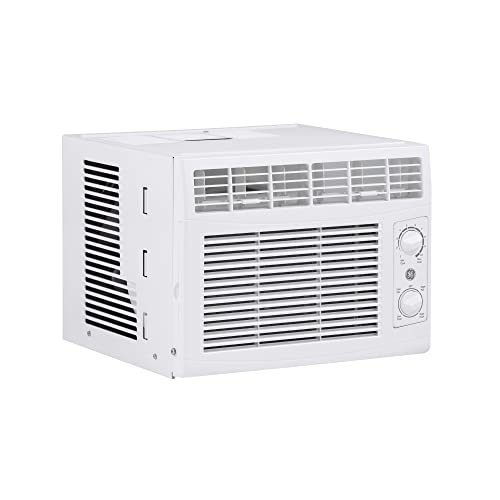
GE Window Air Conditioner 5,000 BTU AC Unit for Small Spaces up to 150 sq ft with Manual Controls & 2 Cooling Modes, Easy Install Kit, White
Check price on Amazon
Midea 6,000 BTU Window Air Conditioner, Electronic Control, 250 Sq Ft, New | 3-In-1 Cool/Fan/Dehumidifier Modes, Easy-To-Use Controls, Remote Control, And Cooling For Bedrooms, Studies and Home Offices
Check price on Amazon
BLACK+DECKER Portable Air Conditioner, 9,000 BTU, BPACT08WT, White | 5,300 BTU SACC for Rooms up to 400 Sq. Ft., 3-in-1 Portable AC, Fan and Dehum with Follow Me Remote Control
Check price on Amazon
GE 6,000 BTU Electronic Window Air Conditioner, Cools Rooms up to 250 sq ft, Digital Controls with Remote, Energy Saver Mode, 24Hr Timer, Easy Install Kit Included, White
Check price on Amazon
Portable Air Conditioner Fan, 4-in-1 Mini Air Cooler with 450ML Water Tank, 3 Speeds Portable Fan 7 Colors LED Ambient Light, Mini Evaporative Cooler Desktop Humidifier Fan for Bedroom Office Travel
Check price on Amazon
Midea 10,000 BTU U Shaped Window Air Conditioner, Cools up to 450 Sq Ft | Ultra Quiet U-Shaped Design, Inverter Control, Open Window Flexibility, Alexa/Google Assistant, 37% Energy Savings, 2026 New
Check price on Amazon
Midea 5,000 BTU EasyCool Small Window Air Conditioner - Cool up to 150 Sq. Ft. with Easy-to-Use Mechanical Controls and Reusable Filter, Perfect for Small Bedroom, Living Room, Home Office
Check price on Amazon