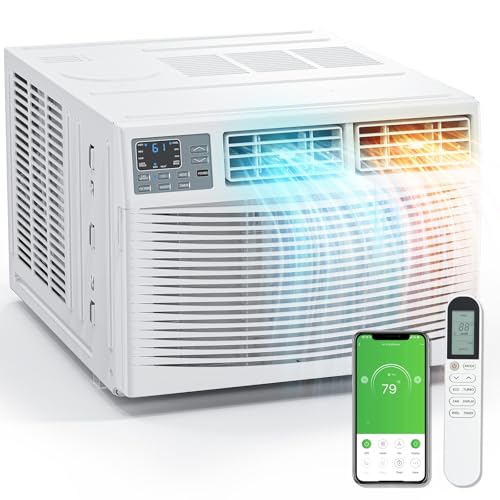
Window AC Unit for a 1200 Sq Ft House
Cooling a 1200 square foot home with window air conditioners is absolutely achievable — but it requires the right BTU math, the right number of units, and smart placement. This guide walks you through every decision so you can buy with confidence.
Start With SizingWhy this page exists: Most people searching for a window AC unit for a 1200 sq ft house fall into one of two traps — they buy a single oversized unit that leaves half the home warm, or they guess at BTU ratings and end up with units that run constantly without ever reaching the set temperature.
This guide is written for the research stage. You already know you want window air conditioning. What you need now is a trustworthy sizing framework, realistic expectations about what window units can and cannot do, and clear tier-based guidance on which models are worth your attention.
The Reality of Cooling 1200 Sq Ft With Window Units
Window air conditioners are room coolers by design. Each unit draws in air from its immediate surroundings, cools it, and blows it back into the same space. They do not distribute air through ductwork, and they cannot push cold air through closed doors.
That single fact shapes everything about cooling a 1200 sq ft house:
- An open-plan 1200 sq ft layout — a great room, kitchen, and dining area with no dividing walls — can often be handled by one high-capacity unit or two well-placed mid-capacity units.
- A compartmentalized 1200 sq ft layout — three bedrooms, two bathrooms, a hallway, and a living room — will almost always need two to three units, because each closed room needs its own cold air source.
- Two-story homes need at least one unit per floor. Cool air does not climb stairs on its own, and warm air rises toward the upper floor.
If your home has an open floor plan with wide doorways and ceiling fans to help circulate air, window units can be surprisingly effective. If your home is a series of closed rooms, plan your unit count around the rooms you actually occupy rather than the total square footage.
For households that eventually want a permanent, whole-home solution, it is worth understanding how whole house air conditioning systems compare to a multi-unit window setup. Many owners start with window units and later upgrade.
How Much BTU Does a 1200 Sq Ft House Need?
The industry baseline is roughly 20 BTU per square foot of cooled space. For 1200 sq ft, that puts you at approximately 24,000 BTU total. But that number is a starting point, not a final answer. Real-world sizing depends on several variables:
- Ceiling height: Standard 8-foot ceilings follow the baseline. Vaulted ceilings of 10 feet or more add 10–20%.
- Sun exposure: South- and west-facing rooms with unshaded windows need more capacity. North-facing rooms need less.
- Insulation quality: Older homes with single-pane windows and minimal attic insulation need a buffer of roughly 10–30%.
- Occupancy: Each additional person adds about 600 BTU of heat load.
- Kitchen appliances: An open kitchen adds heat; count it as an extra load if it shares space with the living area.
For a typical 1200 sq ft house with standard ceilings, average insulation, and mixed sun exposure, the practical range is 22,000 to 26,000 BTU total. If your home runs warm in summer — poor insulation, lots of glass, top-floor exposure — plan for the upper end or slightly beyond.
Room-by-Room BTU Reference
| Room Type | Typical Size | Suggested BTU | Best For |
|---|---|---|---|
| Small bedroom | 100–150 sq ft | 5,000–6,000 BTU | Entry-level single-room cooling |
| Standard bedroom | 150–250 sq ft | 8,000–10,000 BTU | Mid-range bedroom comfort |
| Living room (open plan) | 300–500 sq ft | 12,000–14,000 BTU | Balanced tier main living space |
| Large open great room | 500–800 sq ft | 18,000–24,000 BTU | High-end tier open-plan cooling |
| Whole floor (open concept) | 900–1,200 sq ft | 24,000–28,000 BTU | Top-tier single-zone or dual-unit setup |
If you want to work through the full calculation for your own layout, our guide on how to size an air conditioner covers the manual method step by step, and the BTU calculator by room size gives you a quick reference for individual rooms.
How Many Window Units for a 1200 Sq Ft House?
For most 1200 sq ft homes, the sweet spot is two to three window units. Here are three proven configurations:
Configuration 1: The Open-Plan Pair
Best for open-concept living. One 18,000–24,000 BTU unit in the central great room, plus one 8,000–10,000 BTU unit in the primary bedroom. The large unit handles the shared living space; the smaller unit protects sleep comfort behind a closed door.
Configuration 2: The Three-Room Standard
Best for a traditional 1200 sq ft layout with a central living room and two bedrooms. One 12,000 BTU unit in the living area, one 8,000–10,000 BTU unit per bedroom. This is the most common real-world setup and the easiest to expand later.
Configuration 3: The Per-Floor Split
Best for a two-story 1200 sq ft home. One 12,000 BTU unit downstairs in the main living zone and one or two units upstairs depending on how many bedrooms need cooling. Remember that warm air rises, so the upper floor typically needs the larger share of total capacity.
Whichever configuration you choose, keep interior doors open during the hottest hours when possible. A window unit in the hallway pointed toward an open bedroom door works far better than the same unit sealed behind a closed door.
Window AC Tiers: Which Level Fits a 1200 Sq Ft Home?
For a multi-unit home setup, the tier you choose affects noise, efficiency, and how well the units hold temperature over long summer runs. Here is how the market breaks down:
Entry-Level Tier
Basic mechanical controls, single-speed compressors, and straightforward cooling. Solid choice for guest rooms or spaces used a few hours a day. Expect louder operation and more frequent on/off cycling.
Mid-Range Tier
Digital thermostats, remote controls, sleep modes, and better insulation around the chassis. This is the balanced tier most 1200 sq ft homes should target — quieter and more consistent than entry-level without paying for premium features.
Premium / Top-Tier
Inverter compressors, Wi-Fi control, high SEER2 ratings, and whisper-quiet operation. The best fit when you plan to run multiple units all season and want steady temperatures, lower energy draw, and smart scheduling.
A few specific considerations for a 1200 sq ft deployment:
- Inverter technology is worth prioritizing for the main living area unit. It modulates compressor speed instead of cycling, which means steadier temperatures and less wear. See our guide to window air conditioners with inverter technology for a closer look.
- Smart control matters more when you have multiple units. Being able to schedule each unit from your phone prevents the "forgot to turn off the bedroom AC" problem. Browse window air conditioners with remote control if you want flexibility without a full smart-home setup.
- Heat pump capability extends usefulness into shoulder seasons. If your 1200 sq ft home has no other heating source in a room, window air conditioners with heat can cover both directions.
Placement Strategy for Multiple Units
Placement is where most multi-unit window setups succeed or fail. Follow these rules:
- Cool the space you live in first. Put the highest-capacity unit in the room where your household spends the most waking hours.
- Avoid direct sun on the unit's exterior. A window that faces west will force the compressor to work harder all afternoon. If that is your only option, add exterior shade.
- Do not stack units in adjacent windows of the same room. Two units side by side cool the same air twice and leave the rest of the home warm.
- Use ceiling fans as air movers. A fan in the hallway pushing cool air toward bedrooms dramatically improves how far a single unit's output reaches.
- Check window type before committing. Sliding, casement, and crank-out windows need specific kits. Our guides on window air conditioners for sliding windows and window air conditioners for crank-out windows cover the adaptations.
For homes with narrow or unusually shaped windows, the range of window air conditioners for small windows includes compact chassis models that still deliver mid-range BTU output.
Installation Essentials
Installing two or three window units is a weekend project for most homeowners, but a few details matter:
- Support brackets are non-negotiable for anything above 10,000 BTU or any second-story installation. A proper window AC bracket support takes the load off the window frame and prevents dangerous sagging.
- Check your electrical circuits. Most 8,000–12,000 BTU units run on standard 110V household circuits, but larger 18,000+ BTU units often require a dedicated 220V line. If you are unsure, have an electrician confirm before purchase.
- Seal the gaps. The foam and accordion panels included in most window AC installation kits are adequate, but adding weatherstripping around the frame reduces energy loss noticeably.
- Manage drainage. Some units drip more than others. If staining or pooling is a concern, look at window AC units that don't drip water or plan a drainage path.
- Consider professional help for upstairs units. If lifting and securing a heavy unit on an upper floor feels risky, who sells and installs window air conditioners covers your options for installation support.
Pre-Purchase Checklist
- Measure each room you plan to cool and note the square footage
- Confirm the window type in each target room (double-hung, sliding, casement)
- Verify the electrical circuit available near each window
- Decide on your unit count based on floor plan and door positions
- Choose your tier: entry-level for occasional rooms, mid-range for daily use, premium for all-season running
- Plan bracket support for any upstairs or high-BTU unit
Running Multiple Window Units Without Wasting Energy
Three window units running simultaneously can drive up electricity use quickly if managed poorly. A few habits make a real difference:
- Cool only occupied rooms. Use timers or smart schedules to run bedroom units only at night and living-area units only during the day.
- Set and forget. A consistent temperature setting (typically 75–78°F) uses less energy than frequent adjustments. Our guide on ideal AC temperature setting breaks down the reasoning.
- Pair units with ceiling fans. A fan lets you set the AC a few degrees warmer while feeling equally comfortable. See use ceiling fan with AC for the specifics.
- Shade the exterior. A unit in direct sun works harder. A simple awning or planting can reduce compressor load.
- Seal the building envelope. Weatherstripping doors and windows keeps the cold air you paid for inside. Our guide on reduce AC electricity bill covers this in depth.
If your home has persistent humidity issues even with units running, the problem may be air circulation rather than capacity. Our article on who to call for high humidity in house explains when to bring in a professional.
Common Issues in Multi-Unit Setups
When you run multiple window units, occasional problems are normal. Most are fixable without a service call:
- One unit not blowing cold air while others work fine? Start with the filter and the thermostat. If that does not solve it, see window air conditioner not blowing cold air.
- A unit cooling poorly despite running constantly may be undersized for its room, or the room may have an air leak. Our guide on window air conditioner not cooling properly walks through the diagnosis.
- Water leaking inside the house usually points to a blocked drain or a unit installed at the wrong tilt angle. Read window air conditioner leaking water inside house for the fix.
- Fan running but no cold air often signals a compressor or capacitor issue. See window AC not cooling but fan is running before calling a technician.
For persistent problems that survive basic troubleshooting, window unit repair covers when a professional repair makes sense versus when replacement is the better path.
When Window Units Are Not the Right Answer
Window units are a practical, flexible solution for a 1200 sq ft home, but they are not the only option. It is worth knowing the alternatives before you commit:
- Ductless mini-splits cost more upfront but deliver quieter, more efficient, and better-distributed cooling with a single outdoor unit serving multiple indoor heads. For a whole-home perspective, see whole house ductless heating and cooling system.
- Portable AC units offer flexibility for rooms without suitable windows, though they are generally less efficient than window units of the same capacity. Our guide on where can I find a portable air conditioner explains the trade-offs.
- Central air remains the gold standard for whole-home comfort but requires ductwork and a much larger installation commitment. If you are comparing long-term options, our overview of whole house heating and air conditioning systems helps frame the decision.
If you decide window units are the right fit, our broader window air conditioner guide covers the category in more depth, and the window AC unit for bedroom page focuses on sleep-focused models.
Frequently Asked Questions
Can a single window AC unit cool a 1200 sq ft house?
A single unit is generally not enough for an entire 1200 sq ft house. Standard window units top out around 25,000 BTU, which suits open-plan zones of roughly 1,000 to 1,500 sq ft but cannot push conditioned air through closed doors and separate rooms. Most homes this size use two to three strategically placed units.
How many BTU do I need to cool 1200 square feet?
As a baseline, plan for about 20 BTU per square foot, which works out to roughly 24,000 BTU for 1200 sq ft. Adjust upward for sunny exposures, high ceilings, or poor insulation, and downward for shaded rooms or mild climates. Always confirm with a room-by-room load calculation for the most accurate sizing.
How many window AC units do I need for a 1200 sq ft house?
Most 1200 sq ft homes work best with two to three window units. A common setup pairs one 12,000 BTU unit in the main living area with 8,000 to 10,000 BTU units in bedrooms. The exact count depends on the floor plan, how rooms connect, and whether doors stay open.
Is an inverter window AC better for a 1200 sq ft house?
Inverter window AC units modulate compressor speed instead of cycling on and off, which delivers steadier temperatures, quieter operation, and better efficiency during long cooling sessions. For a home running multiple units through a full summer, inverter models in the mid-range and premium tiers are usually the smarter long-term investment.
Can I install window AC units myself in a 1200 sq ft house?
Yes. Most window units up to 12,000 BTU are manageable for a handy homeowner with a helper, a proper bracket, and the included installation kit. Larger 220V units and any unit installed on an upper floor benefit from professional installation to ensure secure mounting, correct electrical service, and proper drainage.
Ready to Pick Your Units?
You now have the sizing framework, the unit count strategy, and the tier guidance. The next step is comparing real models side by side.
Compare Recommended Models