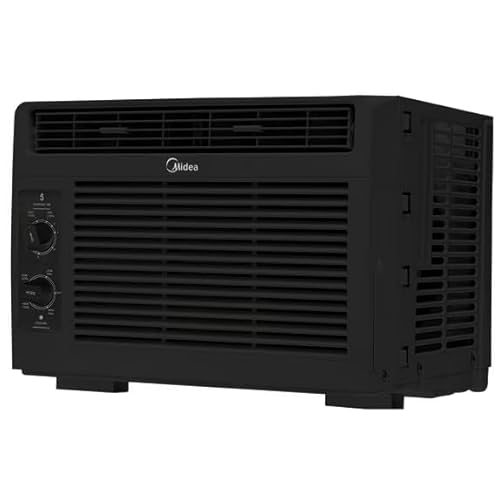
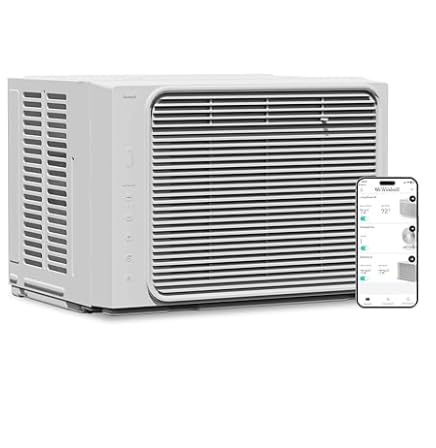
Smallest Most Powerful Window Air Conditioner
How to find a compact window unit with serious cooling output — what the specs really mean, which capacity class fits your room, and the features that separate a strong performer from a noisy compromise.
See Buying ChecklistWho this guide is for: You want a window air conditioner that takes up as little space as possible while still delivering strong cooling. You have likely seen listings that claim both "compact" and "powerful" and want to know which claims hold up. This guide breaks down the trade-offs honestly so you can choose with confidence.
The Real Trade-off: Compact Size vs. Cooling Output
Every window air conditioner has to fit a compressor, condenser coil, evaporator coil, and fan inside its chassis. As BTU capacity rises, so does the physical size of those components — especially the condenser coil and the compressor. That is why a truly tiny unit rarely delivers the highest output, and the most powerful window units are rarely the smallest.
The sweet spot for "smallest most powerful" is the compact high-output class: units in roughly the 8,000 to 12,000 BTU range that use a narrower, deeper chassis design. These sit in the mid-tier to high-end tier of the compact window AC market. A small window air conditioner with high BTU is exactly this category — compact footprint, stronger cooling than a baseline 5,000 BTU unit.
What "Small" Really Means
Small is a physical measurement: chassis width, height, and depth. Many compact units are narrow enough for a standard double-hung window but deeper than expected. Always compare the published outer dimensions to your window opening, not just the BTU number.
What "Powerful" Really Means
Powerful usually refers to BTU capacity and airflow (CFM). BTU tells you how much heat the unit moves; CFM tells you how forcefully it distributes cool air. A high-BTU unit with weak airflow can feel underwhelming in a long or open room.
Choosing the Right Capacity Class
Before shopping for the most powerful compact unit, confirm the capacity your room actually needs. Oversizing is a common mistake — it cools fast but cycles off before dehumidifying, leaving the space feeling sticky.
| Room Size | Typical Capacity | Best For |
|---|---|---|
| Up to 150 sq ft | 5,000–6,000 BTU | Bedrooms, home offices, dorm rooms |
| 150–250 sq ft | 8,000 BTU | Larger bedrooms, studios |
| 250–350 sq ft | 10,000 BTU | Open living areas, converted attics |
| 350–450 sq ft | 12,000 BTU | Large rooms, open-plan layouts |
If your room is at the top of a size bracket and gets strong afternoon sun, step up one capacity class. If you are unsure, the detailed sizing guide walks through the BTU math. For very compact rooms, the 5,000 BTU room size reference is a useful baseline.
What Makes a Compact Window Unit Feel Powerful
- High BTU in a narrow chassis: The strongest compact units pair a deep condenser coil with a narrow frame. Depth is the trade-off — check that the unit protrudes safely outside your wall.
- Strong airflow (CFM): A high-BTU unit with weak fan output will not throw cool air across a room. Look for published CFM figures and multiple fan speeds.
- Efficient compressor: Inverter-style and variable-speed compressors maintain output more steadily than single-stage units, so the room feels consistently cool rather than cycling hot and cold.
- Good sealing kit: A compact unit that leaks air around the frame loses much of its advantage. A complete insulation panel and weather seal are essential.
- Quiet operation: "Powerful" should not mean "deafening." Check decibel ratings, especially for bedrooms.
- Smart or programmable control: Scheduling lets a strong unit run during off-peak hours and hold a comfortable temperature without constant manual adjustment.
If quiet operation matters most in your room, the most efficient compact window AC guide covers efficiency and noise together. If you want remote or app control, see the remote-control window AC overview.
Compact Window AC Tiers at a Glance
Instead of chasing a specific model number, think in tiers. The descriptor reflects where a unit sits in the market relative to others in the compact window AC category.
| Tier | Typical Profile | Best For |
|---|---|---|
| Essential tier | 5,000–6,000 BTU, mechanical controls, compact chassis | Small bedrooms and offices where baseline cooling is enough |
| Balanced tier | 8,000 BTU, digital thermostat, remote, stronger airflow | Daily use in medium rooms with sun exposure |
| High-end tier | 10,000–12,000 BTU, high CFM, efficient compressor, quiet modes | Large rooms where compact size and strong output both matter |
A balanced-tier compact unit usually offers a better cooling-to-size ratio than an essential-tier model, while high-end tier units deliver the most output without jumping to a full-size chassis. If your priority is raw output, the small but powerful window AC overview and the smallest most powerful window AC reference are closely related reads.
Buying Checklist Before You Order
- Measure your window opening: Width, height, and depth. Compare against the unit's published installation dimensions, including any bracket.
- Confirm the BTU-to-room match: Use the capacity table above; do not simply buy the highest BTU you can find.
- Check airflow rating: Higher CFM helps distribute cool air in longer rooms.
- Review the efficiency rating: A higher CEER or ENERGY STAR designation is a long-term investment for daily use — see the ENERGY STAR compact window AC guide.
- Plan the electrical load: Confirm your outlet and breaker support the unit's amperage. Larger compact units may require a dedicated circuit.
- Check the sealing kit: Insulation panels and weather stripping are not optional extras for a powerful unit.
- Read the warranty terms: Compressor and sealed-system coverage vary by brand.
Honest reality check: If your window opening is very small, a 5,000 to 6,000 BTU unit is the practical ceiling — a physically larger high-BTU chassis simply will not fit. If your room needs more cooling than a compact unit can deliver, a compact mini-split system or a high-BTU compact window unit are the two realistic upgrade paths.
Matching the Unit to the Room
The "most powerful" unit in the world will disappoint if it is installed in the wrong room. A compact high-BTU unit works best in a rectangular room where the airflow can reach the far wall. In an L-shaped or open-plan space, a single window unit struggles to distribute air evenly — in that case, a second unit or a compact mini-split is worth considering.
For bedrooms, prioritize quiet operation over maximum BTU; a balanced-tier 8,000 BTU unit is usually a better fit than a high-output unit that roars at night. For home offices with computer equipment, step up one capacity class to offset the extra heat load. The bedroom AC guide and the small room AC overview go deeper on room-specific selection.
Installation Notes for Compact High-Output Units
High-BTU compact units are heavier than baseline models, so installation support matters more. Use the manufacturer's bracket or support arms — never rely on the window sash alone. Confirm the unit tilts slightly outward for drainage, and seal the gap with the included insulation panel. If the frame is older or damaged, a professional install protects both the unit and your window. The guide to hiring an installer explains what to ask.
For narrow frames, check the sizing-specific guides: 12-inch wide units, 14-inch wide units, and 15-inch wide units. For vertical windows, see the vertical window AC guide.
Frequently Asked Questions
What is the smallest most powerful window air conditioner?
There is no single winner for every room. The strongest compact candidates are units in the 10,000 to 12,000 BTU range with a narrow chassis, typically found in the high-end tier of the compact window AC category. Compare published dimensions alongside BTU to find the best ratio for your opening.
How many BTU do I need for a small but powerful window AC?
For rooms up to 150 square feet, 5,000 to 6,000 BTU is standard. For more reserve power in a hot room, an 8,000 to 10,000 BTU compact unit provides stronger output while keeping the chassis manageable.
Does a higher BTU unit always cool better?
No. An oversized unit cools the air quickly but may not run long enough to remove humidity, leaving the room clammy. Match BTU to room size, then choose the most efficient unit within that range.
Will a powerful compact unit fit my window?
Check the published installation dimensions, including depth and bracket clearance. Compact high-BTU units are deeper than baseline models. If your opening is very small, a 5,000 to 6,000 BTU unit may be the practical ceiling.
Is a more powerful unit louder?
Often, yes — higher airflow and a larger compressor generate more noise. Look for published decibel ratings and a "quiet" or "sleep" mode if the room is a bedroom.