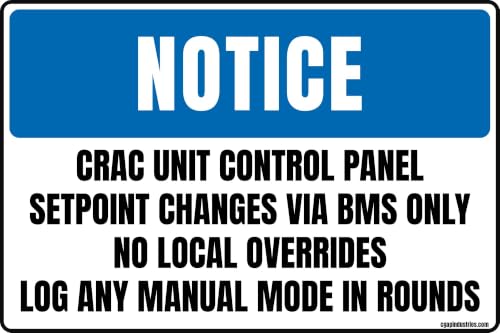
HVAC CRAC Units: The Complete Guide to Precision Cooling
Understand how Computer Room Air Conditioner (CRAC) systems protect servers, telecom equipment, and other heat-sensitive spaces through continuous, tightly controlled cooling.
START LEARNINGWhy CRAC Units Matter: Standard comfort air conditioning is designed for people, not machines. CRAC units are engineered for high heat density, year-round operation, and precise temperature and humidity control — the three pillars of reliable precision cooling.
What Is a CRAC Unit?
A CRAC unit, short for Computer Room Air Conditioner, is a precision cooling system built specifically for spaces with concentrated heat loads — most commonly data centers, server rooms, telecom closets, and laboratory or medical equipment rooms. Unlike a residential split system that cycles on and off to keep occupants comfortable, a CRAC unit is designed to run continuously and maintain tight tolerances on temperature and humidity.
The distinction is important. IT equipment generates heat around the clock, and even brief excursions outside the recommended envelope can shorten hardware life or trigger protective shutdowns. A CRAC unit addresses this by combining a direct-expansion refrigeration circuit, high-static air distribution, and sophisticated controls that respond to sensor feedback in real time.
Understanding precision cooling is part of a broader picture of how HVAC heat ventilation air conditioning systems are engineered for different applications. For a foundational look at the discipline as a whole, our guide to HVAC and air conditioning is a useful starting point before diving into the CRAC-specific details below.
How CRAC Units Work
A CRAC unit follows the same basic refrigeration cycle as a conventional air conditioner, but every component is selected and controlled for continuous duty. The cycle moves through four stages:
- Evaporation: Warm return air passes over the evaporator coil, where refrigerant absorbs heat and the air is cooled and dehumidified.
- Compression: The low-pressure refrigerant vapor is compressed to a high-pressure, high-temperature state.
- Condensation: The hot refrigerant releases heat to the outdoor environment — either through an air-cooled condenser, a water-cooled condenser, or a glycol loop.
- Expansion: The refrigerant passes through an expansion valve and returns to the evaporator to repeat the cycle.
What separates a CRAC unit from a comfort system is not the cycle itself but the surrounding engineering. CRAC units typically use EC fans for variable airflow, staged or modulating compressors, and microprocessor controllers that balance sensible and latent cooling. The goal is to remove heat without over-drying the air, because low humidity can create static discharge risks while high humidity can lead to condensation on cold surfaces.
The underlying thermodynamics are the same as any HVAC cooling cycle, but the control strategy and component durability are tuned for 24/7 operation. For readers comparing system architectures, our overview of HVAC controls systems explains how precision controllers differ from residential thermostats.
Types of CRAC Units
CRAC units come in several configurations, and the right choice depends on facility size, available heat rejection infrastructure, and redundancy requirements. The most common categories are:
Air-Cooled CRAC Units
These units reject heat directly to outdoor air through a remote condenser. They are simpler to install, require no water infrastructure, and are well suited to small and mid-sized server rooms. Their main constraint is that condenser placement and ambient temperature affect performance, so rooftop or outdoor pad space must be planned early.
Water-Cooled CRAC Units
Water-cooled models use a condenser water loop, often connected to a cooling tower. They are more efficient in hot climates and can be quieter at the outdoor side, but they require water treatment, piping, and a tower — infrastructure that makes more sense in larger facilities.
Glycol-Cooled CRAC Units
A glycol loop allows heat rejection over longer distances and provides freeze protection in cold climates. These systems sit between air-cooled and water-cooled designs in complexity and are often chosen when the condenser must be placed far from the indoor unit.
Chilled Water CRAH Units
Strictly speaking, a CRAH (Computer Room Air Handler) is not a CRAC because it has no compressor. It relies on chilled water from a central plant and provides cooling through a coil and fan array. CRAH units are common in large data centers where a chiller plant already exists, and they are often discussed alongside CRAC units because both serve the same precision cooling role.
In-Row and In-Rack Cooling
For high-density racks, in-row CRAC units are placed directly between server cabinets, and in-rack units mount within the rack itself. These approaches shorten the air path and reduce mixing losses, which becomes critical as rack power density rises.
Regardless of type, the mechanical components share a great deal with general HVAC equipment, including coils, fans, and controls. Our guide to HVAC condensers explains the heat-rejection side in more detail.
CRAC vs CRAH: Key Differences
Buyers frequently compare CRAC and CRAH units because they serve the same room type. The distinction comes down to where the refrigeration happens:
| Feature | CRAC Unit | CRAH Unit |
|---|---|---|
| Refrigeration source | Built-in DX compressor | Chilled water from central plant |
| Typical facility size | Small to mid-sized rooms, edge sites | Large data centers with chiller infrastructure |
| Installation complexity | Moderate — needs condenser and refrigerant lines | Higher — needs chilled water piping and pumps |
| Redundancy strategy | N+1 units with independent compressors | N+1 units sharing plant capacity |
| Efficiency profile | Good at part load with variable-speed compressors | Excellent when chiller plant is optimized |
Neither design is universally better. A CRAC unit is often the practical choice when there is no central plant and the room is modest in size. A CRAH becomes attractive when a facility already operates chillers and wants to consolidate heat rejection. For a broader comparison of air-side equipment, see our guide to HVAC evaporators and HVAC coils, which are the heat-exchange cores in both designs.
How to Size a CRAC Unit
Sizing a CRAC unit is fundamentally a heat load calculation, not a room-area rule of thumb. The total load includes IT equipment power, lighting, people, and envelope gains, and it is usually expressed in kilowatts or BTU per hour. A structured approach looks like this:
- Inventory the IT load: Sum the nameplate or measured power draw of servers, switches, storage, and UPS losses. In modern rooms, IT load dominates the total.
- Add non-IT gains: Lighting, occupants, and heat conducted through walls, roof, and glazing.
- Account for airflow strategy: Hot-aisle/cold-aisle containment reduces mixing and can lower the required capacity for the same IT load.
- Apply a redundancy factor: N+1 sizing means total installed capacity exceeds the load so that one unit can be serviced or fail without overheating the room.
- Verify sensible heat ratio: IT equipment produces mostly sensible heat, so the unit must be selected for a high sensible capacity, not just total capacity.
Oversizing is a common mistake. A CRAC unit that is too large will short-cycle, struggle to control humidity, and waste energy. Undersizing leads to high return-air temperatures and equipment throttling. A proper load calculation, ideally following an HVAC design guide and applicable HVAC building codes, is the only reliable way to get it right.
Air distribution matters as much as capacity. Raised-floor or ducted supply, return plenum design, and containment all influence how effectively the unit's capacity reaches the heat sources. Our articles on HVAC ductwork and HVAC air duct sealing cover the distribution side in depth.
Redundancy and Reliability
CRAC units are usually deployed in redundant configurations because downtime is measured in business impact, not comfort. The most common models are:
- N: Installed capacity exactly matches the load. Any failure causes an overload condition.
- N+1: One spare unit beyond the required capacity. The most common configuration for critical rooms.
- 2N: Fully duplicated systems, often with separate power feeds. Used in Tier IV-style facilities.
Redundancy only works if the units are properly coordinated. Controllers should rotate lead units, stage capacity smoothly, and alarm on deviation. Power infrastructure is equally important: CRAC units are large electrical loads and typically require dedicated circuits, proper breaker sizing, and sometimes UPS or generator backup. If you are planning the electrical side, our guide to HVAC contractors and HVAC installation contractors explains how to vet a qualified installer.
Monitoring rounds out reliability. Temperature and humidity sensors at the rack inlet, differential pressure sensors across filters, and condensate pump alarms should feed a building management system. Our overview of HVAC inspection checklist items is a useful reference for building a preventive maintenance program.
CRAC Unit Maintenance
Preventive maintenance is the single most effective way to extend CRAC unit life and avoid unplanned outages. A typical quarterly program includes:
- Filter inspection and replacement: Clogged filters reduce airflow and force fans to work harder. Differential pressure readings indicate when to change them.
- Coil cleaning: Both evaporator and condenser coils accumulate dust. Dirty coils reduce capacity and raise compressor head pressure.
- Drain pan and condensate pump check: Standing water breeds biological growth and can overflow into the room. The HVAC condensate pump should be tested under load.
- Refrigerant or chilled water checks: Verify charge, superheat, subcooling, and for CRAH units, flow and differential pressure.
- Fan and belt inspection: EC fans need bearing checks; belt-driven units need tension and alignment checks. Our guide to HVAC blower fan replacement covers when to repair versus replace.
- Controls verification: Confirm sensor calibration, alarm setpoints, and lead/lag rotation.
High-density rooms often move to monthly inspections plus continuous monitoring. If a unit is not cooling properly, the troubleshooting logic mirrors comfort systems: check airflow first, then refrigerant or water flow, then controls. Our article on HVAC not cooling properly walks through the diagnostic sequence, and the broader HVAC maintenance guide provides a full annual calendar.
How to Choose the Right CRAC Unit
With the fundamentals in place, the selection process becomes a structured comparison. Focus on these decision factors:
- Cooling capacity and sensible ratio: Match the unit to your calculated load and confirm it is rated for high sensible heat.
- Heat rejection method: Air-cooled, water-cooled, or glycol depends on site infrastructure and climate.
- Airflow configuration: Upflow, downflow, or in-row placement must match your room layout and containment strategy.
- Redundancy: Decide on N+1 or 2N before selecting unit count and controls architecture.
- Efficiency and part-load performance: Variable-speed compressors and EC fans pay off in rooms with varying load.
- Serviceability: Filter access, coil cleaning clearance, and controls diagnostics should be practical for your maintenance team.
For a broader procurement framework, the HVAC buying guide and our article on HVAC for commercial spaces are useful companions. If you need installation support, HVAC companies and HVAC professionals with data-center experience should be on your shortlist, and verifying HVAC license and insurance is non-negotiable.
Frequently Asked Questions
What is a CRAC unit?
A CRAC unit (Computer Room Air Conditioner) is a precision cooling system designed for data centers, server rooms, and other spaces with high heat density. It provides close temperature and humidity control, continuous operation, and is built for year-round duty rather than the intermittent cycles of comfort air conditioning.
What is the difference between CRAC and CRAH units?
A CRAC unit uses a direct-expansion (DX) refrigeration cycle with its own compressor, similar to a traditional air conditioner. A CRAH unit (Computer Room Air Handler) has no compressor of its own and relies on chilled water supplied from a central chiller plant. CRAH units are common in larger facilities where chilled water infrastructure already exists.
How are CRAC units sized?
CRAC units are sized by total cooling load, which includes IT equipment heat output, lighting, people, and envelope gains, typically expressed in kW or BTU per hour. A proper sizing process uses a heat load calculation (such as the ASHRAE method) rather than room area alone, and adds a redundancy allowance so the facility stays cool if one unit goes offline.
How often should CRAC units be maintained?
CRAC units typically receive quarterly preventive maintenance with filter checks, coil cleaning, drain pan inspection, refrigerant or chilled water checks, and controls verification. High-density or mission-critical facilities often move to monthly inspections and continuous monitoring of temperature, humidity, and airflow.
Ready to Evaluate Precision Cooling Options?
Browse our curated selection of CRAC units and precision cooling systems below. Compare features, configurations, and tiers to find the right match for your facility.
VIEW RECOMMENDED UNITS