
Portable Air Conditioner Stand Up AC Unit Windowless: The Complete Buyer's Guide
A stand-up portable air conditioner can cool a room that has no usable window — but only if the exhaust heat has somewhere to go. This guide explains how windowless portable AC units actually work, how to vent them, how to size them, and which features matter before you buy.
Understand Windowless VentingQuick summary: A "windowless" portable AC is not a magic unit that cools without exhausting heat. It is a standard stand-up portable air conditioner paired with an alternative exhaust path — a wall vent, ceiling duct, door pass-through, or drop-ceiling plenum. Buyers researching a portable air conditioner stand up AC unit windowless setup are really shopping for two things: a correctly sized self-contained floor unit and a reliable way to route the hot exhaust air out of the sealed room.
What Does "Windowless" Really Mean for a Stand-Up AC?
Every compressor-based air conditioner follows the same physics: it absorbs heat from the room and must reject that heat somewhere else. A window unit rejects heat directly outside through its rear coils. A central system rejects heat at the outdoor condenser. A stand-up portable air conditioner rejects heat through a flexible exhaust hose that carries hot air away from the unit.
That is why the phrase "windowless portable AC" is slightly misleading. The unit itself does not need a window to operate — but the exhaust hose does need a path to the outside, or at least to a space that can absorb the rejected heat. In practice, windowless installations use one of these approaches:
- Wall vent or wall thimble: A permanent or semi-permanent opening cut through an exterior wall, fitted with a louvered cap and a hose adapter.
- Drop-ceiling or plenum return: Common in offices and server closets where the ceiling cavity connects to a return-air path.
- Door pass-through plate: A rigid panel that sits in a slightly open doorway and holds the exhaust hose, used when the adjacent hallway or room can tolerate the heat load.
- Existing duct or dryer vent: Sometimes adapted with a proper backdraft damper, though this requires care to avoid moisture and lint problems.
If none of these paths exist, a compressor portable AC will underperform badly: it will cool the air leaving the vent while simultaneously heating the room with its condenser, and the net result is a warm, humid room. Buyers in this situation should look at portable AC options for rooms without windows and understand the trade-offs before committing.
Venting a Stand-Up Portable AC in a Windowless Room
The venting decision is the single most important factor in whether a windowless portable AC installation succeeds. The exhaust hose must be short, straight, and sealed. Every bend and every gap costs cooling capacity and adds heat back into the room.
Option A: Through-the-Wall Venting
This is the most reliable long-term solution for a room with no window. A contractor cuts a hole sized to the hose adapter (typically 5–6 inches), installs a wall thimble with a weatherproof exterior hood, and seals the interior with foam or a flange plate. The result behaves like a permanent exhaust port and can be capped when not in use. This approach is common in offices, server closets, and basement rooms. If you are cooling equipment rather than people, see the guidance on portable AC for a server closet and portable AC for an office without windows.
Option B: Ceiling and Plenum Venting
In commercial buildings with drop ceilings, the return-air plenum above the tiles can sometimes accept exhaust air, provided the building's HVAC system can handle the added load. This is a building-specific decision and should be confirmed with facility management. It is not a DIY solution for a home with a sealed ceiling.
Option C: Door Pass-Through
A pass-through plate lets the hose exhaust into an adjacent space such as a hallway. This is a temporary fix: it moves the heat rather than removing it from the building. It works for short cooling sessions but is a poor choice for continuous operation in a small apartment or studio.
Option D: Window Kits in Non-Standard Openings
Some "windowless" rooms actually have unusual windows — casement, crank-out, sliding, or very small openings. In those cases a specialized kit solves the problem without cutting walls. Relevant guides include portable AC for casement windows, portable AC for sliding glass windows, portable AC for crank-out windows, and portable AC for small window openings.
How to Size a Windowless Portable AC Unit
Sizing a stand-up unit for a windowless room follows the same logic as any other space, with a few adjustments. Start with the standard baseline of about 20 BTU per square foot, then adjust for the specific conditions of the room.
| Room Type | Typical Floor Area | Baseline Capacity Range | Adjustment Notes |
|---|---|---|---|
| Very small room / closet | Up to 100 sq ft | 5,000 – 6,000 BTU | Add capacity if the room holds networking gear or appliances |
| Small bedroom or home office | 100 – 250 sq ft | 8,000 – 10,000 BTU | Add capacity for west-facing sun or two occupants |
| Studio or single room | 250 – 400 sq ft | 12,000 – 14,000 BTU | Check whether the exhaust path can handle the airflow |
| Office or server space | 150 – 300 sq ft | 12,000 – 14,000 BTU | Heat-generating equipment often pushes sizing to the upper end |
For a more detailed calculation, use the air conditioner sizing guide and the BTU calculator by room size. Two practical rules matter more in windowless rooms than in windowed ones:
- Do not oversize dramatically. A unit that is too large will short-cycle, leaving the room cool but clammy because it removes less humidity. In a sealed room with no fresh-air exchange, that humidity problem compounds.
- Account for the exhaust path's back pressure. A long or kinked hose reduces effective capacity. If your only viable vent path is long, choose a unit with a slightly higher rated capacity and a strong blower.
Key Features to Compare Before Buying
Single-Hose Exhaust
The simplest venting design. Affordable to manufacture and easy to install, but it pulls some conditioned air out of the room as it exhausts. Best for small rooms with a short, straight vent path.
Dual-Hose Exhaust
Draws outdoor air for the condenser and exhausts it separately, reducing negative pressure. A better fit for sealed windowless rooms where air infiltration is already a concern.
Inverter Compressor
Varies compressor speed instead of cycling on and off. Quieter, more stable temperature, and more efficient over long runtimes. See portable AC with inverter compressor.
Condensate Pump / Self-Evaporation
Removes the need to empty a tank manually. Critical in windowless rooms where draining to a floor drain is inconvenient. Compare models with a condensate pump and no-drain designs.
Heat Pump / Heater Combo
Adds reverse-cycle heating for year-round use. Useful in basement rooms and converted spaces. See portable AC heater combinations.
Wi-Fi & Air Purification
Smart scheduling and filtration matter more in sealed rooms with limited fresh air. Explore portable AC with air purifier.
Common Windowless Room Scenarios
Different windowless spaces impose different constraints on a stand-up AC. The table below maps the most common scenarios to the considerations that matter most.
| Scenario | Primary Challenge | Recommended Approach |
|---|---|---|
| Basement room | High humidity, cool ambient temperature | Prioritize dehumidification and a condensate pump. See portable AC with dehumidifier. |
| Interior bedroom or studio | No exterior wall in the sleeping area | Route exhaust through an adjacent room or wall vent; size carefully. See portable AC for a small bedroom. |
| Server closet or network room | Continuous heat load, unattended operation | Choose a unit with a drain pump and reliable thermostat. See portable AC for a server closet. |
| Home office without windows | Occupant comfort plus electronics heat | Mid-range inverter unit with low noise. See portable AC for an office without windows. |
| Garage or workshop | Large volume, poor insulation, dust | Higher capacity and washable filters. Consult the garage AC guide. |
Installation and Setup Checklist
A windowless installation lives or dies on the quality of the exhaust path. Before the first cooling session, work through this checklist:
- Confirm the exhaust route. Identify exactly where the hot air will go. If the answer is "into the hallway," reconsider whether that space can absorb the heat.
- Measure the hose run. Keep the hose as short and straight as possible. Most manufacturers specify a maximum hose length; exceeding it voids efficiency claims.
- Seal the opening. Foam, flange plates, or a proper wall thimble should close every gap around the hose. Leaks pull hot outdoor air back in.
- Check the electrical circuit. Portable AC units draw significant current. Verify the outlet and breaker can handle the load, especially in older buildings.
- Plan condensate management. Decide whether the unit self-evaporates, uses a pump, or needs manual draining. In a windowless room, manual draining is a weekly chore at minimum.
- Position the unit for airflow. Keep clearance around the intake and exhaust grilles. Do not push the unit into a corner or behind furniture.
For a deeper look at the two-hose versus one-hose decision, read the comparison of single-hose portable AC units and their dual-hose counterparts. If you are dealing with a space that is hard to seal, the guide to insulated exhaust hoses explains how hose insulation reduces heat gain along the run.
Windowless Portable AC vs. Other Cooling Options
A stand-up portable unit is not the only way to cool a windowless room, but it is often the most practical when permanent construction is not an option. Here is how it compares:
| Option | Works Without a Window? | Trade-offs |
|---|---|---|
| Stand-up portable AC (vented) | Yes, with an alternative exhaust path | Requires wall vent, ceiling vent, or door pass-through; condensate management |
| Mini-split system | Yes, but needs an exterior wall for the line set | Permanent installation, higher upfront investment, best efficiency |
| Evaporative cooler | Yes | Only effective in dry climates; adds humidity; unsuitable for sealed humid rooms |
| Ceiling cassette or ducted system | Yes, via ductwork | Requires building modification and professional design |
| Fans and air circulation only | Yes | No actual temperature reduction; comfort-only solution |
If the building allows structural work, a ductless mini-split is usually the more efficient long-term choice. If not, a vented stand-up unit is the best available compromise. For spaces where even a wall vent is impossible, the realistic options narrow to portable units with a door pass-through or a temporary hose route — and the expectations should be adjusted accordingly.
Frequently Asked Questions
Can a stand-up portable AC work in a room without a window?
Yes, provided the hot exhaust air has an alternative route out of the room. A wall vent, ceiling plenum, or door pass-through can replace a window opening. Without an exhaust path, the unit cannot remove heat and will not cool the space effectively.
Does a windowless portable AC unit need a window kit?
No. Window kits are only for window openings. Windowless installations use wall thimbles, ceiling vents, or hose pass-through plates. What matters is a sealed, short exhaust path — not the presence of a window.
What BTU size should I choose for a windowless room?
Start with about 20 BTU per square foot, then add capacity for sun exposure, occupancy, and heat-generating electronics. Very small rooms typically fall in the 5,000–6,000 BTU range, while offices and studios usually land between 12,000 and 14,000 BTU.
Will a stand-up AC unit cool a room without outside venting?
No. A compressor-based unit produces heat that must be removed. Units marketed as "no-vent" are usually evaporative coolers, which only work in dry climates and add moisture. For humid or sealed rooms, proper exhaust venting is required.
How do I stop a portable AC from making a windowless room humid?
Choose a unit with a dehumidification mode or a condensate pump, avoid oversizing, and seal the exhaust path tightly. In sealed rooms, humidity control matters as much as temperature control.
How to Choose the Right Windowless Stand-Up AC
Buyers researching a portable air conditioner stand up AC unit windowless configuration should treat the purchase as a two-part decision: the unit and the exhaust solution. The unit decision is straightforward — match capacity to room size, choose single or dual hose based on how sealed the room is, and prioritize condensate management for unattended operation. The exhaust decision is where most installations succeed or fail.
Use these tier descriptors as a consistent framework when comparing models:
- Entry-level: Single-hose, mechanical controls, manual drain. Suitable for occasional use in small rooms with a simple vent path.
- Mid-range: Dual-hose or inverter compressor, digital thermostat, self-evaporation or pump. The balanced choice for daily use in a sealed room.
- Premium: Inverter technology, heat pump capability, Wi-Fi control, air purification. Appropriate for year-round use and spaces where air quality matters.
- Professional-grade / commercial-grade: Continuous-duty spot coolers with high static pressure blowers and robust condensate handling, designed for server rooms and equipment closets.
If you are still narrowing down the category, the portable AC buying checklist and the overview of portable AC units that do not require a window are useful next reads. For rooms where the exhaust route is genuinely impossible, the guide to portable AC without venting explains what is and is not realistic.
Best Stand-Up Portable AC Units for Windowless Rooms
⚠️ AFFILIATE DISCLOSURE: This website contains affiliate links. As an Amazon Associate, we earn from qualifying purchases. If you make a purchase through these links, we may receive a small commission at no additional cost to you. Read our full affiliate policy.
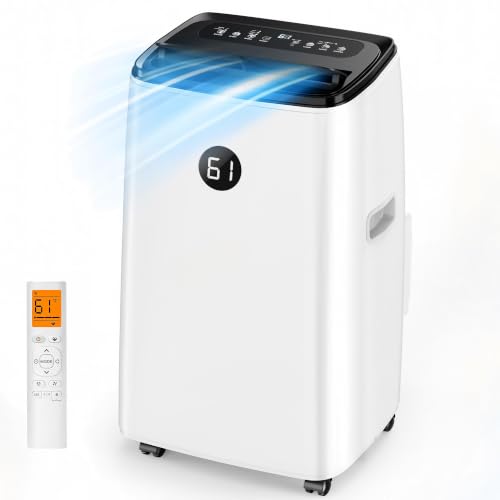
14000 BTU Portable Air Conditioners, 3-in-1 Floor Stand Up Portable AC Unit | Cools Up to 700 Sq.Ft, with Dehumidifier, Fan, Self-Evaporating, Quiet Sleep Mode, Auto Swing, for Large Rooms Bedrooms
Check price on Amazon
Shinco 8,000 BTU Grey Portable Air Conditioner, Portable AC Unit with Built-in Cool, Dehumidifier & Fan Modes for Room up to 350 sq.ft, Room Air Conditioner with Remote Control, Installation Kit
Check price on Amazon
Portable Air Conditioners, Swamp Cooler Portable AC Unit for Room, Windowless Cooling Fan That Blow Cold Air w/Remote 5L Tank 12 Speeds 9H Timer, Evaporative Air Cooler for Bedroom Garage (White)
Check price on Amazon
24" Windowless Portable Air Conditioner, 3-IN-1 Portable AC Unit with Remote, 15H Timer & 120°Oscillation, 2-Gal Tank, 3 Modes & 3 Speeds, Ultra-Quiet Ventless Swamp Cooler for Home Office, Onyx
Check price on Amazon
Windowless Portable Air Conditioners Fan, Swamp Cooler 3 Modes & 3 Speeds, 16FT Remote,12H Timer for Smart Auto-off, No Hose Needed,2-Gal Tank for 20H Cooling 36db Evaporative Air Cooler
Check price on Amazon
BLACK+DECKER Portable Air Conditioner, 9,000 BTU, BPACT08WT, White | 5,300 BTU SACC for Rooms up to 400 Sq. Ft., 3-in-1 Portable AC, Fan and Dehum with Follow Me Remote Control
Check price on Amazon
Humhold 14000BTU Portable Air Conditioners with Remote Control, Dehumidifier & Fan Mode, Floor Stand up Cooling Portable AC Unit for Large Room up to 700 sq.ft, Sleep,Timer & Auto Swing Function
Check price on Amazon
Humhold 14000BTU Portable Air Conditioners, Floor Stand Portable AC Unit | 3 in 1 AC Unit w/t Dehumidifier & Fan, Free Stand up Portable AC for Room up to 700 sq.ft, Sleep,Timer & Remote Control
Check price on AmazonDisclaimer
Some of the content on this site uses AI assistance. Information is provided for educational purposes only. We are not responsible for any losses resulting from the use of this information. By using this site, you waive any right to bring legal claims against us arising from your use of the information provided. If you do not agree, please do not use this site. Read the full disclaimer.