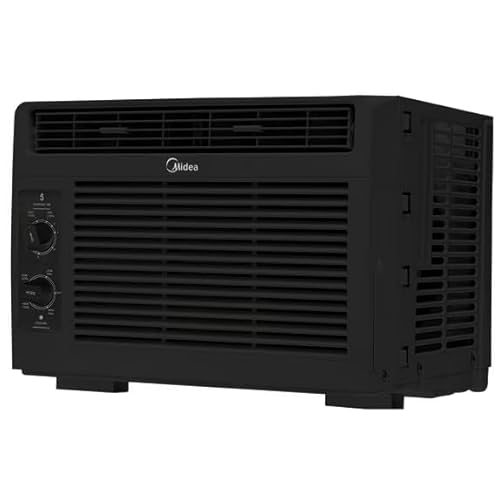
Small Window Air Conditioner with Thermostat
Your complete research guide to understanding built-in thermostats in compact window AC units — how they work, what to look for, and how to choose the right unit for a small room.
Why this guide matters: If you are researching a small window air conditioner with a thermostat, you already know what you want. What you likely need now is clarity — on thermostat types, sizing, efficiency, and which features actually matter in a compact unit. This guide answers those questions so you can move forward with confidence.
What Is a Small Window Air Conditioner with Thermostat?
A small window air conditioner with a thermostat is a compact cooling unit designed for installation in a standard window frame, featuring a built-in temperature control mechanism. These units typically range from 5,000 to 12,000 BTU and are engineered for rooms up to roughly 400 square feet. The thermostat is the component that monitors room temperature and cycles the compressor on and off to maintain your desired setting.
Unlike portable units that sit on the floor, window models draw outside air across the condenser coils and exhaust heat directly outdoors. This design makes them more efficient than many portable alternatives of similar capacity. The thermostat is the feature that transforms a basic cooling appliance into a controllable comfort system.
If you are still exploring broader options, you may want to compare this category against a small air conditioner with thermostat that covers portable and wall-mounted formats as well.
How Built-In Thermostats Work in Window AC Units
The thermostat in a window air conditioner is a temperature-sensing device that reads the temperature of the air entering the unit (the return air) and compares it to your set point. When the room warms above your target, the thermostat signals the compressor to engage. When the room reaches the set temperature, the compressor disengages while the fan may continue running to circulate air.
Mechanical Thermostats
Entry-level window AC units commonly use a rotary dial or slider that adjusts a bimetallic strip or bulb-and-capillary sensor. These are durable and simple but offer wider temperature swings — often several degrees of variance. You turn the dial toward "cooler" or "warmer" without seeing an exact temperature readout.
Digital Thermostats
Mid-range and top-tier small window ACs feature digital thermostats with an electronic sensor and a display showing the set temperature. These typically maintain temperatures within one to two degrees and often include programmable timers, sleep mode, and remote control. Some models add energy-saver modes that cycle the fan with the compressor for reduced energy use.
Precision Control
Digital thermostats hold temperature within a narrow band, reducing the on-off cycling that causes temperature swings and unnecessary compressor wear.
Programmable Scheduling
Many digital units allow you to set different temperatures for daytime and nighttime, or to turn the unit on before you arrive home.
Remote Operation
Remote controls and Wi-Fi connectivity on higher-tier models let you adjust the thermostat without leaving your seat or, in some cases, your car.
Energy-Saver Mode
When the set temperature is reached, the fan may stop with the compressor, saving energy compared to continuous fan operation.
For a deeper dive into thermostat technology and how it applies across different cooling systems, see this guide to a simple AC thermostat.
Sizing a Small Window AC with Thermostat
Correct sizing is the single most important factor in whether your window AC performs well. An oversized unit cools the air quickly but short-cycles the compressor, leaving the room feeling clammy because it does not run long enough to remove humidity. An undersized unit runs continuously and may never reach your thermostat set point on hot days.
| Room Size | Recommended BTU | Typical Use Case | Market Tier Examples |
|---|---|---|---|
| Up to 150 sq ft | 5,000 – 6,000 BTU | Bedroom, small office, studio nook | Entry-level |
| 150 – 250 sq ft | 8,000 – 10,000 BTU | Living room, primary bedroom, home office | Mid-range |
| 250 – 400 sq ft | 12,000 – 14,000 BTU | Open-plan living area, large bedroom, small studio | Top-tier |
These ranges assume standard ceiling height (8 feet), average insulation, and moderate sun exposure. If your room has high ceilings, large west-facing windows, or poor insulation, consider moving up one BTU tier. For a focused breakdown, read this guide on room size for a 5,000 BTU air conditioner.
Thermostat tip: A digital thermostat is more forgiving of slight oversizing because it can modulate more precisely. But no thermostat can fully compensate for a unit that is dramatically oversized or undersized for the space.
Key Features to Evaluate
Beyond the thermostat itself, several features separate a satisfactory unit from an excellent one in a small room.
Thermostat-Controlled Window AC vs Other Small Cooling Options
Understanding how a window AC with thermostat compares to alternative formats helps you confirm you are shopping the right category.
| Option | Thermostat Control | Best For | Trade-Off |
|---|---|---|---|
| Small window AC with thermostat | Built-in mechanical or digital | Rooms with a suitable double-hung window | Requires window installation; blocks window view partially |
| Portable AC with thermostat | Digital, often with remote | Renters or rooms without window compatibility | Less efficient; requires hose venting; bulkier footprint |
| Mini-split with thermostat | Wall-mounted digital thermostat | Whole-room comfort with minimal noise | Professional installation; higher upfront investment |
| Through-the-wall AC | Built-in digital or mechanical | Permanent installation in a wall sleeve | Requires wall modification; less flexible placement |
For spaces without a standard window, a small AC unit that doesn't need a window may be the better fit. If your window is a slider, look at side-to-side window air conditioner options, which are designed for horizontal sliding frames.
Where Small Window ACs with Thermostats Work Best
These units excel in defined, enclosed spaces where cooling loads are predictable. The most common applications include:
For bedroom-specific guidance, see small air conditioners for bedrooms. If your space is particularly compact, small air conditioners for small rooms covers tighter dimensions.
Installation and Placement Considerations
A window AC with thermostat must be installed correctly for the thermostat to read room temperature accurately. The unit should sit level, with a slight downward tilt toward the exterior (about 1/4 inch) to allow condensate drainage. Avoid installing the unit where it receives direct sunlight on the thermostat housing, as this can cause false readings and unnecessary cooling.
Ensure the window frame can support the unit's weight. Most small units weigh between 40 and 70 pounds. A support bracket is recommended for windows that open wider than the unit's side panels can securely fill. For narrow vertical windows, explore 10-inch height units or 14-inch wide models.
Thermostat placement tip: Keep the thermostat sensor away from lamps, televisions, and direct airflow from the unit itself. Obstructions or heat sources near the sensor cause the compressor to cycle incorrectly.
Maintenance for Reliable Thermostat Performance
A thermostat is only as accurate as the unit it controls. Regular maintenance keeps the system responsive and efficient.
For units with remote controls or Wi-Fi, keep firmware updated and replace remote batteries annually. If you are considering upgrading to app-based control, review smart thermostat for air conditioner guidance.
Frequently Asked Questions
Most small window air conditioners include a built-in thermostat, though the type varies. Mechanical rotary dials are common on entry-level models, while mid-range and top-tier units often feature digital thermostats with precise temperature settings and programmable timers.
For a small room up to 150 square feet, a 5,000 to 6,000 BTU window air conditioner is typically sufficient. Rooms between 150 and 250 square feet generally need 8,000 to 10,000 BTU. Always factor in ceiling height, sun exposure, and occupancy when sizing.
A digital thermostat offers more precise temperature control, often within one degree, and usually includes features like timers, sleep modes, and remote control. Mechanical dials are simpler and durable but less accurate. For comfort and efficiency, a digital thermostat is generally preferable.
Most window air conditioners are not directly compatible with conventional smart thermostats. However, some top-tier models include built-in Wi-Fi and app control. Alternatively, smart AC controllers and smart plugs can add remote control capabilities to units with mechanical or basic digital controls. See smart thermostat and smart air conditioner control for more detail.
Clean the filter every two to four weeks during heavy use. A clogged filter restricts airflow, which can cause the evaporator coil to freeze and prevent the unit from reaching the thermostat set point. Regular cleaning is the simplest way to maintain cooling performance.
Making Your Decision
When choosing a small window air conditioner with thermostat, prioritize accurate sizing first, then thermostat type, then efficiency and noise. A digital thermostat on a correctly sized unit will deliver more consistent comfort than a mechanical control on an oversized unit. If efficiency certifications matter to you, look for ENERGY STAR small window units. If you need a stronger cooling output in a compact frame, consider high-BTU compact models.
For niche window configurations, there are specialized formats such as the vertical window air conditioner and small vertical window unit. And if you want remote-free operation without losing convenience, see units with remote control.