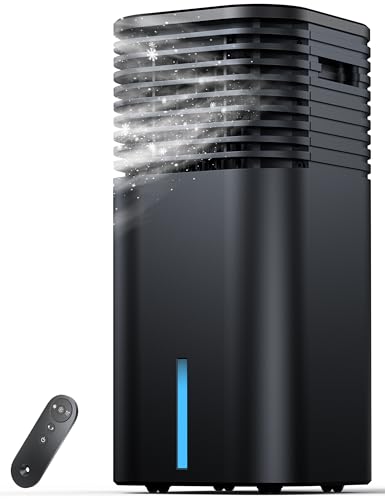
Ventless Evaporative Portable Air Conditioner: Complete Guide
Learn how ventless evaporative portable coolers work, which climates they suit, how to size and position one, and how to choose the right unit before you buy.
Start LearningWhy this guide exists: Evaporative coolers are often confused with compressor-based portable ACs. They are a different technology with different rules — and they only deliver real comfort in the right climate. This guide explains those rules clearly so you can decide with confidence.
What Is a Ventless Evaporative Portable Air Conditioner?
A ventless evaporative portable air conditioner — often called a swamp cooler or evaporative air cooler — is a movable cooling appliance that lowers air temperature by evaporating water through a wicking pad. A fan draws warm, dry air across the moistened pad; as water evaporates, the air cools and is blown into the room.
The "ventless" descriptor is what separates this category from conventional portable ACs. A compressor-based portable unit must exhaust hot air outdoors through a window duct, because it rejects heat as part of the refrigeration cycle. An evaporative cooler does not reject heat — it adds moisture — so it does not need an exhaust hose or window vent. That makes setup simpler and placement more flexible. If you are comparing approaches, our ventless evaporative portable air conditioner anchor page and the broader portable air conditioner overview are useful companion reads.
It is important to be clear about what this appliance is not. It is not a refrigerant-based air conditioner, and it will not cool a humid room the way a compressor unit does. It is a comfort device best suited to dry climates and spot cooling.
How Evaporative Cooling Actually Works
Water Evaporation
A pump wets a pad, and a fan pulls air across it. As water evaporates, it absorbs heat, cooling the delivered air.
No Refrigerant
There is no compressor, no refrigerant loop, and no heat rejection. That is why no exhaust duct is required.
Airflow-Driven Comfort
Comfort comes from a combination of cooler air and moving air. Directed airflow matters as much as temperature drop.
Moisture Addition
Because the unit adds humidity, ventilation is essential. In dry climates this is a benefit; in humid climates it is a drawback.
Simple Setup
Fill the tank, plug it in, and aim the airflow. No window kit, no duct, no exterior bracket.
Portability
Casters and a compact footprint let you move the unit between rooms, a garage, or a covered patio as needed.
Common Configurations
Ventless evaporative coolers come in a few practical formats. The right choice depends on how you plan to use it and how much airflow you need.
- Tower Evaporative Cooler Tall, narrow footprint with vertical airflow. Suited to corners and smaller rooms.
- Box-Style Cooler Wider body with a larger fan and pad area. Better for open spaces and stronger airflow.
- Personal / Desktop Cooler Small unit for a desk or bedside. Best treated as a spot-cooling accessory.
- Industrial-Grade Cooler Heavy-duty build with a large tank and high airflow. Suited to garages, workshops, and commercial spaces.
Ventless Evaporative vs Compressor Portable AC
| Category | Ventless Evaporative Cooler | Compressor Portable AC | Best For |
|---|---|---|---|
| Cooling Method | Water evaporation | Refrigerant cycle | Matching technology to climate |
| Exhaust Requirement | None | Window duct required | Rooms without venting options |
| Humidity Effect | Increases indoor humidity | Dehumidifies | Dry vs humid climates |
| Climate Suitability | Dry climates | Most climates | Regional planning |
| Tier Positioning | Essential tier to professional-grade | Entry-level to top-tier | Scale of use |
For a fuller comparison of cooling formats, the portable AC unit that does not require venting and portable AC unit that does not need a window pages are useful reads. If you are weighing venting accessories in general, window vents for portable air conditioners and window exhaust for portable air conditioner explain the setup side.
Climate Suitability: Where This Technology Shines
Evaporative cooling depends on dry air. The lower the relative humidity, the more effective the cooling. In humid regions, the same unit delivers far less comfort.
Think of it this way: if the air already holds a lot of moisture, water from the pad evaporates slowly, and the temperature drop is small. In arid and semi-arid climates — where summers are hot and dry — the effect is pronounced. As a rule of thumb, evaporative coolers are a strong fit for dry climates and a weak fit for humid ones. To understand the humidity side of the equation, see what humidity level is good for a house and what is the humidity supposed to be in your house.
If you live in a humid climate and still want a portable cooling option, a compressor-based unit is generally the better match. The most efficient portable air conditioner page covers efficiency considerations, and outdoor cooling system for humid climates addresses outdoor comfort in damp regions.
Sizing and Placement Tips
Evaporative coolers are often rated by airflow (cubic feet per minute) rather than by BTU, because they work by moving air rather than by removing heat through a refrigerant cycle. Match airflow to room size and use case, and place the unit where the cooled air can reach you.
- Choose a unit with adjustable fan speeds so you can match output to conditions.
- Position the cooler near an open window or door to encourage cross-ventilation.
- Aim airflow toward the occupied area rather than into a wall or corner.
- Keep the intake clear of curtains and furniture to maintain airflow.
- Drain and refill the tank regularly; stale water reduces performance and can cause odors.
- Clean or replace the cooling pad per the manufacturer's schedule.
If you are also evaluating compressor-based options for comparison, air conditioning units for small spaces and bedroom air conditioner explain room-scale choices, while basement AC covers below-grade spaces.
Strengths and Trade-offs
Strengths
- No exhaust duct or window kit required
- Simple setup and easy portability
- Effective in dry climates
- Adds moisture to dry indoor air
- Useful for garages, workshops, and covered patios
- Straightforward maintenance routine
Trade-offs
- Limited effectiveness in humid climates
- Raises indoor humidity, so ventilation matters
- Not a substitute for a refrigerant AC in humid regions
- Requires regular water refills and pad care
- Cooling effect is localized rather than whole-home
- Performance varies with ambient conditions
Maintenance and Troubleshooting
Routine care keeps an evaporative cooler performing at its best. Drain the tank when the unit is not in use, clean the pad and water reservoir regularly, and keep the fan and intake free of dust. If airflow weakens, check the pad and the intake first. If the unit runs but does not cool, verify the water level and pump operation.
For general upkeep practices that apply across cooling appliances, our AC maintenance guide and AC maintenance plan articles provide structured schedules. If you notice water issues with other equipment, AC leaking water solution and air conditioning unit leaking water cover common causes.
Buying Considerations
When comparing evaporative coolers, weigh climate suitability first, then airflow and tank capacity, then build quality and ease of maintenance. Entry-level personal coolers suit a desk or bedside; mid-range tower and box units suit a room; professional-grade and commercial-grade units are built for garages, workshops, and larger spaces with heavier-duty components and larger reservoirs.
If you are also exploring alternative cooling formats, the window air conditioner and ductless mini split system pages explain other approaches. For air quality add-ons, the air purifier overview is useful context. If you are comparing portable airflow accessories, mobile air conditioner universal adjustable window sealing plate splint baffle and window panel for portable air conditioner cover venting hardware for compressor units.
Compare Ventless Evaporative Cooler Options
Explore models that suit dry-climate cooling, compare features across tiers, and check availability. Confirm climate suitability and airflow before you commit.
Explore OptionsFrequently Asked Questions
What is a ventless evaporative portable air conditioner?
A ventless evaporative portable air conditioner is a movable cooler that lowers air temperature by evaporating water through a wicking pad. Unlike a compressor-based portable AC, it does not need an exhaust duct or window vent, because it does not reject heat outdoors — it adds moisture to the air instead.
Do ventless evaporative coolers work in humid climates?
They perform best in dry climates where relative humidity is low. In humid climates, the air already holds a lot of moisture, so evaporation is slower and the cooling effect is reduced. Evaporative coolers are generally not recommended for humid regions.
How much cooling can an evaporative portable cooler provide?
Cooling output depends on airflow, water-pad efficiency, and ambient humidity. In dry air, a well-designed unit can drop the temperature of the air it delivers by a noticeable margin, but it is best treated as spot cooling for a room, garage, or workspace rather than as a whole-home solution.
Do evaporative coolers add humidity to a room?
Yes. Evaporative cooling works by adding moisture to the air, which raises indoor relative humidity. Good ventilation helps manage this. In tightly sealed rooms, humidity can build up over time, so cross-ventilation is important.
How do I maintain a ventless evaporative portable air conditioner?
Drain and refill the water tank regularly, clean or replace the cooling pad as recommended, and keep the air intake and fan blades free of dust. Routine maintenance preserves airflow and prevents odors from stagnant water.