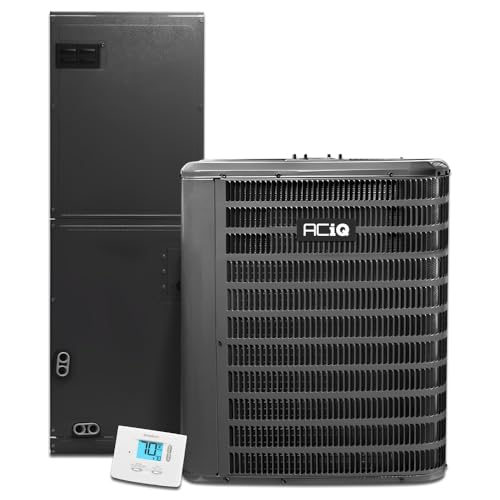
Central Air Conditioning Unit with Heater: Complete Guide
A single system that cools in summer and warms in winter. Learn how a combined central AC and heating unit works, how to size it correctly, and which tier of equipment matches your home and climate.
EXPLORE THE GUIDEWhy a combined system? A central air conditioning unit with heater gives you one thermostat, one set of ductwork, and one installation project for year-round comfort. Instead of maintaining separate cooling and heating equipment, you invest in a single integrated system — provided it is sized and installed correctly. This guide walks you through the fundamentals before you compare models.
What Is a Central Air Conditioning Unit with Heater?
A central air conditioning unit with heater is an integrated HVAC system that shares ductwork and a blower to distribute both cooled and warmed air throughout a home. The cooling side operates on the standard vapor-compression refrigeration cycle, while the heating side uses either electric resistance elements, a gas furnace section, or a reversing heat pump valve.
The most common configurations fall into three families:
- Split system with furnace: An outdoor condenser pairs with an indoor coil mounted above or beside a gas or electric furnace. The furnace handles heating; the coil and condenser handle cooling.
- Heat pump system: A single outdoor unit reverses refrigerant flow to move heat indoors in winter and outdoors in summer. This is the modern interpretation of a central air conditioning unit with heat pump.
- Packaged unit: All components — compressor, coil, and heating section — live in one outdoor cabinet, connected to indoor ducts. Common in homes without basements.
Understanding which family you are shopping in matters, because it determines efficiency metrics, fuel source, and how the system behaves in extreme cold. If you are also comparing a furnace-based setup, the guide on a central air conditioner with furnace covers the indoor-side details in depth.
How Cooling and Heating Share One System
In cooling mode, the compressor circulates refrigerant between the indoor evaporator coil and the outdoor condenser. Warm indoor air passes over the cold evaporator coil, gives up heat, and returns to the rooms through supply registers. In heating mode, the operation depends on the configuration:
- Furnace-based systems switch off the outdoor condenser and ignite the furnace burner or heating elements. The same blower pushes warm air through the same ducts.
- Heat pump systems use a reversing valve to swap the roles of the indoor and outdoor coils, absorbing heat from outdoor air and releasing it indoors.
Because both functions share the blower, filter, and ductwork, maintenance of these shared components affects both seasons. A clogged filter that hurts cooling performance in July will also restrict airflow and reduce heating output in January. This is why a disciplined central air conditioning system maintenance routine is the single highest-leverage habit for a combined unit.
For a broader overview of how the two functions are engineered together, see the reference on central air conditioner and heating units.
Key Benefits of a Combined Central System
One Thermostat, One Control
A single programmable or smart thermostat manages both seasons, simplifying scheduling and reducing the learning curve for the household.
Shared Ductwork
No separate duct runs for heating and cooling. The same supply and return network serves both functions, which keeps the installation footprint compact.
Centralized Filtration
One high-capacity filter handles both seasons, so indoor air quality management stays consistent year-round instead of switching between systems.
Integrated Performance
Modern combined systems are engineered as a matched set, meaning the indoor coil, outdoor unit, and blower are tuned to work together rather than as mismatched parts.
One Service Relationship
Maintenance visits, warranty registration, and troubleshooting all point to one system and often one contractor, reducing administrative friction.
Even Distribution
Central ducting distributes conditioned air across multiple rooms, avoiding the hot-and-cold pockets common with single-room equipment.
Sizing a Central Unit with Heater for Your Home
Sizing is the most consequential decision in the entire project. An oversized system short-cycles, struggles to dehumidify in summer, and wears its compressor prematurely. An undersized system runs continuously and never quite reaches the setpoint on design days. The industry-standard approach is a Manual J load calculation, which accounts for square footage, ceiling height, window area, insulation, orientation, and local climate data.
As a starting reference only — never as a substitute for a proper load calculation — these are typical capacity bands by home size:
| Home Size | Typical Cooling Capacity Band | Heating Consideration | Reference Guide |
|---|---|---|---|
| Up to 1,000 sq ft | Entry-level capacity band | Often a packaged or compact split system | 1,000 sq ft central AC unit |
| 1,000 – 1,500 sq ft | Mid-tier capacity band | Heat pump or furnace-matched split | 1,500 sq ft central AC unit |
| 1,500 – 1,800 sq ft | Mid-to-high capacity band | Variable-speed or two-stage preferred | 1,800 sq ft central AC unit |
| 2,000 – 2,500 sq ft | High-end capacity band | Zoned distribution often warranted | 2,500 sq ft central AC unit |
Heating capacity is sized on a separate load calculation that factors in outdoor design temperature and the home's heat loss. In colder climates, a heat pump system is often paired with a supplemental heating section, while in milder climates the heat pump alone may cover the full heating load.
If your home is older and lacks ductwork, a ductless route may be more practical than retrofitting ducts; the central air conditioning ductless systems overview explains the trade-offs.
Efficiency Metrics That Matter
For the cooling side, SEER2 is the current federal efficiency metric, and higher values indicate more efficient operation. For the heating side, the metric depends on the heat source: HSPF2 for heat pumps, and AFUE for gas furnaces. A combined unit's real-world efficiency is only as good as its installation — duct leakage and charge errors can erase a significant portion of the rated advantage.
When comparing tiers, keep these relationships in mind:
- Entry-level systems are typically single-stage, meaning the compressor is either fully on or fully off. They are straightforward and durable.
- Mid-range systems add two-stage or modestly variable operation, improving humidity control and temperature stability.
- Premium and top-tier systems use fully variable-speed compressors and blowers, delivering the tightest temperature control and the quietest operation.
It is entirely possible for a well-installed mid-range system to outperform a poorly installed premium system. Treat the tier label as a description of capability, not a guarantee of outcome.
Heat Pump vs. Furnace: Which Heating Side Fits Your Climate?
| Consideration | Heat Pump Heating | Furnace Heating |
|---|---|---|
| Cold-climate performance | Strong in mild climates; cold-climate models extend range | Consistent output regardless of outdoor temperature |
| Fuel source | Electricity only | Natural gas, propane, or electric resistance |
| Seasonal efficiency | Rated by HSPF2 | Rated by AFUE for combustion models |
| Dual-fuel option | Can pair with a furnace as backup | Can pair with a heat pump as primary |
| Typical fit | Mild-to-moderate climates, all-electric homes | Colder climates, homes with existing gas service |
Many homeowners in mixed climates choose a dual-fuel configuration: a heat pump handles the shoulder seasons efficiently, and a furnace takes over during the coldest weeks. This pairing is one of the most flexible expressions of a central air conditioning unit with heater, because it adapts the heating method to the outdoor temperature.
Understanding Product Tiers Without Prices
Shopping conversations often collapse into price comparisons, which obscures what actually differs between models. Instead, evaluate systems by capability tier. The following framework describes what each tier delivers, independent of any market number:
Single-Stage, Straightforward
Solid build, predictable operation, and simpler serviceability. A reasonable fit for mild climates and homeowners who prioritize reliability over fine-grained control.
Two-Stage Comfort
Better humidity control and quieter operation than entry-level, with most of the comfort benefit of variable systems at a more approachable position in the market.
Fully Variable-Speed
The tightest temperature control, lowest cycling losses, and quietest operation. A long-term investment for homeowners who intend to stay in the home for many years.
When comparing models within a tier, look at the matched-system rating rather than the outdoor unit alone. A premium outdoor unit paired with a mismatched indoor coil will not deliver the rated efficiency. Ask for the AHRI reference number of the specific combination you are considering.
Installation Considerations for a Combined System
Installation quality determines whether the system performs as designed. The following items deserve explicit attention before and during the project:
- Load calculation first. Insist on a room-by-room Manual J before any equipment is selected.
- Duct assessment. Existing ducts should be pressure-tested for leakage and checked for proper sizing. Undersized ducts choke airflow and degrade both cooling and heating.
- Electrical service. Combined systems draw significant current; the panel and circuit must be verified by a qualified electrician.
- Refrigerant line set. Length and routing affect charge and efficiency. Longer runs require adjustments that the installer must document.
- Condensate management. The indoor coil produces condensate in cooling mode; a properly sloped drain and secondary pan protect the home.
- Permits and inspections. Most jurisdictions require a permit for HVAC replacement or new installation. See the central air conditioning system installation reference for the sequence of steps.
For homes without existing ductwork, the retrofit path is materially different. The guide on central air conditioning installation in older homes covers the duct-chase and zoning decisions that typically arise.
Maintenance for Year-Round Reliability
Because one system serves both seasons, maintenance is not optional — it is the mechanism that preserves comfort across the full year. A practical routine includes:
- Filter replacement every one to three months, more often in dusty homes or with pets.
- Coil cleaning on both the indoor evaporator and outdoor condenser, typically once per year.
- Drain line flushing to prevent algae growth and water backups.
- Seasonal changeover checks — verifying the reversing valve on heat pumps and the burner on furnaces before each season.
- Professional inspection annually, covering refrigerant charge, electrical connections, and blower condition.
The broader central air conditioning system reference and the guide on central air conditioning system maintenance provide expanded checklists.
Common Problems and What They Usually Mean
Many symptoms in combined systems point to shared components — the blower, filter, or thermostat — rather than the cooling or heating section specifically. A short diagnostic primer:
- Running but not cooling: check filter, thermostat mode, and outdoor unit operation. See central air conditioner running but not cooling.
- Running but not blowing air: likely a blower or duct issue. See central air conditioner running but not blowing air.
- Water inside the house: a clogged condensate line is the most common cause. See central air conditioner leaking water inside house.
- Not reaching the set temperature: often a sizing, charge, or duct issue. See central air conditioner not cooling to set temperature.
- Sudden stop: check the breaker, float switch, and thermostat batteries. See central air conditioner stopped working suddenly.
If the issue is limited to the cooling function and the system is otherwise sound, the central air conditioning repair overview describes how a technician typically isolates the fault.
Repair or Replace a Combined System?
The decision hinges on age, failure type, and refrigerant status. A compressor failure on a system past its typical service life usually points toward replacement, while a failed capacitor or contactor on an otherwise healthy system is a straightforward repair. Systems using phased-out refrigerants also face rising service difficulty as the years pass.
When replacement is the right call, plan the project rather than reacting to a failure in peak season. The central air conditioner replacement guide covers staging, permitting, and the questions to ask each contractor. For homes that are being prepared for sale or a major renovation, the central air conditioning system for home overview is a useful starting point.
Frequently Asked Questions
Can a single central unit really heat and cool a whole house?
Yes. A combined system shares ductwork and a blower, with the heating section either a furnace, electric elements, or a reversing heat pump. The cooling section operates on the standard refrigeration cycle. The key requirement is that the system is correctly sized for both the cooling load and the heating load, which are calculated separately.
Is a heat pump better than a furnace for the heating side?
It depends on climate and energy infrastructure. Heat pumps are highly efficient in mild and moderate climates and can be paired with a furnace for cold snaps in a dual-fuel setup. Furnaces provide consistent output regardless of outdoor temperature. Neither is universally superior; the right choice is the one matched to the local design temperature and the home's existing fuel service.
How long does a combined central system typically last?
With consistent maintenance, a well-installed system commonly serves for well over a decade. Outdoor condensers and compressors are the wear-prone components; indoor coils and blowers generally outlast them. Installation quality and filter discipline are the two strongest predictors of service life.
Do I need new ductwork if I am replacing an existing system?
Not necessarily, but the existing ducts should be inspected and pressure-tested. Ducts that are undersized, leaky, or poorly insulated will degrade the performance of even a premium system. In many replacement projects, targeted duct sealing and insulation upgrades deliver a meaningful efficiency improvement for a modest additional scope.
What efficiency metrics should I compare?
For cooling, compare SEER2. For heat pump heating, compare HSPF2. For gas furnace heating, compare AFUE. Always compare the matched-system rating — the combination of indoor and outdoor units — rather than the outdoor unit in isolation, because the rated efficiency applies to the matched set.
How often should the filter be changed?
Every one to three months for standard filters. Homes with pets, high dust, or heavy occupancy should change more frequently. A restricted filter reduces airflow in both cooling and heating modes, so it is the single most impactful routine task for a combined system.
Ready to Compare Combined Systems?
Use the guide above to shortlist the tier and configuration that fits your home, then explore matched systems below.
VIEW RECOMMENDED SYSTEMS