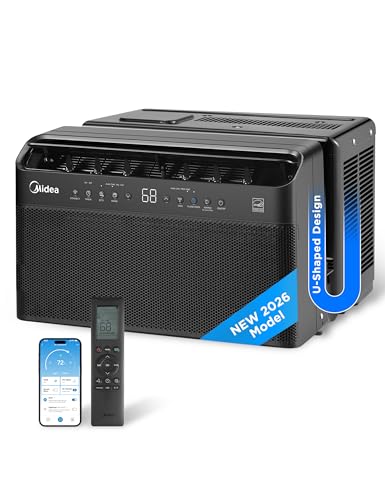
ENERGY STAR 6000 BTU Air Conditioner
A 6000 BTU unit is the small-room specialist of the window AC category — compact, efficient, and often ENERGY STAR certified. This guide explains what 6000 BTU covers, what ENERGY STAR actually guarantees, how to size and install one, and how to get the best long-term performance from it.
Start the GuideWhy this capacity and certification combination matters: 6000 BTU sits at the sweet spot for single-room cooling — small enough to run on a standard household circuit, large enough to handle a typical bedroom or home office. Adding ENERGY STAR certification on top means the unit has been independently verified against a higher efficiency threshold than baseline models. For a room that gets used every summer, that efficiency difference is what separates a good short-term choice from a strong long-term one.
What a 6000 BTU Air Conditioner Covers
British Thermal Units (BTU) measure cooling capacity — how much heat the unit can remove from a room per hour. A 6000 BTU air conditioner is the entry point for serious single-room cooling, positioned above the smallest 5000 BTU units and below the mid-sized 8000 BTU class. For context on how the category fits into the full landscape of home cooling, see our overview of different types of air conditioning for homes.
Typical room coverage
A 6000 BTU unit is generally suited to rooms of roughly 150 to 250 square feet. Common matches include:
- Standard bedrooms (roughly 10x12 to 12x15 feet)
- Small home offices and studies
- Guest rooms and nurseries
- Small living rooms in apartments or condos
- Dorm rooms and studio spaces
That range is a starting point, not a firm rule. A room with large west-facing windows, poor insulation, high ceilings, or many occupants can push beyond what 6000 BTU comfortably handles. Similarly, a very well-insulated, shaded room of the same size may only need 5000 BTU. Our room-by-room category page for ENERGY STAR 6000 BTU air conditioner units collects models within this exact class, which is useful once you know 6000 BTU is the right target.
What ENERGY STAR Certification Means
ENERGY STAR is a voluntary efficiency certification program that identifies products meeting efficiency thresholds higher than the federal minimum. For air conditioners, the certification is based on the unit's efficiency ratio — the amount of cooling it delivers relative to the energy it consumes. A certified 6000 BTU unit will use less electricity than a comparable non-certified model to deliver the same cooling.
Practical benefits of certification
- Lower energy use over a full season: the efficiency advantage compounds the more hours the unit runs.
- Verified performance: efficiency claims are tested against a defined standard rather than a marketing number.
- Access to rebate programs: many utilities offer incentives for ENERGY STAR certified equipment — see ENERGY STAR HVAC for background on how the broader program works.
- Better long-term value: a certified unit is typically a stronger investment AC for long-term use than an uncertified model of the same capacity.
Where certification matters less
If a 6000 BTU unit will only run a few hours per year in a guest room or occasional-use space, the efficiency difference between certified and non-certified models matters much less. The value of certification scales with how heavily the unit is used.
How a 6000 BTU Window AC Works
Window air conditioners are self-contained refrigeration systems. Inside the casing are four core components working together:
- Compressor: circulates refrigerant through the system and drives the heat-transfer cycle.
- Evaporator coil: absorbs heat from the indoor air as the fan blows room air across it.
- Condenser coil: releases the absorbed heat to the outdoors.
- Fans: one circulates air across the evaporator into the room, another exhausts heat across the condenser out the back.
Because the unit sits in a window frame, the hot side faces directly outdoors and heat is rejected without a hose or duct. That direct exhaust is one reason window units are generally more efficient than comparable portable units. Inverter-equipped models — which vary compressor speed rather than cycling on and off — are increasingly common in this capacity class; our comparison of inverter vs non-inverter explains the operational difference in detail.
Window, Through-the-Wall, and Portable Options
6000 BTU capacity is available in several form factors, and the right one depends on your window situation and installation preferences.
Window AC Most common
The standard configuration for 6000 BTU. It installs in a double-hung window with the hot side facing outdoors. This is the format most ENERGY STAR certified small-room units take, and it tends to be the most efficient option in this capacity class. If you need the full range of options, our window air conditioner guide covers the category in more depth.
Through-the-Wall AC Permanent
A 6000 BTU through-the-wall unit is installed in a wall sleeve rather than a window, keeping the window free and the installation permanent. Inverter-equipped versions are available in the dual inverter through-the-wall air conditioner category. Also, some models combine cooling and heating — see heat and air unit for wall. For a broader look at the format, our through-the-wall AC guide covers the trade-offs.
Portable AC Flexible
Portable 6000 BTU models exist, though they are often less efficient than window units of the same capacity due to the hose-venting arrangement. They suit renters, sliding-door setups, and spaces where window installation is impractical. See our portable air conditioner guide for the category overview.
Key Features to Look For
Within the 6000 BTU category, feature differences separate a basic starter unit from a well-specified one. Prioritize the features that genuinely affect comfort and daily use.
Efficiency and controls
- ENERGY STAR certification: the primary efficiency benchmark in this category.
- Inverter compressor: smoother temperature control and quieter operation than fixed-speed units.
- Programmable or smart thermostat: scheduling avoids cooling an empty room; see electronic home thermostat for general thermostat considerations.
- Wi-Fi and app control: increasingly common even in this capacity class — models in the dual inverter smart Wi-Fi enabled window air conditioner category are a representative example.
Comfort and convenience
- Multiple fan speeds and modes: low fan for sleeping, high fan for rapid cooling, plus a dehumidify-only mode.
- Sleep mode: gradually raises the setpoint overnight for comfort and efficiency.
- Remote control or app: useful when the unit is mounted high in a window.
- Adjustable louvers: direct airflow away from seating areas for draft-free comfort.
- Auto-restart: resumes previous settings after a power interruption.
Installation and durability
- Included mounting hardware: support brackets and window seals that simplify installation.
- Washable filter: easier upkeep than disposable filter-only designs.
- Solid build quality: a reinforced chassis and rust-resistant finish matter more in humid climates.
Strengths and Trade-offs
Like any capacity class, a 6000 BTU ENERGY STAR unit brings clear benefits and a few limitations worth knowing before you commit.
Strengths
- Right-sized for typical bedrooms and home offices
- ENERGY STAR efficiency lowers energy use over a season
- Runs on standard household circuits in most cases
- Straightforward window installation
- Light enough for seasonal removal if needed
- Quiet relative to larger capacities
Trade-offs
- Only suitable for one room at a time
- Window space and some light are blocked
- Not usable in every window style without adapters
- Weight still requires secure mounting
- Cannot cool an open-plan or multi-room area
How 6000 BTU Compares to Nearby Capacities
Understanding where 6000 BTU sits relative to its neighbors helps confirm the right choice for your room.
| Capacity | Typical Coverage | Best For | Notes |
|---|---|---|---|
| 5,000 BTU | Up to ~150 sq ft | Very small bedrooms, dorm rooms | Smallest standard window size; lightest |
| 6,000 BTU | ~150–250 sq ft | Standard bedrooms, home offices, small living areas | Sweet spot for single-room cooling |
| 8,000 BTU | ~250–350 sq ft | Larger bedrooms, medium living rooms | Starts to need more electrical headroom |
| 10,000+ BTU | ~350+ sq ft | Large rooms and open-plan spaces | Heavier; often needs dedicated circuits |
Efficiency tiers in this category
| Tier | Typical Characteristics | Best Fit |
|---|---|---|
| Entry-level | Basic non-inverter compressor; manual or simple digital controls; no certification | Occasional-use rooms |
| Mid-range | ENERGY STAR certified; digital thermostat; multiple fan speeds; washable filter | Daily-use bedrooms and offices |
| Premium | Inverter compressor; Wi-Fi/app control; sleep mode; quieter operation | Primary bedrooms and year-round use |
Installation Essentials
A 6000 BTU window unit is one of the simpler HVAC installations, but a few details matter for both safety and performance.
- Window fit and support: the unit must be fully supported — use the included bracket or a dedicated support arm, especially on upper floors.
- Slight downward tilt: the unit should tilt slightly toward the outside so condensation drains properly.
- Weather sealing: use the included foam or weather stripping to close gaps around the unit.
- Electrical check: most 6000 BTU units run on a standard 115V circuit and draw roughly 5–7 amps, but confirm the nameplate rating and that the outlet circuit is not shared with major appliances. Our pages on electrical outlet plugs and electrical outlet with USB port cover outlet considerations.
- Consider professional mounting for upper-floor windows or tricky installations — handyman to install window air conditioner explains the option.
After installation, our guide to the first week after AC installation lists what to check so any small issue — a leak, a vibration, or an airflow restriction — is resolved quickly.
Maintenance and Long-Term Care
Ductless window units are low-maintenance, and a small set of habits keeps them efficient and quiet across their service life.
- Clean the filter every two to four weeks during heavy use. A clogged filter is the most common cause of weakened cooling.
- Clean the front grille and air path periodically with a damp cloth.
- Inspect the outdoor side for debris or insect nests, especially before each cooling season.
- Check the condensate drain path to ensure water is not pooling indoors.
- Remove or cover the unit in winter if it will not be used year-round, to protect seals and the compressor.
- Listen for new noises — rattling, grinding, or repeated short-cycling all warrant investigation before they become larger failures.
If something does go wrong, our troubleshooting reference on fixing an air conditioner covers the most common symptoms. Refrigerant-related issues should always be handled by a technician — background is available in freon for the air conditioner and freon gas cost.
How to Shop Wisely
Buying a 6000 BTU ENERGY STAR air conditioner is a straightforward decision once you have narrowed the category. Work through these steps in order:
- Confirm the capacity fits the room. Use area, ceiling height, sun exposure, and insulation to sanity-check the 6000 BTU target. Oversizing a small room wastes energy and reduces dehumidification.
- Verify the ENERGY STAR certification. Look for the certification on the product page or nameplate, not just the marketing copy.
- Choose window vs wall vs portable. If windows are suitable, a window unit is typically the better performer in this capacity class.
- Decide on inverter and smart control. Inverter models cost more upfront but offer smoother operation and often lower long-term energy use. Smart controls make scheduling effortless for rooms used on a predictable routine.
- Check the included installation hardware. A bracket and sealing kit in the box are worth seeking out.
- Read reviews focused on noise and durability — those two factors affect daily satisfaction more than most spec-sheet numbers.
If your situation is more about a lack of ductwork across the whole home rather than a single room, a window unit is the wrong tool. In that case, our guides to ductless mini-split systems and mini-split air conditioning unit options are the more relevant starting points.
Ready to Compare 6000 BTU Models?
Once you have confirmed that 6000 BTU is the right capacity and ENERGY STAR is the right certification target, the next step is comparing specific units. Browse our recommended selections below.
View Recommended UnitsFrequently Asked Questions
What size room does a 6000 BTU air conditioner cool?
A 6000 BTU air conditioner is generally suited to rooms of roughly 150 to 250 square feet, such as a bedroom, small living room, or home office. Exact coverage depends on ceiling height, insulation, window area, sun exposure, and local climate, so a load calculation gives the most reliable result.
Is an ENERGY STAR 6000 BTU air conditioner worth it?
An ENERGY STAR certified unit meets higher efficiency requirements than standard models, which usually translates to lower energy use over a full cooling season. For rooms cooled regularly through summer, the efficiency advantage compounds over the unit's service life and makes it a solid long-term investment.
How many amps does a 6000 BTU air conditioner use?
Most 6000 BTU window air conditioners run on a standard 115V household circuit and draw roughly 5 to 7 amps during normal operation. Startup current is briefly higher. Confirm the exact rating on the unit's nameplate and ensure the outlet circuit can support it.
Can a 6000 BTU air conditioner cool more than one room?
A 6000 BTU unit is designed for a single room. Trying to cool multiple rooms with one small unit usually leads to continuous running and uneven comfort. For multi-room coverage, a ductless mini-split or a larger system is a better fit.
How often should a 6000 BTU window AC filter be cleaned?
During heavy summer use, clean the filter every two to four weeks. A clogged filter restricts airflow, reduces cooling performance, and forces the compressor to work harder. Rinse it with lukewarm water, let it dry completely, and reinstall.
The bottom line: A 6000 BTU ENERGY STAR air conditioner is the right tool when you need to cool one small-to-medium room efficiently and don't want to touch the home's ductwork. Confirm the capacity fits the room, verify the ENERGY STAR certification is real, choose window or wall format based on your installation constraints, and prefer an inverter plus smart-control model if the room sees daily use. From there, comparing specific units within the category is a matter of feature fit rather than fundamental trade-offs. If you are still deciding between this capacity and a slightly larger one, the most efficient small room air conditioner and most efficient window air conditioner with heater pages are useful next reads.