Different Types of Air Conditioning for Homes
Every home is different, and so is every cooling need. This guide breaks down the main types of residential air conditioning — central, ductless mini-split, window, portable, and through-the-wall — so you can match the right system to your layout, climate, and lifestyle before you buy.
Compare AC TypesWhy the type matters more than the brand: The single biggest decision in home cooling is not which logo is on the unit — it is which system architecture fits your house. A premium central system is wasted on a home with no ductwork, and a window unit cannot cool a 3,000 sq ft layout. Choosing the right category first makes every later decision — sizing, efficiency, and features — far simpler.
Quick Overview of Home AC Types
Residential air conditioning falls into two broad families: ducted systems that cool a whole home through a network of ducts, and ductless systems that cool individual rooms or zones directly. Within those families there are five practical types most homeowners encounter. Each has a distinct installation profile, a different comfort footprint, and its own trade-offs in efficiency and maintenance.
Below is a fast orientation. Details for each type follow in the sections underneath.
Central Air Conditioning Whole-home
A split system with an outdoor condenser and an indoor air handler connected to ductwork. It conditions every room the ducts reach and is usually paired with a furnace for heating. Best suited to single-family homes that already have — or can economically add — ductwork. For a deeper dive, see our overview of house air conditioner systems.
Ductless Mini-Split Zoned
An outdoor compressor linked by refrigerant lines to one or more slim wall-mounted indoor heads. No ducts required, and each indoor unit can be controlled independently. The standard recommendation for older homes, additions, and open-plan renovations. Explore the full category at ductless mini-split.
Window Air Conditioner Single-room
A self-contained unit that sits in a window frame and exhausts heat directly outdoors. Straightforward to install in a double-hung window and effective for one room. The classic choice for apartments and rentals. See the full range of window air conditioner options.
Portable Air Conditioner Flexible
A floor-standing unit on casters that vents hot air through a window hose. It can follow you from room to room, which suits renters and spaces where window units are not permitted. Browse models in our portable air conditioner guide.
Through-the-Wall AC Permanent
Built into a wall sleeve rather than a window, freeing up the window itself and improving security. Common in hotels, condos, and homes where windows are unsuitable. Learn more about through-the-wall AC systems.
1. Central Air Conditioning
Central air conditioning is the benchmark for whole-home comfort. A single outdoor condenser works with an indoor air handler and a network of supply and return ducts to distribute conditioned air throughout the house. Because the same ductwork can serve a furnace or heat pump, central systems are the natural anchor of a full HVAC setup — see how the pieces fit together in our guide to heating and air conditioning units combined.
How it works
The condenser rejects heat outdoors while the evaporator coil inside the air handler absorbs heat from indoor air. A blower pushes the cooled air through supply ducts and pulls return air back. Thermostat control is centralized, so one setpoint governs every connected room. For an overview of the full mechanical cycle, read how a house air conditioner operates.
Strengths and limitations
Strengths
- Even, whole-home temperature from one thermostat
- Ductwork also serves heating, so one system handles both seasons
- Indoor equipment is largely out of sight
- Filtration at the air handler improves indoor air quality
Limitations
- Requires existing or newly installed ductwork
- Cooling is all-or-nothing unless the home is zoned
- Duct losses can erode efficiency in older homes
- Installation is invasive and best handled by a contractor
If your home lacks ducts and adding them is impractical, a central system is usually the wrong starting point. The alternatives below exist precisely for that situation — the trade-offs are explored in our comparison of ductless vs ducted AC.
2. Ductless Mini-Split Systems
A ductless mini-split pairs one outdoor compressor with one or more indoor air handlers, connected only by a small refrigerant line set and a power cable. There is no ductwork at all. Each indoor head has its own thermostat, so a single outdoor unit can serve several zones at different temperatures — a configuration known as a multi-zone system, and in larger setups a five-zone mini-split can condition an entire floor.
Why mini-splits dominate the no-duct market
- Minimal structural impact: only a small hole through an exterior wall is needed for the line set.
- Room-by-room control: unused rooms can be left off instead of cooling the whole house.
- High efficiency: many models are among the most efficient systems available, and some qualify for ENERGY STAR mini-split heat pump status.
- Year-round capability: heat-pump versions provide both cooling and heating, covered in ductless mini-split air conditioners and heat pumps.
- Quiet indoor operation: the noisy compressor lives outside.
Where mini-splits shine
Older homes without ducts are the classic case, and our guide to ductless air conditioning for older homes walks through the retrofit considerations. Additions, converted garages, sunrooms, and attic conversions are other natural fits, since extending ductwork to them is often the most disruptive part of a central install. Installation is more involved than a window unit but less invasive than a full duct system — see installing a mini-split and installing a mini-split AC system for process details, and ductless mini-split AC installation cost for what the project involves in scope.
Sizing a mini-split
Capacity matters as much here as anywhere. Coverage depends on climate zone, insulation, ceiling height, and window area, so the safest approach is a load calculation rather than a rule of thumb. For orientation, our room-specific guides cover a mini-split AC unit for 500 square feet, a mini-split air conditioner for 600 square feet, and a mini-split AC unit for 1200 sq ft.
3. Window Air Conditioners
A window AC is a single self-contained box that contains the compressor, condenser, evaporator, and fan. The unit slides into a window frame with the hot side facing outdoors, so heat is exhausted directly outside without a hose. It is the most direct path to cooling a single room and a long-standing staple of apartments, dormitories, and rental units.
Practical considerations
Strengths
- Straightforward installation in a double-hung window
- Direct outdoor exhaust is efficient for one room
- Self-contained — no separate outdoor unit
- Easy to remove for the cold season
Limitations
- Blocks part of the window and its light
- Weight requires secure mounting and support brackets
- Not usable in casement or sliding windows without adapters
- Can be visually intrusive and noisy at higher fan speeds
Window units are best treated as a room-level solution rather than a whole-home strategy. If your window configuration will not accept a standard unit, a low-profile window air conditioner 5000 BTU or a heat and air conditioner window unit may open up options. When windows are simply not available, see I need an air conditioner but no window for alternative paths. Professional mounting is often worth arranging — handyman to install window air conditioner covers that route.
4. Portable Air Conditioners
Portable ACs are floor-standing units with casters, requiring only a window or sliding door for the exhaust hose. Their defining feature is mobility: they can be rolled between rooms, stored out of season, and used where window or wall installation is not allowed. For renters and flexible spaces, that convenience is the whole point.
Single-hose vs dual-hose
A single-hose portable draws indoor air across the condenser and exhausts it outside, which can create slight negative pressure and pull warm outside air back in through gaps. A dual-hose design separates intake and exhaust, reducing that effect and generally performing closer to a window unit. Models in the dual inverter portable air conditioner category combine dual-hose airflow with variable-speed compression. Hose length also matters for placement — long exhaust hose for portable air conditioner covers how to extend reach without hurting performance.
Strengths and limitations
Strengths
- No permanent installation or landlord approval needed
- Moves between rooms as needs change
- Works with sliding doors and casement windows
- Stores away easily off-season
Limitations
- Floor footprint takes up room space
- Generally less efficient than window or split systems
- Single-hose models can create negative pressure
- Higher noise levels near the unit
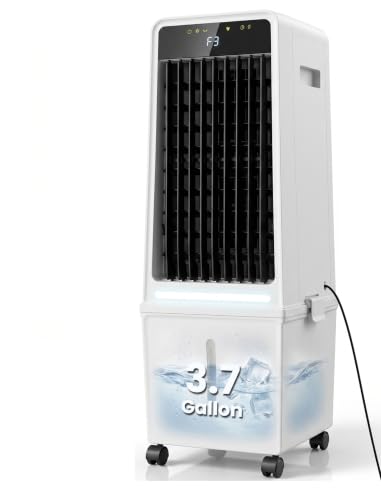
For a focused look at the most practical models, see most cost-effective portable air conditioner. Evaporative ("swamp") coolers are a different category and only suit dry climates — they are covered separately in evaporative air cooler portable air conditioner and fully evaporative portable air conditioner.
5. Through-the-Wall Air Conditioners
Through-the-wall ACs sit in a permanent wall sleeve rather than a window frame. The unit is installed into an opening cut through an exterior wall, leaving the window completely free. Hotels and condominiums popularized the format, and it remains a practical choice for homes where windows are unsuitable, small, or valuable for light and view.
When the wall-mounted format makes sense
- Window preservation: keeps the full glazing area clear for light and view.
- Security: no window opening left partly ajar.
- Permanent mounting: the unit does not need seasonal removal.
- Sleeve compatibility: replacement units can often slide into an existing sleeve.
- Heat-pump variants: combined cool-and-heat models exist, such as the heat and air unit for wall category.
The trade-off is that the installation is structural and not renter-friendly, and the unit's location is fixed for its service life. Inverter-equipped versions improve part-load behavior — see dual inverter through-the-wall air conditioner.
Inverter vs Non-Inverter: The Technology Layer
Compressor technology cuts across every system type above. A conventional (non-inverter) compressor runs at a single fixed speed, switching on at full power and off again once the thermostat is satisfied. An inverter compressor varies its speed continuously, throttling up or down to match the cooling load. The practical differences are steady temperatures, quieter operation during light load, and lower energy consumption over time — the core argument in our inverter vs non-inverter comparison.
Inverter versions exist in every form factor, including dual inverter smart Wi-Fi enabled window air conditioner models and investment AC for long-term use. DC inverter motors take the efficiency theme further — see direct current air conditioner. The right choice depends on how heavily and how long you cool each room: light, occasional use gets less from inverter benefits than a space that runs daily through summer.
Side-by-Side Comparison of AC Types
The table below summarizes the five main types across the dimensions that matter most for a home purchase decision. Use it to shortlist a category, then verify sizing for your specific rooms.
| Type | Best For | Ductwork | Coverage | Installation Effort | Zoning |
|---|---|---|---|---|---|
| Central AC | Whole-home cooling in a ducted house | Required | Whole home | High — contractor install | Single-zone unless zoned |
| Ductless Mini-Split | Homes without ducts; room-by-room control | None | One room per head; multi-zone capable | Moderate — contractor install | Excellent, per-unit |
| Window AC | Single rooms in apartments and rentals | None | One room | Low — DIY feasible | One room |
| Portable AC | Flexible cooling where installation is limited | None | One room at a time | Minimal — plug and vent | One room, movable |
| Through-the-Wall AC | Permanent single-room cooling without using a window | None | One room | Moderate — wall opening required | One room |
How to Choose the Right Type for Your Home
Work through these questions in order — each one narrows the field quickly.
1. Does your home have usable ductwork?
If yes, and the ducts are in reasonable condition, central AC is usually the most complete solution. If no — or if extending ducts to the space is impractical — ductless mini-split is the default answer. Duct condition and design matter: an undersized or leaky system will underperform regardless of the equipment, as covered in our ductwork design guide.
2. How many rooms need cooling?
One room points toward window, portable, or through-the-wall. Several rooms with independent schedules point toward multi-zone mini-split. The entire house, cooled and heated as one, points toward central. Mixed needs are common — a central system for the main living area plus a mini-split for a converted attic is a legitimate hybrid approach.
3. Is this a permanent home or a temporary situation?
Renters and temporary residents should favor window or portable units that can be removed without altering the property. Owners planning to stay long-term can justify the installation effort of central or mini-split systems, which deliver better comfort and efficiency over the years.
4. What is your climate profile?
In hot, humid climates, a correctly sized system with good dehumidification matters more than raw capacity. In mild climates, a heat-pump mini-split can handle both seasons efficiently. In dry climates, evaporative cooling is worth investigating separately — start with evaporative cooler maintenance to understand the upkeep involved. Homes in colder regions that cool only part of the year may find fans heating and cooling strategies complement any system.
5. What does the electrical setup allow?
Window, portable, and smaller mini-split units commonly run on standard household circuits, while central systems and larger multi-zone setups typically need dedicated circuits. If you are uncertain about circuit capacity, an electrician can verify it — see electrical outlet plugs for outlet-related considerations and electrical outlet with USB port if you are updating outlets anyway.
6. Can the system be controlled conveniently?
Thermostat and control quality affects daily satisfaction more than many shoppers expect. A programmable or smart thermostat — see electronic home thermostat — pairs naturally with central and mini-split systems and makes scheduling straightforward.
Ready to Look at Specific Models?
Once you know which category fits your home, the next step is comparing real units within that type. Browse our recommended selections below to move from research to a shortlist.
View Recommended UnitsFrequently Asked Questions
What is the most common type of air conditioning for homes?
Central air conditioning remains the most common type for single-family homes with existing ductwork. It distributes cooled air through the home's duct system and is typically paired with a furnace or air handler for year-round comfort.
Which AC type is best for a home without ductwork?
Ductless mini-split systems are the ideal choice for homes without ductwork. They deliver efficient, room-by-room cooling through a small wall-mounted indoor unit connected to an outdoor compressor, avoiding invasive duct installation entirely.
Are portable air conditioners as effective as window units?
Window units generally cool more efficiently because they exhaust heat directly outside. Portable ACs must vent hot air through a window via a hose, and single-hose models can create negative pressure that draws warm air back in. Dual-hose portable models perform closer to window units.
What is an inverter AC and how does it differ?
An inverter AC uses a variable-speed compressor that adjusts its output to match cooling demand, rather than cycling on and off at full power. This results in steadier temperatures, quieter operation, and lower energy use over the long run.
How long does a typical home air conditioning system last?
With proper maintenance, central AC systems typically last 15 to 20 years, while ductless mini-splits last about 12 to 20 years. Window and portable units generally last 8 to 12 years depending on usage and upkeep.
The bottom line: For a ducted house, central AC delivers the most complete comfort. For a house without ducts, a ductless mini-split is the answer. For one room — whether owned or rented — a window or portable unit gets the job done with minimal commitment. Choose the category first, size it correctly, then compare models within it. If you are replacing an existing system, also weigh heat pump vs air conditioner before committing to a like-for-like swap.