
Evaporative Cooler & Swamp Cooler Guide
Everything you need to know about evaporative cooling systems — how they work, who they suit, how to size one, and how to maintain it for reliable comfort in dry climates.
Start LearningWhat Is an Evaporative Cooler?
An evaporative cooler — widely nicknamed a swamp cooler — is a cooling appliance that lowers air temperature through the natural process of water evaporation. Instead of using a refrigerant compressor like a traditional air conditioner, it pulls hot outside air through water-soaked pads. As the water evaporates, it absorbs heat energy from the air stream, and a blower pushes the cooled, slightly humidified air into the living space.
Because the technology relies on dry air, evaporative cooling is most effective in hot, arid regions such as the southwestern United States. In those conditions, a well-maintained unit can deliver comfortable indoor temperatures with remarkably low electrical demand compared to compressor-based systems. For a broader comparison of cooling approaches, see our overview of the evaporative cooling system and how it fits into a whole-home strategy.
How Swamp Coolers Work
Understanding the airflow path helps you diagnose problems later and choose the right installation type. The process follows a consistent sequence across rooftop, window, and portable designs.
Air Intake
A fan draws hot, dry outdoor air into the unit through louvered openings or side panels.
Water Saturation
A pump circulates water over the cooling pads, keeping them uniformly wet as air passes through.
Evaporation
Water absorbs heat from the air and turns to vapor, dropping the air temperature by a meaningful margin.
Delivery
A blower pushes the cooled, moistened air into the room or ductwork, while warm air exits through open paths.
The cooling pads are the heart of the system. Their material, thickness, and condition determine how much evaporation occurs. Rigid cellulose media generally outlast and outperform thin aspen pads, which is why upgrading to quality evaporative cooler pads is one of the most effective improvements you can make to an existing unit.
Climate Requirements and Humidity
Evaporative cooling is a climate-specific solution. Its performance is directly tied to relative humidity: the drier the incoming air, the greater the temperature drop. In areas where summer humidity stays low, a swamp cooler can comfortably cool a home. In humid regions, the air is already close to saturation, so little evaporation occurs and the unit mostly moves warm, damp air.
A practical rule of thumb: evaporative coolers work well where relative humidity is generally below 50 percent during the cooling season. Homes in coastal or southeastern climates should generally favor refrigerated systems instead. If you are weighing alternatives, our guide to the evaporative cooler alternative explains when a conventional unit is the more sensible path. Homeowners comparing long-term options may also find value in our look at environmentally friendly heating and cooling systems.
Types of Evaporative Coolers
Evaporative coolers come in several form factors, each suited to different installation constraints and cooling goals. Choosing the right type depends on whether you need whole-home coverage, single-room spot cooling, or mobility.
Rooftop Systems
Central units mounted on the roof and connected to ductwork. They deliver whole-home cooling and are common in arid regions. A rooftop evaporative cooler requires professional installation and seasonal servicing.
Portable Units
Freestanding models on casters that cool a single room. Many combine cooling and fan functions. A portable evaporative air cooler and fan is a practical starting point for renters or single-room use.
Windowless & 3-in-1 Designs
Compact units that combine cooling, humidifying, and fan modes without a window exhaust. The 3-in-1 windowless portable cooler suits spaces where venting is difficult.
Fully Evaporative Portables
Units engineered for stronger evaporation with larger water tanks and higher airflow. See our notes on fully evaporative portable air conditioners for a closer look.
Car & Specialty Units
Small 12-volt and USB-powered coolers for vehicles and personal spaces. The evaporative cooler for car guide covers practical expectations.
Window & Wall-Mounted
Side-draft units installed in a window or wall opening. They offer a middle ground between portable convenience and central coverage.
How to Size a Unit
Sizing an evaporative cooler is measured in cubic feet per minute (CFM) rather than BTU. The goal is to move enough air to fully exchange the room or home volume regularly. Undersized units fail to cool; oversized units waste energy and create excessive draft and humidity.
A common starting method is to calculate the cubic footage of the space and divide by two to estimate the minimum CFM. For whole-home systems, professional load calculations account for ceiling height, insulation, window area, and sun exposure. Portable units are typically rated for a single room, so match the CFM rating to the room's square footage and ceiling height rather than assuming a small unit will cool an open-plan area.
Ventilation is equally important. Evaporative coolers require an exhaust path — typically open windows or dedicated relief vents — so warm air can escape as cooled air enters. Without relief, humidity rises indoors and cooling stalls. If you are designing airflow across a larger space, our ductwork guidance on flexible ducting for HVAC can help clarify how distribution affects performance.
Evaporative Cooler vs Air Conditioner
Both technologies cool homes, but they operate on entirely different principles and suit different climates. The table below summarizes the practical trade-offs.
| Factor | Evaporative Cooler | Refrigerated Air Conditioner |
|---|---|---|
| Cooling method | Water evaporation | Refrigerant compression cycle |
| Best climate | Hot and dry (low humidity) | Any climate, including humid regions |
| Indoor air effect | Adds moisture, constant fresh air | Dehumidifies, recirculates air |
| Electrical demand | Low — fan and pump only | Higher — compressor-driven |
| Installation | Roof, window, or portable | Central, mini-split, window, portable |
| Maintenance focus | Pads, water quality, winterization | Filters, coils, refrigerant charge |
| Market tier span | Entry-level to commercial-grade | Entry-level to premium |
For homes in dry climates, a swamp cooler can be a smart long-term investment because it uses far less electricity to run. For homes in humid climates, a modern ENERGY STAR qualified air conditioner remains the more reliable choice. If you want to explore high-efficiency compressor options, our pages on ENERGY STAR mini-split systems and the most efficient air conditioner are useful references.
Maintenance Essentials
Evaporative coolers are mechanically simple but require routine attention to stay efficient and hygienic. Neglected pads and standing water are the most common sources of reduced performance and unpleasant odors.
Inspect Pads
Check for mineral scale, sagging, and mold. Replace pads at least once per season. See our evaporative cooler maintenance guide for a full checklist.
Flush the Water System
Drain and clean the reservoir regularly to prevent algae and sediment buildup that clogs the pump.
Clean or Replace Filters
Some units include inlet filters. Clean them monthly during heavy use to maintain airflow.
Winterize
Before cold weather, drain all water, disconnect the supply line, and cover the unit to prevent freeze damage.
If the unit produces weak airflow despite clean pads, check the blower belt and pump. For broader troubleshooting of cooling appliances, the fans and air coolers reference and the evaporative air cooler overview offer additional context on common issues.
Market Tiers and What to Expect
Evaporative coolers span a wide range of build quality and capability. Understanding the tiers helps you set realistic expectations without relying on numeric comparisons.
Entry-Level Tier
Compact portable units with basic controls and smaller water tanks. Suitable for single-room spot cooling and occasional use.
Mid-Range Tier
Larger tanks, stronger blowers, and multi-speed fans. These models balance airflow and convenience for daily use in a room or small open area.
High-End Tier
Heavy-duty construction, remote or smart controls, and longer pad life. Well-specified for extended seasonal use and larger spaces.
Professional & Commercial-Grade
Ducted rooftop and industrial units engineered for continuous operation, whole-building airflow, and serviceable components. These are long-term investments for larger properties.
Within any tier, prioritize solid build, reputable pad media, and serviceable parts. A mid-range model with quality pads and a reliable pump often outperforms a higher-tier unit that is poorly maintained.
Frequently Asked Questions
How does an evaporative cooler work?
An evaporative cooler draws hot, dry outside air through water-saturated pads. As water evaporates, it absorbs heat from the air, lowering the temperature before the cooled air is blown into the room.
Is a swamp cooler the same as an evaporative cooler?
Yes. Swamp cooler is a common nickname for an evaporative cooler. Both terms describe the same cooling technology that relies on water evaporation instead of a refrigerant compressor.
Do evaporative coolers work in humid climates?
Evaporative coolers perform best in hot, dry climates with low relative humidity, generally below 50 percent. In humid climates their cooling effectiveness drops significantly, and a refrigerated air conditioner is a better choice.
How often should evaporative cooler pads be replaced?
Evaporative cooler pads typically need replacement once per cooling season, or sooner if they become clogged with mineral deposits or mold. Regular inspection keeps airflow strong and cooling efficient.
Can a portable evaporative cooler cool a whole house?
No. Portable evaporative coolers are designed for spot cooling in a single room or open area. Whole-home cooling requires a central or rooftop evaporative cooling system sized to the home's square footage and airflow needs.
Recommended Evaporative Coolers & Swamp Coolers
⚠️ AFFILIATE DISCLOSURE: This website contains affiliate links. As an Amazon Associate, we earn from qualifying purchases. If you make a purchase through these links, we may receive a small commission at no additional cost to you. Read our full affiliate policy.

VEVOR Evaporative Air Cooler, Portable Cooling Fan, 12H Timer, 4 Ice Boxes | 4129 CFM with 12.7 Gallon Water Tank Swamp Cooler, With Remote Control, Quiet Operation, For Outdoor Indoor Use
Check price on Amazon
Portable Swamp Coolers - 1300 CFM MC18M Evaporative Air Cooler with 2-Speed Fan, 53.4 dB - 500 sq. ft. Coverage Evaporative Air Cooler Portable High Velocity Outdoor Cooling Fan by Hessaire - White
Check price on Amazon
SereneLife Evaporative Air Cooler Tower with Remote, 5L Tank, 4 Ice Boxes, 3 Speeds, Quiet Standing Cooler with Oscillation for Home, Office or Bedroom, Portable & Energy Efficient, 10” x 13” x 39”
Check price on Amazon
Swamp Cooler, 3-IN-1 Portable Air Conditioners,Evaporative Air Cooler, 4-IN-1 Portable Air Conditioners 2508
Check price on Amazon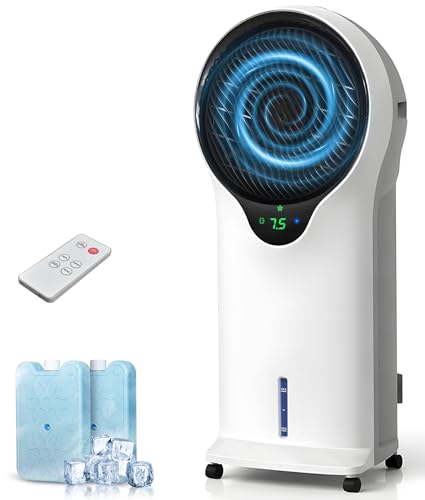
EXNOS 35" 3-in-1 Evaporative Air Cooler, Portable Swamp Cooler Air Conditioner with 3 Speeds & 3 Modes, 7.5H Timer, Remote Control, 2 Ice Packs, Cooling Fans that Blow Cold Air for Home & Office
Check price on Amazon
Uthfy 41" Swamp Cooler, 4800 CFM Evaporative Air Cooler with 10.6 Gallon Water Tank, Portable Outdoor Air Conditioner with 3 Ice Pack, 110° Oscillation, 3 Speed for Garage, Yard, Midnight Blue
Check price on Amazon