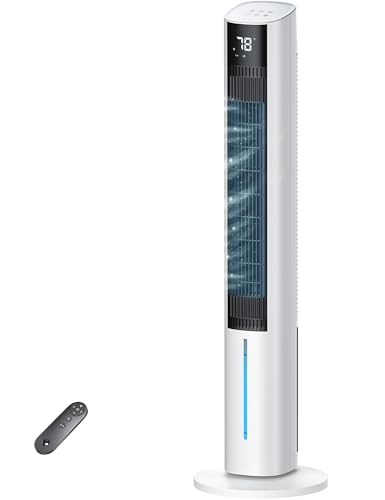
Portable Air Conditioner vs Evaporative Air Cooler: Complete Guide
Understand how each cooling method works, where it performs best, and how to choose the right unit for your room, climate, and daily routine.
Portable Air Conditioner vs Evaporative Air Cooler: How They Work
Both devices are portable cooling solutions, but they use fundamentally different methods to produce cool air. Understanding the underlying mechanism is the fastest way to avoid buying the wrong type for your space.
Portable Air Conditioner
A portable air conditioner works like a compact version of a traditional air conditioner. It contains a compressor, refrigerant, evaporator coil, and condenser coil. The unit absorbs heat and moisture from the indoor air, cools the air, and then releases the collected heat through an exhaust hose that must be routed outdoors. Because it removes both heat and humidity, a portable AC is effective in humid and dry climates alike. Most models require a window kit for the exhaust hose. If you want to understand the venting requirement in more depth, see portable AC units without venting and portable AC units that do not require venting.
Evaporative Air Cooler
An evaporative air cooler, sometimes called a swamp cooler, uses a fan to pull warm, dry air through a water-saturated cooling pad. As water evaporates, it absorbs heat from the air, lowering the air temperature. The output is cooler and more humid than the incoming air. Evaporative coolers do not use refrigerant or a compressor, and they do not need an exhaust hose. However, they perform best in dry climates with low relative humidity, and they need a source of dry outdoor air to keep working efficiently. For outdoor use, see outdoor evaporative air cooler guidance.
Climate and Humidity Suitability
Climate is the most important factor when choosing between these two cooling methods. A unit that performs well in one region can be disappointing in another.
Where Portable Air Conditioners Excel
- Humid climates: the unit dehumidifies as it cools, improving indoor comfort rather than adding moisture.
- Rooms without cross-ventilation: because the unit cools the air directly and exhausts heat outdoors, it does not depend on a constant flow of outside air.
- Bedrooms and home offices: a closed room with a window for the exhaust hose is an ideal setup. See portable air conditioner for bedroom and office desk AC.
- Year-round use: many portable ACs include a dehumidify mode and some include a heat pump function. Learn about portable air conditioner dehumidifier configurations and portable air conditioner and heater combo options.
Where Evaporative Air Coolers Excel
- Dry climates: low humidity allows rapid evaporation, which produces a noticeable temperature drop.
- Well-ventilated spaces: an open window or door lets humid air escape and dry air enter.
- Garages, workshops, and patios: spaces where slight humidity increase is not a concern and where airflow is abundant.
- Outdoor gatherings: outdoor-rated evaporative coolers can take the edge off heat in shaded, dry outdoor areas.
If your indoor humidity is already high, an evaporative cooler can make the room feel clammy. Understanding normal humidity inside the house helps you judge whether evaporative cooling is appropriate. For humid outdoor conditions, compare outdoor cooling systems for humid climates and outdoor air conditioners for humid climates.
Room Sizing and Placement
Correct sizing prevents short cycling, weak cooling, and unnecessary energy use. Portable air conditioners are rated in BTU, while evaporative coolers are often rated by airflow in cubic feet per minute and by the volume of water they hold.
Sizing a Portable Air Conditioner
As a starting point, match BTU to room area, then adjust upward for sun exposure, kitchen heat, occupant load, and poor insulation. Common reference points include portable AC for a 100 sq ft room, portable air conditioner for 200 square feet, portable air conditioner for 300 square feet, and portable air conditioner for 400 square feet. Larger spaces may need higher-capacity units such as portable air conditioner 16000 BTU.
Sizing an Evaporative Air Cooler
Evaporative cooler performance depends on airflow and air exchange. A unit that is too small for the room will feel like a fan with a slight chill. For a compact space, a personal evaporative cooler may be enough. For a larger open area, choose a unit with higher airflow and a larger water tank so it can run longer between refills.
Placement Tips
- Place a portable AC near the window used for the exhaust hose, and keep the hose as short and straight as possible.
- Keep the evaporative cooler near an open window or door so humid air can escape and dry air can enter.
- Avoid blocking the intake and outlet grilles on either type of unit.
- For rooms without windows, review portable AC for a room without windows and portable air conditioner for a room without windows.
- For awkward window shapes, see portable air conditioner for a casement window and portable AC window kit for casement windows.
Ventilation and Drainage Needs
Ventilation and drainage are the practical details that determine how much effort a unit requires day to day.
Portable AC Ventilation
Most portable air conditioners ship with a window kit and exhaust hose. The hose carries warm air and moisture out of the room. Without proper venting, the unit will struggle to cool and may add heat back into the room. Some models are designed to operate without a hose, but their cooling capacity is generally limited. Explore portable AC unit that does not need a window and portable AC unit that does not need venting if a window is unavailable.
Portable AC Drainage
Portable ACs collect condensate in a tank or drain pan. Some units evaporate most of the moisture automatically and require infrequent draining, while others need more regular emptying. Models marketed as self-evaporating reduce the frequency of manual draining. See portable AC that does not need to be drained and portable AC you do not have to drain for options that minimize this task.
Evaporative Cooler Ventilation
Evaporative coolers need fresh, dry air to keep cooling effectively. In a closed room, humidity rises quickly and the cooling effect drops. Open a window or door slightly to create cross-ventilation. Drainage is simple: most units have a water tank that you refill, and some include a drain plug for cleaning.
Market Tiers and Feature Expectations
Portable cooling products span several market tiers. The tier reflects build quality, feature set, and expected service life rather than a specific figure. Use these tiers to calibrate expectations.
Essential Tier
Basic controls, single fan speed or a small number of speeds, smaller water tanks or condensate tanks, and simpler exhaust kits. Suitable for occasional use in small rooms or for short cooling periods.
Balanced Tier
Multiple fan speeds, timers, remote control, improved airflow paths, larger tanks, and better window kits. A solid choice for daily use in bedrooms, home offices, and living areas.
High-End Tier
Quieter operation, smart controls, humidity management, self-evaporating condensate handling, better insulation, and durable construction. Well-suited to long daily runtime and rooms where noise matters.
Within the portable AC category, entry-level units typically need more frequent draining and offer simpler exhaust kits, while mid-range and high-end models often include better condensate management and quieter fans. In the evaporative cooler category, entry-level units tend to have smaller tanks and fewer speed settings, while higher tiers add larger tanks, oscillating louvers, and improved cooling pad design.
Maintenance and Longevity
Both cooling types benefit from routine care. The maintenance tasks differ because the underlying mechanisms differ.
Portable Air Conditioner Maintenance
- Clean or replace the air filter every two to four weeks during heavy use.
- Empty the condensate tank regularly, or set up continuous drainage if the model supports it.
- Inspect the exhaust hose for kinks, cracks, or loose connections.
- Clean the condenser and evaporator coils according to the manufacturer schedule.
- If the unit stops cooling, see portable AC unit repair and air conditioner not blowing cold air.
Evaporative Air Cooler Maintenance
- Drain and refill the water tank frequently to prevent stagnation and odor.
- Clean or replace the cooling pad when it becomes crusty or clogged with mineral deposits.
- Wipe the tank and water distribution components to reduce scale and mold growth.
- Store the unit dry when it is not in use for an extended period.
Both types last longer when stored indoors during the off-season and when filters and pads are kept clean.
Buying Checklist
Use this checklist to narrow your options before comparing specific models.
| Consideration | Portable Air Conditioner | Evaporative Air Cooler |
|---|---|---|
| Best climate | Humid or mixed climates | Dry, low-humidity climates |
| Room ventilation | Requires a window kit or exhaust route for most models | Requires an open window or door for air exchange |
| Humidity effect | Reduces indoor humidity | Increases indoor humidity |
| Cooling power | Rated in BTU; can cool a defined room area | Rated by airflow; best for spot cooling and ventilated spaces |
| Drainage | Condensate tank or continuous drain | Water tank refill and periodic draining |
| Noise profile | Compressor and fan noise | Fan and pump noise |
| Best for | Bedrooms, home offices, apartments | Garages, workshops, patios, dry-climate living areas |
Feature Priorities
- Cooling capacity: match BTU or airflow to the room, and add margin for sun exposure and heat-producing appliances.
- Noise level: check the decibel rating at the fan speed you expect to use most often, especially for bedrooms.
- Controls: timers, remote control, and programmable settings help reduce runtime waste.
- Smart features: Wi-Fi and app control are convenient if you want scheduling and remote adjustment.
- Air quality: some portable ACs include a purifier stage. See portable air conditioner and air purifier combo.
- Multi-function: a unit that cools, dehumidifies, and heats can replace several devices. See portable air conditioner dehumidifier heater and portable air conditioner and heater.
Frequently Asked Questions
What is the difference between a portable air conditioner and an evaporative air cooler?
A portable air conditioner uses refrigerant and a compressor to remove heat and humidity from the room, exhausting warm air through a hose. An evaporative air cooler uses water evaporation to cool the air and adds humidity instead of removing it.
Which is better for a humid climate?
In humid climates, a portable air conditioner is generally the better choice because it dehumidifies while cooling. Evaporative coolers work best in dry, low-humidity climates.
Do evaporative air coolers need ventilation?
Yes. Evaporative coolers add moisture to the air, so they perform best with an open window or door to allow humid air to escape and fresh dry air to enter.
Do portable air conditioners need to be vented?
Most portable air conditioners require a window kit and exhaust hose to vent warm air outside. Some models are designed without venting, but they are generally less effective at cooling a room.
How do I size a portable cooling unit for a room?
Sizing depends on room area, ceiling height, sun exposure, and occupant load. Portable AC capacity is measured in BTU, while evaporative coolers are often rated by airflow in cubic feet per minute. Use the room size as a starting point and adjust for heat gain.
Which type is quieter?
Evaporative air coolers typically produce fan and pump noise, while portable air conditioners produce compressor and fan noise. The quietest option depends on the specific model and fan speed setting.