
Portable Air Conditioner for Windows That Open Out
A complete guide to venting a portable AC through casement, awning, and push-out windows — including window kit options, installation steps, and practical tips for a sealed, efficient setup.
Explore Window Kit OptionsUnderstanding Windows That Open Out
Windows that open outward — commonly called casement, awning, or push-out windows — swing away from the room rather than sliding up, down, or sideways. This design is popular in modern homes because it offers excellent ventilation, a tight seal when closed, and a clean appearance. However, it creates a unique challenge for portable air conditioner owners: the window opening is not a flat, stable surface where a standard window kit can rest.
Casement vs. Awning vs. Push-Out
- Casement windows are hinged on one side and swing outward like a door. The opening is vertical and tall.
- Awning windows are hinged at the top and push out from the bottom. The opening is horizontal and wide.
- Push-out windows are a broader category that includes any window where the sash moves outward rather than sliding within a frame.
Each of these styles shares the same venting challenge: the moving sash leaves a gap when open, and the exhaust hose of a portable AC needs to pass through that gap without letting outdoor air, insects, or rain back into the room.
Why These Windows Are Common in Modern Homes
Outswing windows are standard in many newer construction and renovation projects because they provide a superior weather seal when closed. They also do not take up interior wall space, which makes them ideal for small rooms and apartments. If you live in a home with this window style, you already know that traditional slider kits are not an option — but a portable AC is still very much achievable.
Why Standard Portable AC Window Kits Do Not Fit
Most portable air conditioners ship with a rigid window kit designed for double-hung or horizontal sliding windows. These kits consist of adjustable panels that press against the window frame and the sash to create a sealed opening for the exhaust hose. They rely on a flat, parallel track where the window slides.
Outswing windows do not have that track. When a casement or awning window opens, the sash moves away from the frame at an angle. There is no fixed surface to clamp a rigid panel against. Forcing a slider kit into a casement opening usually results in a loose fit, gaps around the hose, and poor cooling performance.
If you are working with a side-hinged window, our guide to portable AC for casement windows covers the specific seal options in more detail. For crank-operated styles, see portable AC for crank out windows.
Key point: You do not need a different air conditioner — you need a different window seal. The portable AC itself works the same way regardless of window style.
Window Kit Options for Outswing Windows
There are three practical approaches to venting a portable AC through a window that opens out. Each has trade-offs in terms of installation effort, sealing quality, and how much the window can remain open.
1. Fabric Window Seal with Zippered Hose Opening
This is the most popular and versatile solution. A fabric seal attaches to the window frame and the moving sash using adhesive strips or hook-and-loop tape. A zippered opening in the center allows the exhaust hose to pass through. When the window closes against the seal, the gap is covered and the hose is held in place.
- Best for: Casement, awning, and push-out windows of most sizes.
- Advantages: Universal fit, easy to install and remove, works with irregular openings.
- Limitations: The window must remain slightly open, which can reduce security. Fabric seals need to be checked for wear over time.
For a detailed breakdown of this style, see the guide to portable AC for push out windows.
2. Custom Rigid Panel or Acrylic Insert
A rigid panel cut to the size of the window opening can replace the screen or sit inside the frame. The panel includes a circular opening for the exhaust hose. This approach provides a more stable and permanent seal than fabric, but it requires measuring and cutting, and the window cannot be closed while the panel is installed.
- Best for: Awning windows and fixed-frame openings where a solid insert is practical.
- Advantages: Durable, excellent seal, holds the hose securely.
- Limitations: Requires custom work, blocks the window entirely while in use.
3. Sliding Window Kit (Limited Use)
Some outswing windows have a small sliding section or a screen track that can accept a narrow slider kit. This is uncommon and should only be attempted if the frame genuinely has a parallel track. Do not force a slider kit into a casement opening. If you are unsure, check our guide to portable AC for vertical windows for related frame styles.
Comparison at a Glance
| Kit Type | Best For | Seal Quality | Window Stays Closed? |
|---|---|---|---|
| Fabric seal with zipper | Casement, awning, push-out | Good when installed tightly | No, partially open |
| Custom rigid panel | Awning, fixed openings | Excellent | No, panel replaces window |
| Sliding kit | Rare track-equipped frames | Good if fitted correctly | Partially open |
How to Install a Portable AC on an Outswing Window
The installation process depends on the kit you choose, but the general sequence is the same. Follow these steps for a stable, sealed setup.
Step 1: Measure the Opening
Measure the width and height of the window opening when the sash is partially open — typically 5 to 8 inches is enough for the exhaust hose. Note the depth of the frame and the position of the sash hinge. These measurements determine whether a fabric seal or a custom panel is the better fit.
Step 2: Choose and Prepare the Kit
For a fabric seal, clean the frame and sash surfaces so the adhesive strips bond properly. For a rigid panel, cut the material to size and sand the edges. Test-fit the kit before attaching anything permanently.
Step 3: Attach the Seal
Attach the fabric seal to the frame first, then to the moving sash, leaving enough slack for the window to close against it. If using a rigid panel, position it in the frame and secure it with weatherstripping or clips.
Step 4: Route the Exhaust Hose
Connect the exhaust hose to the portable AC and route it through the zippered opening or the panel hole. Keep the hose as short and straight as possible. Avoid sharp bends, which restrict airflow and reduce cooling performance.
Step 5: Close the Window Against the Seal
Close the window until it presses gently against the seal. The goal is a snug fit without crushing the fabric or cracking the panel. Check for gaps around the edges and fill any you find with weatherstripping.
Step 6: Test the Setup
Turn on the AC and check that the exhaust air is flowing outside and that no outdoor air is entering around the seal. If you feel a draft, adjust the seal or add weatherstripping. Our guide to portable AC not vented to outside covers common mistakes if the setup is not performing as expected.
Choosing the Right Portable AC Capacity
The window style does not change how much cooling capacity you need — that depends on the size of the room, ceiling height, sun exposure, and how well the space is insulated. Use the following as a general starting point, then adjust upward for sunny rooms or rooms with large windows.
| Room Size | Suggested Capacity | Typical Use |
|---|---|---|
| Up to 150 sq ft | 5,000 – 6,000 BTU | Small bedroom, home office |
| 150 – 250 sq ft | 8,000 – 10,000 BTU | Medium bedroom, studio |
| 250 – 400 sq ft | 12,000 – 14,000 BTU | Living room, open-plan space |
| 400 – 600 sq ft | 14,000 – 18,000 BTU | Large living area, basement |
If you are cooling a small bedroom, the guide to portable AC for small bedroom explains how to match capacity to room layout. For studio layouts, see portable AC for studio apartment.
Single-Hose vs. Dual-Hose Models
Single-hose portable ACs pull air from the room and exhaust it outside, which creates negative pressure and can draw warm air in through gaps. Dual-hose models separate intake and exhaust, which generally improves efficiency in sealed rooms. If your outswing window seal is not perfect, a dual-hose model can help compensate. Our comparison of single-hose portable AC explains the trade-offs in more detail.
Sealing and Efficiency Tips for Outswing Windows
A portable AC is only as effective as the seal around its exhaust path. Outswing windows are more challenging to seal than sliders, so pay attention to these details.
Use Weatherstripping Around the Frame
Apply foam or rubber weatherstripping to the window frame where the seal meets the sash. This closes small gaps that fabric alone may leave and reduces vibration noise.
Insulate the Exhaust Hose
The exhaust hose radiates heat back into the room. An insulated hose cover — or a wrap made from reflective material — reduces this heat gain and improves cooling. Our guide to insulated exhaust hose for portable AC covers options and installation.
Keep the Hose Short and Straight
Long, coiled hoses restrict airflow and reduce cooling capacity. Position the AC close to the window and route the hose with as few bends as possible. If the hose must curve, use a gentle arc rather than a sharp kink.
Block Direct Sunlight
Outswing windows often face direct sun. Close blinds or curtains during the hottest part of the day to reduce the cooling load on the unit. This is especially important in rooms with large casement windows.
Check for Air Leaks
After installation, run your hand around the seal and the window frame. If you feel warm air entering, add weatherstripping or adjust the seal. Small leaks add up quickly and can make a well-sized AC feel underpowered.
Efficiency note: If the room feels humid or the AC runs constantly, the seal may be the culprit. A tight fabric seal with weatherstripping usually resolves the issue without changing equipment.
Troubleshooting Common Issues
Even with a good seal, portable ACs in outswing window setups can run into a few recurring problems. Here is how to diagnose them.
The AC Runs But the Room Does Not Get Cold
This usually points to a venting or seal problem. Check that the exhaust hose is connected securely, that the window seal has no gaps, and that the hose is not kinked. If the unit is running but not cooling, our guide to portable AC not blowing cold air but running walks through the possible causes.
The Room Feels Humid
Humidity can rise if the AC is oversized, if the seal is leaking, or if the unit is not draining properly. In humid climates, a model with a dehumidifier mode or a condensate pump can help. See portable AC with dehumidifier for options and portable AC for humid climates for broader guidance.
Water Is Collecting Inside the Unit
Some portable ACs evaporate condensate automatically, while others require manual draining. If your unit has a drain outlet, check it regularly. Models with a condensate pump can drain continuously, which is useful in rooms where the AC runs for long periods.
The Window Seal Keeps Coming Loose
Adhesive strips can lose grip over time, especially on surfaces that expand and contract with temperature. Clean the frame thoroughly before applying, and consider hook-and-loop fasteners for a more removable, reusable seal. If the sash is warped or the frame is uneven, a fabric seal with elastic edges may hold better than a rigid panel.
The AC Is Not Cooling Enough for the Room
If the unit is correctly sized and sealed but still struggles, check the room’s heat load. Large windows, poor insulation, and open doorways all increase demand. For a room that is difficult to cool, see portable AC not cooling enough for a step-by-step diagnostic.
What to Look For in a Portable AC for Outswing Windows
When shopping for a portable air conditioner to use with a casement or awning window, focus on features that make venting easier and performance more consistent.
- Included window kit compatibility: Check whether the manufacturer offers a fabric seal or casement kit. Many brands sell universal seals separately. Our guide to what to look for in a portable AC covers the full checklist.
- Hose length and diameter: A shorter hose is easier to route through a narrow outswing opening. Confirm the hose diameter matches any seal kit you plan to use.
- Dual-hose design: Better for rooms where the seal is not perfect, because it reduces negative pressure and outdoor air infiltration.
- Dehumidification mode: Useful in humid climates and in rooms where the AC runs for long hours.
- Condensate management: Self-evaporating systems or a built-in pump reduce manual draining. See portable AC with self-evaporating system.
- Noise level: Outswing windows often sit in bedrooms or living areas. A quieter unit is easier to live with. Our guide to quiet air conditioner covers decibel ratings.
- Smart controls: Wi-Fi and remote control are convenient if the unit is placed near a window that is awkward to reach. See portable AC with heat and remote control.
Tier Guidance
Portable ACs are generally available across three broad tiers. Entry-level models cover basic cooling for small rooms and typically include a standard slider kit, so you will need to add a fabric seal separately. Mid-range models often include a more versatile window kit, quieter operation, and a dehumidifier mode. Premium and top-tier models add dual-hose designs, inverter compressors, smart controls, and more robust condensate management. For outswing windows, the mid-range tier is usually the sweet spot because it balances kit flexibility with reliable cooling performance.
Best Portable AC Units for Windows That Open Out
⚠️ AFFILIATE DISCLOSURE: This website contains affiliate links. As an Amazon Associate, we earn from qualifying purchases. If you make a purchase through these links, we may receive a small commission at no additional cost to you. Read our full affiliate policy.
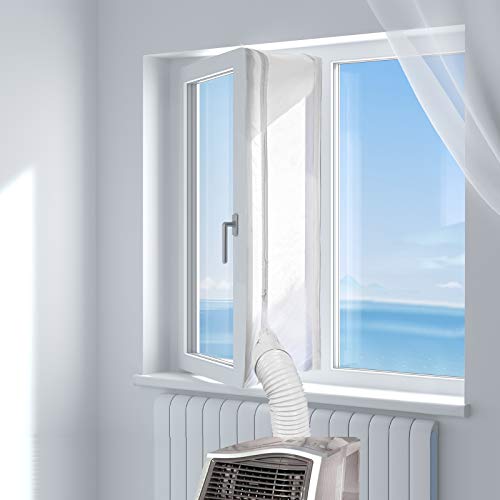
HOOMEE 157”(400CM) Universal Window Seal for Mobile Air Conditioner and Tumble Dryer – Window Kit Works with Portable AC, Easy to Install - Air Exchange Guards with Zip and Adhesive Fastener
Check price on Amazon
BLACK+DECKER Portable Air Conditioner, 9,000 BTU, BPACT08WT, White | 5,300 BTU SACC for Rooms up to 400 Sq. Ft., 3-in-1 Portable AC, Fan and Dehum with Follow Me Remote Control
Check price on Amazon
BLACK+DECKER Portable Air Conditioner, 10,000 BTU, BPACT10WT, White | 5,500 BTU SACC for Rooms up to 450 Sq. Ft., 3-in-1 Portable AC, Fan and Dehum with Follow Me Remote Control
Check price on Amazon
HYUIO Portable Air Conditioner No Window Needed, Wireless Remote Control, 3 Speed Settings, Long Air Outlet for Cooling Room, Bedroom, Office
Check price on Amazon
LOVIGA Portable AC Window Vent Kit, 100% Sealing, Adjustable 10x40~60 Inch | For Sliding & Hung Windows, Keep Hot Air/Rian/Bugs Out, No Sealing Strips Needed, Easy Install, Reusable, Renter-Friendly
Check price on Amazon
IKSTAR Portable AC Window Seal Kit 400CM/157 for Casement, Crank-Out & Skylight Windows, No-Drill Window Vent Kit with Adjustable Zipper, Fits Single & Dual Hose Portable Air Conditioners
Check price on Amazon
14,000 BTU Portable Air Conditioner Cools Up to 700 Sq.Ft, 3-IN-1 Energy Efficient Portable AC Unit with Remote Control & Installation Kits for Large Room, Office, Temporary Space
Check price on Amazon
HOOMEE 118”(300CM) Universal Window Seal for Mobile Air Conditioner and Tumble Dryer – Window Kit Works with Portable AC, Easy to Install - Air Exchange Guards with Zip and Adhesive Fastener
Check price on AmazonFrequently Asked Questions
Can a portable air conditioner be used with a window that opens out?
Yes. Outswing windows such as casement and awning styles can accommodate a portable AC using a fabric window seal or a custom rigid panel. The exhaust hose passes through a zippered opening or a cut hole, and the window closes against the seal to keep outdoor air out.
What type of window kit works for an outswing casement window?
A fabric seal with a zippered hose opening is the most reliable option. It attaches to both the frame and the moving sash, so it accommodates the angled opening of a casement window. Rigid slider kits do not fit because casement windows do not have a horizontal track.
Does a portable AC work with an awning window?
Yes. Awning windows push out from the bottom, leaving a horizontal gap at the top of the opening. A fabric seal attached to the frame and the sash, with the hose exiting through a zipper, seals that gap effectively. A custom rigid panel is also an option if you prefer a more permanent setup.
How do I seal the gap around the exhaust hose on an outswing window?
Attach a fabric window seal to the frame and the moving sash, then zip the exhaust hose through the opening. Close the window until it presses against the seal. Add weatherstripping around the frame edges for a tighter fit, and check for drafts after installation.
Can I use a sliding window kit on a casement window?
No. Sliding kits rely on a parallel track and a fixed panel section. Casement and awning windows swing outward and do not have that track. Forcing a slider kit into the opening usually leaves gaps and results in poor cooling. Use a fabric seal or a custom panel instead.
Will a portable AC with a single hose work on an outswing window?
Yes, but single-hose units create negative pressure and can pull warm outdoor air through any gaps in the seal. If your outswing window seal is not perfect, a dual-hose model is generally more forgiving. The window style itself does not prevent single-hose use — the seal quality is the deciding factor.
Do I need a special portable AC for a push-out window, or just a different kit?
You need a different kit, not a different AC. The portable air conditioner itself works the same way regardless of window style. The key is choosing a fabric seal or custom panel that matches the geometry of a push-out window. For more detail, see the guide to portable AC for push out windows.
Ready to Choose a Portable AC for Your Outswing Window?
Start with the room size and the window opening, then choose a kit that seals tightly and a unit that matches the cooling load. If you are still deciding between styles, the portable AC for windows that open out overview is a good reference point. For homes with multiple window styles, our guide to portable AC for multiple rooms explains how to plan cooling across spaces.
When you are ready to compare models, the recommendations above are selected for their venting flexibility and performance in rooms with casement and awning windows.