Portable Air Conditioner with Sliding Window: The Complete Buyer's Guide
Sliding windows are one of the most common window styles in modern homes, yet they present a unique challenge for portable AC venting. This guide explains exactly how to pair a portable air conditioner with a sliding window, which window kits work best, how to seal the gap properly, and how to size a unit for efficient, reliable cooling.
Jump to Buying GuideWhy a Sliding Window Needs Special Attention
A portable air conditioner removes heat from your room and expels it through an exhaust hose. That hose must reach outside, and the opening it passes through must be sealed so hot outdoor air does not flow back in. A sliding window opens horizontally rather than vertically, which means a standard vertical window kit often does not fit correctly.
The good news is that manufacturers now offer dedicated sliding window kits with adjustable panels that bridge the horizontal opening. When installed correctly, a portable AC with a sliding window can cool a room just as effectively as one vented through a double-hung window. The key is choosing the right kit, sealing the gap, and matching the unit's capacity to your room.
How Portable AC Venting Through a Sliding Window Works
A single-hose portable air conditioner draws indoor air, cools it, and exhausts hot air through the hose. Because it pulls air from the room, it creates slight negative pressure, which can draw warm outdoor air through gaps. A dual-hose model avoids this by drawing outdoor air for cooling the condenser separately. Either way, the venting pathway through the sliding window must be sealed.
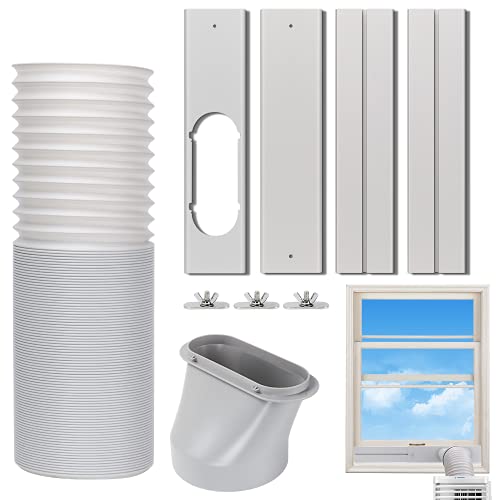
The typical sliding window kit includes:
- Adjustable panels that extend to fill the horizontal opening of the window.
- A hose connector plate with a circular opening sized to the exhaust hose diameter.
- Foam or weather-stripping seals to close the remaining gaps.
- Locking pins or screws to keep the window from sliding open further.
For a more detailed walkthrough of the hardware itself, see our guide to the portable air conditioner window kit for sliding window. If your window is glass and slides horizontally on a lower track, the installation approach is nearly identical to a portable air conditioner for sliding glass window setup.
Buying Guide: What to Look For
1. Match Capacity to Room Size
Portable AC capacity is measured in BTU. Undersizing leaves the room warm; oversizing causes short cycling and poor dehumidification. As a general rule, aim for roughly 20 BTU per square foot, then adjust upward for sun exposure, ceiling height, and occupancy.
- Up to 150 sq ft: around 5,000–6,000 BTU
- 150–250 sq ft: around 8,000–10,000 BTU
- 250–400 sq ft: around 12,000–14,000 BTU
- 400–550 sq ft: around 14,000–18,000 BTU
For a bedroom-sized space, see our recommendations for a portable air conditioner for small bedroom. For studio layouts, the guidance in our portable air conditioner for studio apartment article is useful because open floor plans distribute cool air differently.
2. Confirm the Window Kit Is Sliding-Compatible
Not every portable AC ships with a kit that fits a horizontal slider. Check the product specifications for the maximum window width the kit supports. If the included kit is designed for vertical windows, you may need to purchase a separate sliding window kit. Our overview of the portable air conditioner sliding window kit explains the panel dimensions and track types to measure before ordering.
3. Decide Between Single-Hose and Dual-Hose
Single-hose units are simpler to install and generally lighter. Dual-hose units are more efficient because they do not depressurize the room as much. If your climate is hot and humid, dual-hose is usually the better long-term investment. For humid regions, also review our notes on a portable air conditioner for humid climates.
4. Consider Drainage and Humidity Control
Portable ACs produce condensate. Many units use self-evaporating technology to expel most moisture through the exhaust, but in very humid conditions you may still need to drain the tank. If you prefer to avoid manual draining, look for a portable air conditioner with self evaporating system or one with a built-in condensate pump.
5. Noise, Wheels, and Placement
Portable units are noisier than window or mini-split systems because the compressor sits inside the room. Look for models with a low-noise mode if the unit will run at night. Casters make repositioning easier; our article on the portable air conditioner on wheels covers mobility features worth checking. Remember that the hose length limits where the unit can sit relative to the window.
Comparing Portable AC Tiers for Sliding Window Use
The table below groups portable ACs by market tier rather than by any specific figure. Use it to understand what each tier typically delivers for a sliding window setup.
| Tier | Typical Features | Best For | Sliding Window Notes |
|---|---|---|---|
| Entry-level | Single hose, basic mechanical controls, manual drain | Occasional cooling in small rooms | Often ships with a basic vertical kit; verify sliding compatibility or add a kit |
| Mid-range | Single or dual hose, digital controls, remote, sleep mode | Daily use in bedrooms and living rooms | Usually includes an adjustable kit with multiple panel sizes |
| High-end tier | Dual hose, inverter compressor, self-evaporation, Wi-Fi | Large rooms, humid climates, quiet operation | Premium kits fit wider openings and seal more tightly |
| Professional-grade | Heavy-duty components, high airflow, condensate pump, rugged housing | Commercial or continuous operation | Check for commercial window kit options and longer hose runs |
Across all tiers, the quality of the window seal matters as much as the unit itself. A well-sealed entry-level setup can outperform a poorly sealed premium unit in a hot climate.
Step-by-Step Installation for a Sliding Window
- Measure the window opening. Record the height of the track and the maximum width the window can open. Compare these to the kit's stated range.
- Assemble the adjustable panels. Extend the panels to fill the opening and lock them in place according to the manual.
- Insert the hose connector plate. Fit the exhaust hose onto the connector and slide the plate into the panel opening.
- Seal the perimeter. Use the included foam strips or weather-stripping to close gaps at the top, bottom, and sides. Pay special attention to the corner where the two panels meet.
- Lock the window. Use the kit's locking pins or a window lock to prevent the slider from opening further.
- Position the unit. Place the portable AC on a level surface within hose reach, keeping at least 12–18 inches of clearance around the intake and exhaust.
- Test airflow. Run the unit and check that hot air exits outside and no warm air leaks back through the seal.
- Window track measured and kit range confirmed
- Panels locked and connector plate seated
- Foam seals applied on all four sides
- Window locked to prevent accidental opening
- Hose routed without sharp bends or kinks
- Unit on a level surface with clearance
If your window has a crank mechanism instead of a slider, the process differs; see our guide to a portable air conditioner for crank out window for the alternative approach.
Sealing Tips for Maximum Efficiency
The single biggest performance issue with sliding window installations is air leakage. Even a small gap lets hot, humid outdoor air enter and forces the compressor to work harder. Follow these practices:
- Use closed-cell foam tape along the top and bottom tracks where the panels meet the frame.
- Apply weather-stripping to the vertical edge where the two adjustable panels overlap.
- Insulate the exhaust hose if it runs through a hot space, especially in attics or sunrooms.
- Keep the hose as short and straight as possible; excess length reduces airflow and cooling efficiency.
- Close curtains or blinds on sun-facing windows during peak afternoon hours to reduce the cooling load.
For units with a single hose, the negative pressure effect is more pronounced. If you notice warm air being pulled in through doors or vents, consider upgrading to a dual-hose model or adding a passive intake vent near the unit.
Common Problems and How to Solve Them
The Unit Runs but Does Not Cool Enough
Check the seal first, then the hose routing, then the filter. A clogged filter or a kinked hose can dramatically reduce cooling. Our troubleshooting article on a portable air conditioner not cooling enough walks through the diagnostic sequence.
Water Leaks or Overflow
In high humidity, condensate can exceed the self-evaporation capacity. Empty the tank more frequently or add a condensate pump. If the unit stops cooling while running, refer to our guide for a portable air conditioner not blowing cold air but running.
The Hose Keeps Falling Out of the Window
This usually means the connector plate is undersized for the opening or the panels are not locked. Verify the kit's maximum width and add foam shims if needed. A dedicated sliding window kit with a wider panel range solves most of these cases.
The Room Feels Humid Despite Cooling
Single-hose units can struggle in very humid conditions. Consider a model with a stronger dehumidification mode or a portable air conditioner with dehumidifier function. Our article on a portable air conditioner with humidity control explains the settings to look for.
Matching the Setup to Your Space
Sliding windows appear in apartments, condos, and many single-family homes. The right portable AC depends on the room and how you plan to use it:
- For a compact living space, see the portable air conditioner for small apartment guide.
- If the unit will cool a single room only, the portable air conditioner for single room article covers sizing and placement.
- To supplement an existing central system during heat waves, read about a portable air conditioner to supplement central air.
- For a home office or workspace, the portable air conditioner for office without windows guide offers alternatives if no slider is available.
- If your window is unusually narrow, check the portable air conditioner for small window recommendations before ordering a kit.
Renters often prefer portable ACs because they require no permanent modification. The portable air conditioner for renters temporary overview covers lease-friendly installation. If you also need heating in shoulder seasons, consider a portable air conditioner heater combination or a model with a portable air conditioner with heat pump.
Frequently Asked Questions
Can any portable air conditioner vent through a sliding window?
Almost any portable AC can vent through a sliding window, but the included kit may not fit. You may need a dedicated sliding window kit with adjustable horizontal panels. Check the maximum window width supported by the kit before purchasing.
Do I need to drain a portable AC used with a sliding window?
Many modern units use self-evaporation and require draining only in high humidity. If your unit lacks this feature, plan to empty the tank regularly or choose a model with a condensate pump.
How do I stop hot air from coming back through the window gap?
Seal all four sides of the kit with foam or weather-stripping, lock the window so it cannot open further, and keep the exhaust hose short and straight. A dual-hose unit further reduces backflow by avoiding negative pressure.
What size portable AC do I need for a room with a sliding window?
Use roughly 20 BTU per square foot as a starting point, then increase capacity for sun exposure, high ceilings, and multiple occupants. A 250-square-foot room typically needs around 8,000–10,000 BTU.
Can I use a portable AC with a sliding glass door?
Yes, but you will need a taller kit designed for door-height openings. Standard window kits usually do not reach. Look for kits rated for sliding doors or patio openings.
Is a single-hose or dual-hose unit better for sliding windows?
Dual-hose units are generally more efficient and maintain better pressure balance. Single-hose units are simpler and lighter. For hot climates and daily use, dual-hose is the stronger long-term choice.
Related Guides
- Portable Air Conditioner Sliding Window
- Window Kit for Sliding Window
- Portable AC for Sliding Glass Window
- Sliding Window Kit Overview
- Portable AC for Vertical Sliding Windows
- Portable AC for Long Windows
- Portable AC for Small Window
- Portable AC for Small Window Opening
- Portable AC for Crank Out Window
- Portable AC for Casement Windows
- Portable AC for Single Room
- Portable AC for Small Bedroom
- Portable AC for Studio Apartment
- Portable AC for Small Apartment
- Portable AC for Humid Climates
- Portable AC with Self Evaporating System
- Portable AC with Dehumidifier
- Portable AC with Humidity Control
- Portable AC Not Cooling Enough
- Portable AC Not Blowing Cold Air
- Portable AC on Wheels
- Portable AC to Supplement Central Air
- Portable AC Heater Combination
- Portable AC with Heat Pump
- Portable AC for Renters Temporary