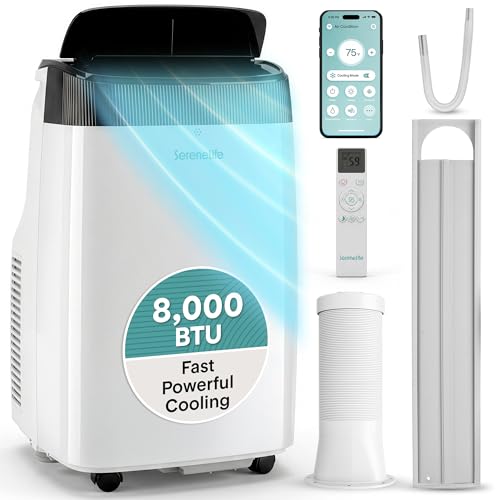
A small portable air conditioner for office use is a floor-standing unit that cools one room and discharges hot air through a hose. It is the most flexible cooling option for a workspace because it requires no window installation and no permanent modification. The trade-offs are noise, venting logistics, and the need to match capacity to the heat load of the room and its equipment. When those factors are handled correctly, a portable AC can keep a home office comfortable through the summer.
In This Guide
Sizing for an Office
Office sizing starts with square footage but must account for heat-generating equipment. A desktop computer and monitor add roughly the heat of one additional person, while a printer, server, or multiple monitors add more. The table below gives a starting range for typical home and small offices.
| Office Size | Recommended BTU | Typical Setup |
|---|---|---|
| Up to 150 sq ft | 5,000 – 6,000 BTU | Home office, single desk, one monitor |
| 150 – 250 sq ft | 8,000 – 10,000 BTU | Small studio office, dual monitors, occasional printer |
| 250 – 400 sq ft | 12,000 – 14,000 BTU | Shared workspace, server closet nearby, multiple desks |
For a room around 150 square feet, the guide on room size for a 5,000 BTU air conditioner explains the base formula in more detail. If your office is shared or has significant solar gain, the article on small air conditioners for small rooms compares typical configurations. For a very compact workspace, the small area air conditioner overview is a useful starting point.
Venting Options for Office Spaces
A portable AC must exhaust hot air somewhere. In an office, the venting path matters as much as the cooling capacity. The most common options are:
- Sliding door panel kit: A sealed panel inserts into a sliding glass door track. This is the cleanest solution for leased offices where drilling is not permitted.
- Wall vent kit: A small hole is cut through an exterior wall and fitted with a weather-sealed vent. This is a permanent modification, so it is best for owned spaces.
- Drop ceiling: In some commercial buildings, hot air can be vented into the plenum above a drop ceiling. This requires careful consideration of building codes and fire safety.
- Existing dryer vent: Occasionally an existing vent can be adapted, but this is not recommended for long-term use because of lint and moisture concerns.
For a detailed look at door-based venting, see the sliding glass door air conditioner kit guide. If your office has a sliding window, the sliding window portable air conditioner kit and sliding window kit for portable air conditioner articles explain the panel fit and sealing process.
Single-Hose vs Dual-Hose Units
Single-hose units exhaust room air and create a slight negative pressure, which pulls warm outside air in through gaps. Dual-hose units use one hose for intake and one for exhaust, which improves efficiency and reduces this effect. For a small office that is in use all day, a smallest dual hose portable air conditioner is often the better choice.
Offices Without a Usable Window
Many offices have windows that are sealed, blocked, or unsuitable for venting. The guide on a small AC unit that doesn't need a window covers alternative venting paths, and the small air conditioner that doesn't need a window article compares portable and mini-split options for this scenario.
Noise, Airflow, and Focus
Noise is the most common complaint about portable ACs in offices. Compressor noise, fan noise, and refrigerant gurgling all contribute. The practical approach is to choose a unit with a low-fan or sleep mode and to place it away from the desk and microphone. The small lightweight portable air conditioner guide covers compact models that are easier to position, and the small portable air conditioner for office category overview compares noise levels across tiers.
Airflow also matters for focus. A direct stream of cold air on the face and hands is uncomfortable for long work sessions. Aim the louvers upward or toward a wall so the cool air mixes before reaching the desk. A small floor fan can help distribute air without adding much noise.
Placement and Setup Tips
Placement has a large effect on comfort and efficiency in a small office. A few practical guidelines:
- Keep the vent hose short and straight: Long or kinked hoses reduce cooling performance noticeably.
- Do not block the intake or exhaust: Leave at least a foot of clearance around the unit.
- Seal the vent panel: Gaps around the hose or panel let warm air back in.
- Position away from direct sun: A unit sitting in a sunbeam works harder and cools less effectively.
- Close doors to adjacent rooms: Cooling an open floor plan with a single portable unit is inefficient.
If you also need heating in the same office, the small portable air conditioner with heater guide covers combination units. For a workspace that needs to stay cool without a hose at all, the small portable air conditioner without hose article explains evaporative and personal cooling alternatives.
Efficiency and Smart Controls
Efficiency in a small office is driven by capacity matching and scheduling. A correctly sized portable AC running on a schedule uses less energy than an oversized unit cycling on and off. For the rating system itself, see what is a SEER rating.
Adding a smart thermostat or a smart thermostat guide overview helps you understand how scheduling and remote control work for whole-office setups. If your office uses a mini-split instead of a portable unit, the smart thermostat for mini split and smart thermostat for split systems articles are relevant. For offices with window units, the small window air conditioner with remote control guide covers convenient control options.
Maintenance That Keeps the Office Cool
Clean the filter every two to four weeks during heavy use, empty the condensate tank regularly, and inspect the vent hose for kinks. A clogged filter reduces airflow quickly in a small room, and a full tank can shut the unit down mid-workday. The seasonal AC checklist and the AC not cooling troubleshooting guide cover the common failure points.
Comparison Table
The table below compares portable AC tiers for office use and notes the trade-offs at each level.
| Tier | Category | Best For |
|---|---|---|
| Essential tier | Entry-level | Small home offices with a simple vent path and low noise sensitivity |
| Balanced tier | Mid-range | Offices with frequent calls, dual monitors, and a need for quieter operation |
| High-end tier | Premium | Shared workspaces or client-facing offices where noise and comfort are priorities |
If your office is a converted bedroom, the small air conditioners for bedrooms article covers noise and placement considerations that translate well to office use. For a single-room setup, the small portable air conditioner for one room guide explains how to size for a single occupied space.
Compare Office Portable AC Options
Explore our recommended small portable air conditioners below and match your office size with the right capacity, venting, and noise level.
VIEW RECOMMENDATIONSFrequently Asked Questions
What size portable air conditioner do I need for a small office?
For an office up to 150 square feet, a 5,000 to 6,000 BTU portable air conditioner is typically sufficient. For offices between 150 and 250 square feet, an 8,000 to 10,000 BTU unit is a better fit. Server equipment, large windows, and occupant count can shift the requirement upward.
How do I vent a portable AC in an office without a window?
You can vent through a wall kit, a drop ceiling, a sliding door panel, or an existing dryer vent. In most offices, a wall vent kit is the cleanest permanent solution, while sliding door kits work for leased spaces where drilling is not permitted.
Are portable air conditioners too noisy for an office?
Portable AC noise levels vary significantly. Entry-level units can be quite loud, while mid-range and high-end tier models are designed with quieter compressors and fans. Look for models with a sleep mode or low-fan setting for calls and focused work.
Can a portable AC cool a home office with a computer?
Yes. A portable AC can cool a home office with a computer, and the heat from the equipment should be factored into the sizing calculation. A mid-range unit with a programmable thermostat or a smart control feature helps maintain stable temperatures around sensitive electronics.