
Window Unit Air Conditioner Guide: Sizing, Installation & Top Picks
Window units remain one of the most practical cooling solutions for single rooms, apartments, and homes without ductwork. This guide walks you through BTU sizing, window compatibility, installation safety, efficiency ratings, maintenance, and the features that separate a starter-tier unit from a top-tier performer — so you can choose with confidence.
Explore Top Window Unit Picks1. What Is a Window Unit and Who Is It For
A window unit is a self-contained air conditioner that sits in a window frame or a dedicated wall sleeve. Unlike central systems, all cooling components — compressor, condenser, evaporator, and controls — live inside a single chassis. The indoor side blows cold air into the room while the outdoor side rejects heat.
Best-fit scenarios
- Single rooms, bedrooms, home offices, and studio apartments.
- Homes without ductwork or where extending ducts is impractical.
- Renters who need a removable cooling solution (check lease terms first).
- Supplemental cooling for a hot room that a central system struggles to reach.
- Seasonal cabins, guest rooms, and converted garages with a suitable window.
Where a window unit is not ideal
- Whole-home cooling across multiple rooms — a whole-house air conditioning system is far more efficient at scale.
- Windows that cannot physically hold the unit or accept a support bracket.
- Historic or landlord-restricted facades where exterior protrusion is not allowed.
2. How to Size a Window Unit by Room and BTU
Sizing is the single most important decision. An undersized unit runs continuously and never dehumidifies properly; an oversized unit short-cycles, leaving the room clammy and wearing the compressor faster. BTU (British Thermal Unit) is the standard capacity measure.
| Room Size (sq ft) | Typical BTU Range | Common Use Case | Tier Guidance |
|---|---|---|---|
| Up to 150 | 5,000 – 6,000 BTU | Small bedroom, nursery, office nook | Entry-level to mid-range |
| 150 – 250 | 8,000 – 10,000 BTU | Standard bedroom, small living area | Mid-range sweet spot |
| 250 – 400 | 12,000 – 14,000 BTU | Large bedroom, open living room | Mid-tier to high-end tier |
| 400 – 550 | 15,000 – 18,000 BTU | Studio, open-plan space | High-end tier |
| 550 – 700 | 20,000 – 24,000 BTU | Large open area, double room | Premium tier |
Adjustment factors
- Sun exposure: A south- or west-facing room with large unshaded glass may need one size up.
- Ceiling height: Rooms above 8 feet need proportionally more capacity.
- Occupancy: Add roughly 600 BTU per additional regular occupant.
- Kitchen adjacency: Add 4,000 BTU if the unit cools an open kitchen area.
- Insulation quality: Poorly insulated or older homes benefit from a size up.
For a bedroom-specific breakdown, see window AC unit for bedroom. If you are cooling a larger footprint such as a 1,200 sq ft home with multiple units, the window AC unit for 1,200 sq ft house guide covers multi-unit strategy.
3. Window Types and Compatibility
Most window units are engineered for double-hung (vertical sliding) windows with a minimum opening width and height. If your window differs, you will need adapters, brackets, or a different mounting approach.
| Window Type | Standard Unit Fits? | Recommended Approach |
|---|---|---|
| Double-hung (vertical sliding) | Yes, most common | Standard install with side accordion panels |
| Sliding (horizontal) | With kit or filler panel | See window air conditioner for a sliding window |
| Casement / crank-out | No, not directly | See window AC in casement window |
| Side-opening | Needs special kit | See window air conditioner for side opening window |
| Narrow window | Depends on chassis width | See window unit for small window |
| No usable window | N/A | See window air conditioner no window |
Measuring before you buy
- Measure the window opening width at its narrowest point.
- Measure the window opening height from sill to lower sash.
- Check the unit's minimum and maximum window width specs.
- Confirm the unit's outdoor protrusion is acceptable for your building.
- Verify there is a sturdy sill or wall for bracket support.
For unusual openings, the window AC unit for windows that open sideways and window air conditioner for vertical windows guides walk through specific adapter options. If you need extra stability, see window AC bracket support and window air conditioner bracket no drilling.
4. Efficiency Ratings, Voltage, and Running Behavior
Window units are rated by CEER (Combined Energy Efficiency Ratio) or EER, which measures cooling output per unit of electricity. Higher ratings mean more cooling per watt, but efficiency also depends on installation quality and maintenance.
What to check on the label
- BTU capacity: Matched to your room size.
- CEER or EER: Higher is better within the same capacity class.
- Voltage: Most small units are 110V/115V; larger units often require 220V/230V.
- Amperage: Confirm your circuit can handle the draw.
- Refrigerant type: Modern units use R32 or R454B; older R410A stock is phasing out.
If your outlet is 220V, see window unit air conditioner 220V for circuit and plug considerations. For units equipped with inverter compressors, the window air conditioner with inverter technology guide explains how variable-speed operation changes power draw and comfort.
5. Features That Matter: Inverter, Heat, Smart Control
Modern window units range from essential-tier mechanical models to feature-rich smart units. Decide which features actually improve your daily use.
Inverter compressor
Inverter units vary compressor speed instead of cycling on and off. The result is steadier temperature, quieter operation, and often better long-run efficiency. If you plan to run the unit many hours per day, an inverter model is a worthwhile investment.
Heat pump and heater options
Some window units include a reverse-cycle heat pump or an electric heater element, extending usability into shoulder seasons. See window air conditioners with heat and window unit with heater for comparison.
Remote and thermostat control
A remote control improves usability when the unit is mounted high. A remote thermostat or programmable control helps maintain a stable setpoint. See window air conditioner with remote control and window air conditioner with thermostat.
Smart and Wi-Fi features
Wi-Fi-enabled units allow scheduling and app control. If you are building a connected setup, see Wi-Fi air con and Wi-Fi thermostat for air conditioner.
6. Installation, Support, and Safety
A window unit is heavy, and an improper install can damage the window, the wall, or cause injury. Follow the manufacturer's instructions and use appropriate support.
Installation checklist
- Confirm the window and sill can bear the unit's weight.
- Install a support bracket rated for the unit's weight, especially for larger models.
- Maintain a slight outward tilt (typically about 1/4 inch per foot) so condensate drains outside.
- Seal gaps with the provided accordion panels and foam insulation.
- Plug directly into a grounded outlet; avoid extension cords.
- Test cooling, fan speeds, and drainage before finalizing the install.
If your window sits above ground level, a bracket is not optional. See window air conditioner supports and window AC installation kit. For units that must sit on the floor or a low sill, see window air conditioner that sits on the floor.
7. Maintenance and Troubleshooting
Window units are simple machines, and most performance problems trace back to airflow, drainage, or dirt. A short seasonal routine keeps cooling strong and extends service life.
Routine maintenance
- Clean or rinse the filter every two to four weeks in peak season.
- Inspect and gently clean the condenser coils at the start of the season.
- Check that the outdoor drain path is clear and the unit tilts outward correctly.
- Tighten the mounting bracket and inspect seals before each cooling season.
- Vacuum dust from the front grille and control panel area.
Common symptoms and where to start
| Symptom | Likely Cause | Next Step |
|---|---|---|
| Fan runs but no cold air | Dirty filter, low refrigerant, or compressor issue | See window AC not cooling but fan is running |
| Water leaking inside | Improper tilt or blocked drain | See window air conditioner leaking water inside house |
| Not blowing cold air | Compressor, thermostat, or airflow issue | See window air conditioner not blowing cold air |
| Water dripping outside excessively | High humidity condensate (normal) or drainage fault | See window unit air conditioner leaking water |
| Unit needs repair | Mechanical or electrical fault | See window unit repair |
If you prefer a model that manages condensate differently, see window AC unit that doesn't drip water.
Recommended Window Units
⚠️ AFFILIATE DISCLOSURE: This website contains affiliate links. As an Amazon Associate, we earn from qualifying purchases. If you make a purchase through these links, we may receive a small commission at no additional cost to you. Read our full affiliate policy.

GE Window Air Conditioner 5,000 BTU AC Unit for Small Spaces up to 150 sq ft with Manual Controls & 2 Cooling Modes, Easy Install Kit, White
Check price on Amazon
Midea 6,000 BTU Window Air Conditioner, Electronic Control, 250 Sq Ft, New | 3-In-1 Cool/Fan/Dehumidifier Modes, Easy-To-Use Controls, Remote Control, And Cooling For Bedrooms, Studies and Home Offices
Check price on Amazon
Midea 8,000 BTU Smart Inverter Air Conditioner Window Unit with Heat and Dehumidifier – Cools up to 350 Sq. Ft., Energy Star Rated, Quiet Operation, Electronic Controls, Remote Control, White
Check price on Amazon
Frigidaire 5,000 BTU Window-Mounted Air Conditioner, Cools Up to 150 Sq. Ft., Quiet Operation, Effortless Temperature Control, 2 Fan Speeds, Auto Restart, White
Check price on Amazon
Midea 10,000 BTU U Shaped Window Air Conditioner, Cools up to 450 Sq Ft | Ultra Quiet U-Shaped Design, Inverter Control, Open Window Flexibility, Alexa/Google Assistant, 37% Energy Savings, 2026 New
Check price on Amazon
ROVSUN 8000 BTU Window Air Conditioner with Heat, AC Unit for Window, 115V | 4-in-1 Cool, Heat, Dehumidify & Fan, APP & Voice Control, Compatible with Alexa/Google, Timer & ECO Mode, 350 Sq Ft
Check price on Amazon
Midea 5,000 BTU EasyCool Small Window Air Conditioner - Cool up to 150 Sq. Ft. with Easy-to-Use Mechanical Controls and Reusable Filter, Perfect for Small Bedroom, Living Room, Home Office
Check price on Amazon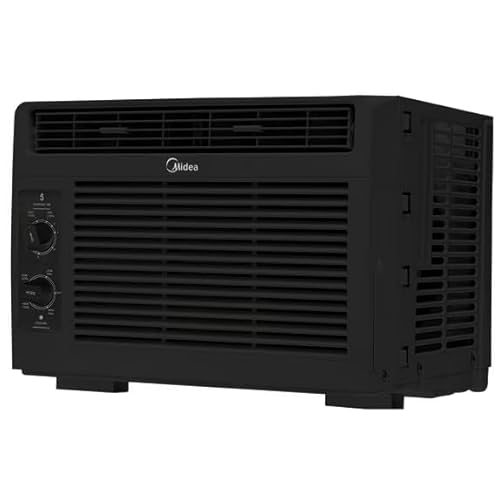
Midea 5,000 BTU 150 Sq ft Mechanical Window Air Conditioner, Black (Renewed)
Check price on AmazonFrequently Asked Questions
What size window unit do I need for a bedroom?
For a typical bedroom up to 250 square feet, an 8,000 to 10,000 BTU window unit is usually appropriate. Rooms up to 150 square feet generally work well with a 5,000 to 6,000 BTU model, while larger bedrooms between 250 and 400 square feet may need 12,000 to 14,000 BTU. See window air conditioner for small room for compact-space guidance.
Can a window unit be installed in a sliding window?
Yes, but standard window units are designed for double-hung windows. For sliding or side-opening windows, you will need a specialized installation kit, a support bracket, and sometimes a filler panel to secure the unit properly and prevent air leaks. See window air conditioner for sliding windows and window air conditioner sliding window kit.
How many watts does a window unit use?
Small 5,000 BTU units typically draw around 450 to 550 watts, mid-range 8,000 to 10,000 BTU models generally use 700 to 1,000 watts, and larger 12,000 to 14,000 BTU units may draw 1,100 to 1,500 watts. Inverter models often modulate power draw for better efficiency.
How often should I clean a window unit filter?
Clean the filter every two to four weeks during peak cooling season, or more often in dusty environments. A clogged filter reduces airflow, strains the compressor, and lowers cooling performance.
Does a window unit need a dedicated circuit?
Most 110V window units can share a standard 15-amp circuit, but larger 220V models and high-BTU units should be on a dedicated circuit. Always check the nameplate amperage and consult a licensed electrician if you are unsure.
Where can I find a window unit nearby or on sale?
Availability varies by retailer and season. See window air conditioner nearby and window air conditioning units for sale for guidance on locating stock. For installation support, see who sells and installs window air conditioners.
Final Thoughts
A well-chosen window unit delivers reliable, targeted cooling with a straightforward installation. Focus on correct BTU sizing, a window-compatible chassis, sensible efficiency for your usage pattern, and safe mounting. When those fundamentals are right, the differences between tiers come down to comfort features and long-run efficiency — and you can choose the model that fits your room and your routine with confidence.
Still comparing form factors? Revisit the window air conditioner hub, or explore window mounted AC units and window air units for additional model categories.