
Portable Air Conditioner That Runs on Batteries
Everything you need to know about battery-powered portable cooling — how it works, what to expect, and how to choose the right setup for off-grid comfort
EXPLORE THE GUIDEResearching battery-powered portable AC? You already know you want cooling without a wall outlet. What you likely need now is clarity on realistic performance, battery runtime, venting requirements, and which product tier fits your use case — camping, van life, emergency backup, or a windowless room. This guide answers those questions before you commit.
What Exactly Is a Battery-Powered Portable Air Conditioner?
The phrase "portable air conditioner that runs on batteries" can mean two distinct product categories, and understanding the difference is the single most important step before you buy.
Category 1: Integrated battery portable AC. These are true all-in-one units with a built-in rechargeable battery pack. They are relatively rare in the compressor-based segment because cooling compressors draw significant wattage. Most integrated-battery models are small-capacity spot coolers, evaporative coolers, or low-BTU compressor units designed for personal cooling rather than whole-room comfort.
Category 2: Standard portable AC paired with an external power station. This is the more practical and widely adopted approach. You choose a conventional portable air conditioner — often a single-hose portable AC or a portable AC with inverter compressor — and pair it with a high-capacity lithium power station (sometimes called a solar generator). The power station's battery runs the AC, and you recharge it from mains power, a solar panel, or a vehicle outlet.
Both approaches share the same physics: removing heat from a room requires energy. Battery capacity determines how long that energy lasts. There is no magic unit that cools a large room for a full day on a pocket-sized battery — but there are excellent solutions when expectations are matched to the right tier.
Key insight: Battery power eliminates the need for a nearby wall outlet. It does not eliminate the need to vent hot exhaust air outside. Almost every compressor-based portable AC still requires an exhaust hose, even when running on battery. Plan your window or wall venting accordingly — see our guides on sliding window setups and casement window vent kits if your room has unusual windows.
How Battery Runtime Is Actually Calculated
Battery runtime is not a single fixed number — it is a relationship between three variables:
- AC power draw (watts): A 5,000 BTU portable AC might draw around 450–550W while running. A 10,000 BTU inverter unit might draw 800–1,000W under load but drop lower once the room reaches target temperature.
- Battery capacity (watt-hours, Wh): A 1,000Wh power station nominally delivers 1,000W for one hour, or 500W for two hours — minus inverter and conversion losses, typically 10–15%.
- Duty cycle: Compressors cycle on and off. An inverter compressor modulates smoothly and can run at partial load, stretching runtime significantly compared to a fixed-speed compressor that repeatedly surges on at full draw.
A practical approximation: runtime hours ≈ (battery Wh × 0.85) ÷ AC running watts. If your AC draws 600W and your power station has 2,000Wh, expect roughly 2.8 hours of continuous high cooling — longer if the compressor cycles or you use eco mode.
This is why portable AC units with inverter technology are particularly well suited to battery pairing: their variable-speed compressors avoid the hard start surges that can trip smaller power stations and waste energy.
Battery-Powered Portable Cooling Tiers Compared
The table below classifies battery-capable portable cooling setups by market tier. No numeric pricing is used — instead, tiers reflect relative position, build quality, and feature depth.
| Tier | Typical Setup | Best For | Runtime Expectation | Venting |
|---|---|---|---|---|
| Entry-level | Small evaporative cooler or low-BTU spot cooler with integrated battery | Personal cooling at a desk, tent, or small very small room | 2–5 hours on low, depending on fan speed | Often none (evaporative) or short exhaust |
| Mid-range | 5,000–8,000 BTU portable AC paired with a 1,000–2,000Wh power station | Small bedroom, van life, camper, emergency backup | 3–6 hours continuous; longer with cycling | Exhaust hose to window required |
| Premium | 8,000–12,000 BTU inverter portable AC + 2,000–3,500Wh power station with solar input | Small apartment off-grid, office without windows, extended outages | 6–10 hours mixed-mode; solar extends indefinitely with good sun | Exhaust hose to window or wall vent required |
| Top-tier | High-capacity inverter AC + large power station (3,500Wh+) or dual-battery bank, solar array | Full off-grid cabins, server closet backup, professional-grade remote sites | 10–14+ hours; effectively continuous with adequate solar | Dedicated exhaust routing recommended |
Notice that venting requirements appear in every compressor-based tier. This is non-negotiable physics. If your space genuinely cannot accommodate any exhaust routing, explore portable AC options that do not require venting — but understand those are evaporative or specialty units with different cooling principles.
Advantages and Trade-Offs of Battery-Powered Cooling
What You Gain
- No dependency on a nearby wall outlet — ideal for pickup truck beds, campers, and remote rooms
- Silent power source (the battery itself makes no noise; only the AC fan and compressor produce sound)
- Emergency resilience during grid outages — a charged power station plus portable AC keeps one room comfortable
- Solar recharge capability extends runtime indefinitely in sunny conditions
- Cleaner setup: no extension cords running across floors, reducing trip hazards
- Modularity: the power station can run other devices (fans, lights, devices) when not cooling
What You Trade
- Higher upfront investment than a standard corded portable AC of equivalent BTU
- Runtime is finite — you must plan recharge cycles or solar input
- Battery weight adds portability burden; a 2,000Wh power station is heavy
- Most setups still require exhaust venting, so true "place anywhere" freedom is limited
- Extreme heat reduces both battery efficiency and AC cooling performance simultaneously
- Integrated-battery compressor ACs remain rare; most practical paths involve pairing two products
What to Look For Before Buying
Battery AC Buyer's Checklist
- Continuous output rating of the power station: It must exceed the AC's running wattage, and its surge rating must handle compressor startup. Inverter ACs have gentler startup.
- Battery chemistry and cycle life: LiFePO4 (lithium iron phosphate) offers longer cycle life and better thermal stability than older Li-ion chemistries — a long-term investment characteristic.
- AC running watts and BTU: Lower BTU does not always mean lower watts; check the actual power draw, not just the cooling rating. Inverter models often draw less once stabilized.
- Venting kit completeness: Confirm the AC includes a window kit. If your window is unusual, you may need a specialized kit — see guides for vertical sliding windows and crank-out windows.
- Condensate management: Some units require manual draining. If that is a concern, look for a self-evaporating system or a model with a condensate pump.
- Solar input compatibility: If off-grid use is the goal, confirm the power station accepts solar panels and check the maximum input wattage.
- Noise level: Battery power removes generator noise but not fan noise. Check decibel ratings if sleeping nearby.
- Weight and wheels: A portable AC on wheels is easier to reposition, but the power station may still need separate carrying.
Realistic Use Cases Where Battery Cooling Makes Sense
Van life and RV travel. A mid-range inverter portable AC paired with a 2,000Wh power station and roof solar is a proven combination for sleeping comfortably in warm climates. For smaller rigs, see our guide to portable AC for pop-up campers.
Emergency preparedness. During a summer outage, a charged power station running a single-room portable AC keeps one bedroom livable. Pair it with a portable AC with heat pump for year-round resilience.
Windowless rooms and offices. Rooms without conventional windows are challenging because venting is difficult, but not impossible — a portable AC for a room without windows can route exhaust through a wall or drop ceiling. Battery power then removes the outlet constraint as well.
Outdoor events and porches. A battery-powered spot cooler can take the edge off a screened porch or a sporting event viewing area, though full sun and open air limit effectiveness.
Humid climates. Compressor-based battery ACs dehumidify as they cool. If humidity is your primary discomfort, review our notes on portable AC for humid climates and consider a model with dedicated humidity control.
Installation, Venting, and Safety Considerations
Battery power changes where you plug in, but not how the AC moves heat. The exhaust hose must discharge hot air outside the cooled space. Common mistakes include venting into an adjacent room (which simply moves the heat), using an excessively long or kinked hose (which reduces efficiency), and failing to seal the window kit (which lets hot outside air rush back in).
For unusual window types, the right kit matters enormously. If you have a small window or a window that opens outward, standard kits may not seal properly. Explore sliding glass window solutions and casement window kits before assuming a standard setup will work.
Safety notes: keep the power station in a ventilated area away from direct sun, do not exceed its continuous output rating, and use the AC's own circuit protection. Never run a fuel generator indoors — battery power stations are the safe indoor alternative because they produce no exhaust fumes.
Keeping a Battery-Powered Setup Efficient
Battery runtime degrades if the AC is working harder than necessary. Clean or replace the air filter regularly — a clogged filter forces the compressor to run longer, draining the battery faster. Keep condenser coils free of dust. If your unit has a drain system, empty it promptly; a full tank can trigger a shutdown mid-cycle. For a seasonal routine, follow our seasonal AC checklist.
On the battery side, store power stations at moderate charge (roughly 50–80%) if unused for long periods, avoid charging in extreme heat, and use the manufacturer's charger. If you notice the AC not cooling enough, check venting and filters before blaming the battery — airflow problems are far more common than battery failure.
Frequently Asked Questions
Can a portable air conditioner really run on batteries?
Yes, but with important limitations. True integrated-battery compressor ACs are rare; the practical approach is pairing a standard portable AC with a high-capacity lithium power station. Runtime depends on AC wattage, battery watt-hours, and duty cycle. These setups excel at spot cooling and off-grid scenarios rather than cooling a large home all day.
How long does a battery-powered portable AC run on a single charge?
Entry-level integrated-battery coolers may run 2–5 hours on low. Mid-range pairings (5,000–8,000 BTU with a 1,000–2,000Wh station) typically deliver 3–6 hours of continuous cooling. Premium inverter setups with 2,000–3,500Wh batteries can reach 6–10 hours or more in mixed mode, and solar input can extend runtime indefinitely with adequate sunlight.
Do battery-powered portable AC units still need venting?
Most compressor-based units do require an exhaust hose, regardless of power source. Battery power removes the electrical cord, not the need to reject heat outdoors. Evaporative coolers and some specialty spot coolers are exceptions, but they cool via evaporation rather than refrigeration and perform differently in humid conditions.
What size battery do I need for a portable AC?
Estimate runtime hours ≈ (battery Wh × 0.85) ÷ AC running watts. For 8 hours of a 600W AC, you need roughly 5,600Wh of nominal capacity after losses — which is a large, premium-tier power station. Most users accept shorter sessions or pair with solar. Always confirm the station's continuous output exceeds the AC's running wattage and its surge rating handles startup.
Are battery-powered portable air conditioners worth it for camping?
For car camping, van life, and RV setups with solar, a battery-paired portable AC is a worthwhile investment in comfort. For tent camping, weight and capacity make them impractical — a 12V cooler or evaporative option is lighter. Match the solution to the scenario; battery AC shines where you have a vehicle or basecamp to carry the power station.
Can I charge the battery with solar while running the AC?
Many premium power stations support pass-through charging, meaning solar input can offset AC draw while the unit runs. In strong sun, a 400–800W solar array can significantly extend runtime or even sustain a low-draw inverter AC indefinitely. Check the station's maximum solar input and whether pass-through is supported.
Will a battery-powered AC work in a room without windows?
Cooling is possible, but venting is the obstacle. You can route the exhaust hose through a wall penetration, a drop-ceiling plenum, or a dedicated vent — but you cannot skip venting for a compressor unit. If no venting path exists at all, consider an evaporative cooler or a portable AC that does not need an exhaust hose, accepting their different performance profile.
Recommended Battery-Friendly Portable Air Conditioners
⚠️ AFFILIATE DISCLOSURE: This website contains affiliate links. As an Amazon Associate, we earn from qualifying purchases. If you make a purchase through these links, we may receive a small commission at no additional cost to you. Read our full affiliate policy.

Portable Air Conditioner Fan, 4-in-1 Mini Air Cooler with 450ML Water Tank, 3 Speeds Portable Fan 7 Colors LED Ambient Light, Mini Evaporative Cooler Desktop Humidifier Fan for Bedroom Office Travel
Check price on Amazon
3-IN-1 Portable Air Conditioners, 5400mAh Built-In Battery Personal Evaporative Air Cooler with Remote, 2 Ice Packs & 1.2L Water Tank, 7h Timer Mini Air Conditioner for Car Desktop Camping
Check price on Amazon
Portable Air Conditioner -5200mAh Rechargeable Mini Air Conditioner with 3 Speed Settings, 5-10 Hours Runtime,Quiet Desk Cooling Fan, Personal Air Cooler for Home, Bedroom, Travel, Office, Outdoor
Check price on Amazon
Portable Air Conditioners, Portable AC Unit with Remote, 1100ml Tank Evaporative Air Cooler, Mini AC with 4 Speeds & 2 Mist Modes, 2/4/6 Hour Timer, USB Powered Cooling Fan for Bedroom, Room
Check price on Amazon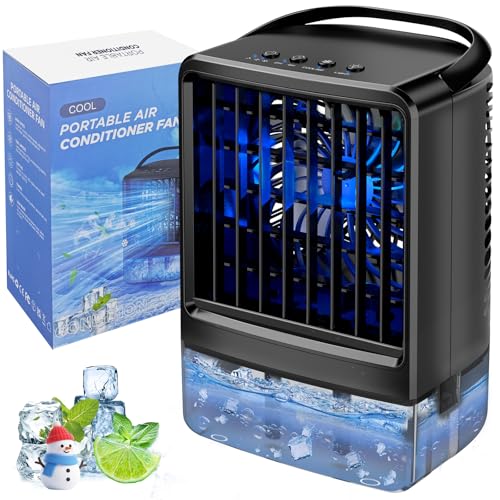
Portable Air Conditioner,Personal Mini Air Conditioners,Small Portable AC,3-Speed Desk AC Fan,Evaporative Air Cooler with Timer Function,7-Color Night light,Mist Modes for Bedroom,Office,Room(Black)
Check price on Amazon
2026 New Battery Powered Air Conditioner, Mini Ac Unit for Bedroom, Portable Wireless Wall Mounted Air Conditioner, Suitable for Bedroom, Kitchen, Home Office,White,Grey
Check price on Amazon
Arctic Air Pure Chill 2.0 Evaporative Air Cooler by Ontel - Powerful, Quiet, Lightweight and Portable Space Cooler with Hydro-Chill Technology For Bedroom, Office, Living Room & More,Blue
Check price on Amazon
Vidihill Portable Air Conditioner, Evaporative Air Cooler, 2-4-8H Timer Auto-Off &Remote, Water Tank, Three ultrasonic nozzles, 3-Speed Personal Air Conditioner Cooling Fan
Check price on AmazonDisclaimer
Some of the content on this site uses AI assistance. Information is provided for educational purposes only. We are not responsible for any losses resulting from the use of this information. By using this site, you waive any right to bring legal claims against us arising from your use of the information provided. If you do not agree, please do not use this site. Read the full disclaimer.