
Portable Air Conditioner and Cooler: The Complete Guide
Everything you need to know before choosing a portable AC unit or evaporative cooler — how they work, how to size them, venting options, maintenance, and which type suits your space.
Start LearningWhat You'll Learn on This Page
- What Is a Portable Air Conditioner and Cooler?
- Portable AC vs Evaporative Cooler: Key Differences
- How to Size a Portable AC for Your Room
- Venting Options and Window Kits
- Features That Matter in a Portable AC
- Maintenance and Troubleshooting
- Which Portable Cooling Solution Is Best for You?
- Frequently Asked Questions
What Is a Portable Air Conditioner and Cooler?
A portable air conditioner is a self-contained cooling unit on wheels that can be moved from room to room. Unlike a window unit or central system, it sits on the floor and uses an exhaust hose to remove hot air. A portable cooler — often called an evaporative cooler or swamp cooler — is a different device that cools air by passing it over water-saturated pads, adding moisture to the air stream.
Both categories are popular for renters, home offices, bedrooms, and spaces where installing a permanent system is impractical. They are also widely used in campers and temporary setups. If you want to understand how they compare with other formats, see our overview of portable AC units and the broader guide to portable AC unit repair when issues arise.
How a Portable AC Works
The unit draws warm room air across an evaporator coil, where refrigerant absorbs heat. The cooled air is blown back into the room, while the absorbed heat is expelled through a condenser and exhausted outdoors via a hose. Moisture removed from the air collects in a tank or drains continuously through a hose.
How an Evaporative Cooler Works
An evaporative cooler pulls hot, dry air through wet pads. As water evaporates, it absorbs heat from the air, lowering the temperature. The cooled, moistened air is then blown into the room. This method works best in dry climates and should not be confused with a refrigerant-based air conditioner.
Portable AC vs Evaporative Cooler: Key Differences
Choosing between a portable AC and an evaporative cooler depends on your climate, your space, and your tolerance for venting. The table below summarizes the most important differences using neutral tier descriptors rather than numeric figures.
| Feature | Portable Air Conditioner | Evaporative Cooler |
|---|---|---|
| Cooling Method | Refrigerant cycle (compressor) | Water evaporation |
| Humidity Effect | Dehumidifies the room | Adds moisture to the air |
| Best Climate | Most climates, including humid | Dry, low-humidity climates |
| Venting Required | Yes, exhaust hose to window or wall | No exhaust hose needed |
| Typical Tier | Mid-tier to premium depending on BTU and features | Entry-level to mid-range |
| Installation Effort | Moderate — window kit and hose | Minimal — fill tank and plug in |
| Maintenance Focus | Filter cleaning, condensate draining | Pad replacement, water refilling |
| Best For | Bedrooms, home offices, apartments, campers | Garages, patios, dry-climate rooms |
If you are specifically interested in a unit that works without a traditional window, explore options for a portable AC unit for a room without windows or a portable air conditioner without window vent. For dry climates, an evaporative technology portable cooler may be a better fit.
How to Size a Portable AC for Your Room
Portable air conditioners are rated in British Thermal Units (BTUs). Choosing the right capacity is essential — an undersized unit will run continuously and struggle to cool the space, while an oversized unit may short-cycle and leave the room clammy.
Basic BTU Rule of Thumb
- Measure the room's length and width in feet, then multiply to get square footage.
- Multiply square footage by 20 BTUs as a starting point.
- Add 10% for rooms with direct sun exposure, high ceilings, or more than two occupants.
- Subtract 10% for heavily shaded rooms or cooler climates.
| Room Size (sq ft) | Suggested BTU Range | Typical Use Case |
|---|---|---|
| Up to 150 | 5,000 – 6,000 | Small bedroom, home office, tiny apartment |
| 150 – 250 | 8,000 – 10,000 | Medium bedroom, small living area |
| 250 – 400 | 12,000 – 14,000 | Large bedroom, living room, open-plan space |
| 400 – 600 | 14,000 – 18,000 | Open living areas, basements, camper trailers |
For a more tailored approach, read our dedicated guide to portable air conditioners for a 500 sq ft room or the in-depth article on portable AC for 1,000 square feet. If you are setting up a small bedroom, the small bedroom portable AC guide is a useful next step.
Venting Options and Window Kits
Portable AC units produce hot exhaust air that must be routed outdoors. Most units ship with a window kit, but the type of window in your home determines which kit you need. Standard sliding or double-hung windows are usually straightforward; casement, crank-out, and side-opening windows require specialized adapters.
Common Venting Situations
- Sliding windows: Use a sliding window kit with an adjustable panel. See our guide to portable air conditioner sliding window kits.
- Casement windows: A casement window kit uses a fabric or rigid insert to seal around the open sash. Read about portable air conditioners for casement windows and the casement window kit.
- Crank-out windows: These need a specific adapter. See the crank-out window kit guide and the portable AC for crank-out windows overview.
- Side-opening windows: Look for kits designed for side-hinged windows. The side-opening window guide explains the options.
- Small windows: If your window opening is narrow, see the portable AC for small windows guide.
What If You Have No Window?
Some spaces — basements, interior rooms, and certain campers — lack a suitable window. In those cases, you can explore windowless venting approaches such as a portable air conditioner without a window vent, a portable AC unit that doesn't need venting (limited cooling), or a portable AC without outside vent. For basement-specific setups, the basement window portable AC guide is helpful.
Features That Matter in a Portable AC
Not all portable AC units are built the same. The features below separate entry-level models from mid-range and premium tiers. Use them to match a unit to your specific needs.
Cooling and Compressor Technology
- Single-hose vs dual-hose: A single-hose portable AC is simpler and more common; dual-hose models can cool more efficiently because they separate intake and exhaust. Read more about portable AC intake and exhaust.
- Inverter technology: A portable AC with inverter technology varies compressor speed for steadier temperatures and quieter operation — typically a mid-tier to premium feature.
- Multi-function units: Many models combine cooling, heating, and dehumidification. See portable air conditioner and heater in one, portable AC dehumidifier heater, and portable AC with heater and dehumidifier.
Drainage and Moisture Management
- Self-evaporating systems: Reduce manual draining by using condensate to cool the condenser. See portable AC with self-evaporating system.
- No-drain operation: Some units are designed for no drain required or portable AC that doesn't need draining under normal conditions.
- Without dehumidifier: If you only need cooling and want a simpler unit, see portable AC without dehumidifier.
Smart and Convenience Features
- Wi-Fi control: A portable AC with Wi-Fi control lets you schedule and adjust from a phone — increasingly common in mid-range and premium tiers.
- Mobility: All portable ACs have casters, but check the portable AC on wheels guide for weight and handle considerations.
- Multi-room flexibility: If you plan to cool several rooms, a single portable unit may not be enough. Explore multi-zone mini-split systems or multi-head mini-split options as a longer-term alternative.
Maintenance and Troubleshooting
Portable AC units are relatively low-maintenance, but a few habits keep them running efficiently. Neglecting the filter and drain tank is the most common cause of weak cooling.
Routine Maintenance Checklist
- Clean or replace the filter every two to four weeks during heavy use. A clogged filter restricts airflow and reduces cooling.
- Empty the drain tank before it fills completely, or connect a continuous drain hose if the unit supports it.
- Inspect the exhaust hose for kinks, cracks, or disconnected sections.
- Wipe down the intake grille to prevent dust buildup.
- Store the unit upright during the off-season and cover it to prevent dust intrusion.
Common Problems and Fixes
- Not cooling enough: Check the filter, confirm the exhaust hose is properly vented, and make sure the room is not too large for the BTU rating. See portable air conditioner not cooling enough.
- Water leaking: The drain tank may be full or the unit may not be level. If the issue persists, see portable AC unit repair.
- Fan running but no cold air: This may indicate a compressor issue or low refrigerant. The broader fan spinning but no cold air guide covers diagnostic steps.
- Unit won't turn on: Check the outlet, breaker, and whether the unit has an internal reset button. For compressor-related symptoms, see my AC compressor is not running.
Which Portable Cooling Solution Is Best for You?
The right choice depends on your space, climate, and how much effort you are willing to put into installation. Below is a practical breakdown by use case.
| Use Case | Recommended Type | Why |
|---|---|---|
| Small bedroom or home office | Entry-level to mid-range single-hose portable AC | Simple setup, adequate for compact spaces |
| Large living area | Mid-range to premium dual-hose or inverter portable AC | Better airflow and steadier cooling |
| Humid climate | Refrigerant-based portable AC with dehumidification | Removes moisture instead of adding it |
| Dry climate, garage or patio | Evaporative cooler | Adds moisture and cools dry air effectively |
| Camper or trailer | Compact portable AC with flexible window kit | Portable and adaptable to small openings. See portable air conditioner for camper. |
| No available window | Specialized windowless venting solution | Options include portable AC for room without windows and portable AC without window access. |
| Off-grid or battery use | Battery-powered or solar-compatible portable cooler | See portable AC that uses batteries, portable AC with solar panel, and off-grid cooling. |
| Server closet or equipment room | Dedicated spot-cooling portable AC | Continuous operation and targeted airflow. See portable AC for server closet. |
For commercial or larger-scale needs, see portable air conditioner for commercial use. If you are considering a permanent solution instead, our multi-zone ductless heating and cooling systems guide explains the long-term alternative.
Frequently Asked Questions
How does a portable air conditioner work?
A portable AC draws in room air, cools it through a refrigerant cycle, and exhausts hot air through a hose that must be vented out a window or opening. It also removes moisture as condensate.
Do portable air conditioners need to be vented?
Yes, most portable AC units require an exhaust hose to be vented through a window or wall opening. There are ventless evaporative coolers, but they work differently and are best for dry climates.
What is the difference between a portable AC and an evaporative cooler?
A portable AC uses a refrigerant cycle to cool and dehumidify air, while an evaporative cooler adds moisture to dry air to create a cooling effect. Evaporative coolers work best in dry climates, whereas portable AC units work in most climates.
How many BTUs do I need for a portable air conditioner?
As a general rule, use 20 BTUs per square foot of room area, then adjust for sun exposure, ceiling height, and occupancy. A 300 sq ft room typically needs around 6,000 to 8,000 BTUs.
Can a portable air conditioner cool more than one room?
Not effectively. Portable AC units are designed for single-space cooling. For multiple rooms, consider a multi-zone mini-split system or individual units per room.
How often should I drain the water tank?
In humid conditions, the tank may need draining daily. In dry climates, it may last several days. Units with a self-evaporating system or continuous drain hose reduce or eliminate manual draining.
Top-Rated Portable Air Conditioners and Coolers
⚠️ AFFILIATE DISCLOSURE: This website contains affiliate links. As an Amazon Associate, we earn from qualifying purchases. If you make a purchase through these links, we may receive a small commission at no additional cost to you. Read our full affiliate policy.

24" Windowless Portable Air Conditioner, 15H Timer & 120°Oscillation, 3-IN-1 Portable AC Unit w/Remote, 2Gal Tank, 3 Modes & 3 Speeds, Ultra-Quiet Ventless Swamp Cooler for RoomHomeOffice, Matte Black
Check price on Amazon
Windowless Portable Air Conditioner, 24.3" Small Evaporative Air Cooler for Room No Window, 3-Speed Settings, 4 Modes, 15H Timer, Remote Control, 4 Ice Packs, Quiet AC Unit for Bedroom, Black
Check price on Amazon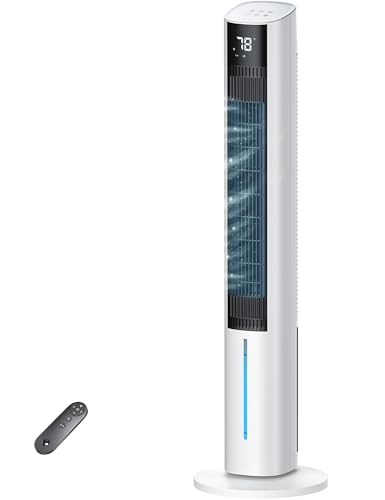
Windowless Portable Air Conditioners, 45.1" Evaporative Cooler for Room No window, 12H Timer & 60° Swing, 1.06Gal Water Tank & 4 Ice Packs, Quiet Portable ac Unit with Remote for Bedroom white
Check price on Amazon
Arctic Air Pure Chill 2.0 Evaporative Air Cooler by Ontel - Powerful, Quiet, Lightweight and Portable Space Cooler with Hydro-Chill Technology For Bedroom, Office, Living Room & More,Blue
Check price on Amazon
Portable Air Conditioner Fan, 4-in-1 Mini Air Cooler with 450ML Water Tank, 3 Speeds Portable Fan 7 Colors LED Ambient Light, Mini Evaporative Cooler Desktop Humidifier Fan for Bedroom Office Travel
Check price on Amazon
Vidihill Portable Air Conditioner, Evaporative Air Cooler, 2-4-8H Timer Auto-Off &Remote, Water Tank, Three ultrasonic nozzles, 3-Speed Personal Air Conditioner Cooling Fan
Check price on Amazon
BLACK+DECKER Portable Air Conditioner, 10,000 BTU, BPACT10WT, White | 5,500 BTU SACC for Rooms up to 450 Sq. Ft., 3-in-1 Portable AC, Fan and Dehum with Follow Me Remote Control
Check price on Amazon